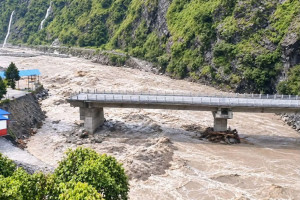
The government has immediate access to around Rs20 billion from the current fiscal year’s budget for rescue, relief and other emergency needs. Following the devastating Bhotekoshi flood, donations to government relief funds are also pouring in. Wednesday’s flash flood originating in the Bhote Koshi-Trishuli river system damaged at least 19 bridges and washed away roughly 40 kilometres of roads along the Trishuli corridor and adjoining highways. Post Photo
The government is scrambling to mobilise funds for rescue, relief and rehabilitation efforts in areas affected by the Bhotekoshi flood, as it appeals for support from both domestic and international sources.
The finance ministry has been assessing which budget allocations can be redirected for emergency response. Finance Secretary Ghanshyam Upadhyaya said the government could immediately mobilise around Rs20 billion from funds already allocated in the current fiscal year’s budget for relief, disaster management and rescue operations.
The government has yet to find a complete assessment of the human and physical damage caused by the floods. But Upadhyaya said around Rs20 billion could be used immediately for rescue, relief and short-term management of the disaster.
“This is money already allocated in the current fiscal year’s budget under various headings, including relief, disaster management and rescue, and it can be used immediately as needed,” he said.
“We do not yet know how much will ultimately be required because the full extent of the damage has not been assessed. The finance ministry is working to secure additional resources, including by reaching out to governments and agencies at home and abroad.”
Upadhyaya said several countries and international agencies had already expressed interest in assisting.
The government is collecting donations through two existing accounts, the Prime Minister’s Relief Fund and the Prime Minister’s Disaster Relief Fund, held at ten commercial banks. The accounts were already operating before the latest disaster and contained funds collected previously.
According to Hemraj Aryal, spokesperson for the Prime Minister’s Office, the Prime Minister’s Relief Fund had around Rs110 million and the Prime Minister’s Natural Disaster Relief Fund around Rs2.05 billion before the latest fundraising drive began.
The government appealed for donations on Wednesday evening, with contributions beginning to arrive on Thursday. India, China and the World Bank have also begun coordinating financial and other assistance for rescue and reconstruction, Upadhyaya said.
David Sislen, the World Bank’s country director, has informed the finance ministry that up to Rs25 billion could potentially be mobilised as emergency assistance from various sources, according to Upadhyaya.
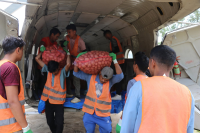
India has asked the government to provide a list of relief materials needed immediately for flood victims, and some supplies have already arrived, he said.
China has also agreed to provide immediate cash assistance. Chinese Ambassador Zhang Maoming has asked the Nepali government, through the finance ministry, to begin the process of transferring the funds, Upadhyaya said.
Finance Minister Swarnim Wagle has thanked neighbouring countries and development partners for their pledges of support and is holding discussions on how the assistance should be channelled through government-to-government coordination.
Govinda Raj Pokharel, former chief executive officer of then National Reconstruction Authority, said Nepal would need to mobilise substantial foreign capital for relief, recovery and reconstruction.
“The damage appears to be greater than that caused by the 2015 earthquake,” Pokharel said. “Rebuilding infrastructure on such a large scale will not be possible through domestic resources alone. The government needs to mobilise as much foreign capital as possible.”
Given the scale of destruction in Rasuwa, some settlements may have to be relocated, requiring significant reconstruction funds, he said.
“We need to change the development model in which roads are built along riverbanks and settlements are then established along those roads,” Pokharel said.
Government agencies, Nepal Rastra Bank, the Nepal Insurance Authority and the Securities Board of Nepal have also urged companies and institutions under their jurisdiction to contribute to the government fund.
Nepal Rastra Bank has amended its guidelines on corporate social responsibility to encourage banks and financial institutions to spend CSR funds on disaster response. Under the revised guidelines, spending on medical treatment, rescue and relief for disaster victims can also be counted as CSR expenditure.
The government has introduced a ‘one-door policy’ for collecting and distributing relief to prevent irregularities and ensure that assistance reaches victims quickly.
The finance ministry said individuals, private companies, donor agencies and international organisations wishing to provide cash or in-kind assistance to flood victims should channel their support through the Prime Minister’s National Disaster Relief Fund under the ‘one-door policy’.
The Prime Minister’s Office has designated focal persons and agencies to coordinate the collection and distribution of relief.
Donors can also provide relief materials instead of cash, either handing them over to the government or distributing them directly to affected communities.
For materials collected through the government, three locations have been designated.
Relief supplies arriving by air from abroad will be stored at the National Emergency Warehouse of the Tribhuvan International Airport before being distributed to affected areas as needed.
Supplies collected within Nepal will be stored at the Nepali Army’s Maithili Barracks in Battar, Nuwakot, and its Baireni Barracks in Dhading, before being transported to affected areas.
Individuals and organisations wishing to donate relief materials have been asked to deliver them to one of these designated collection points.




 18.54°C Kathmandu