Nepal tourism faces another setback as Rasuwa disaster exposes mountain risks
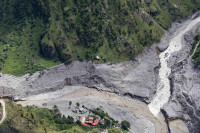
A devastating flash flood in Rasuwa has dealt a fresh blow to Nepal’s tourism industry. Experts warn that worsening climate risks in the mountains could make natural disasters an increasingly serious threat to the country’s tourism-dependent economy.Houses at Devighat bazar in Nuwakot are submerged in sludge on Thursday after flash floods lashed the market on Wednesday morning. Hemanta Shrestha/TKP
Nepal’s tourism industry was entering its peak season last September when the Gen Z-led anti-corruption protests brought the sector to a sudden halt.
The unrest came after years of setbacks. Before that, catastrophic floods had battered the country, two major aviation accidents had raised fresh concerns about air safety, and the Covid-19 pandemic had brought international tourism to a standstill.
Now, another disaster has struck at a particularly vulnerable time.
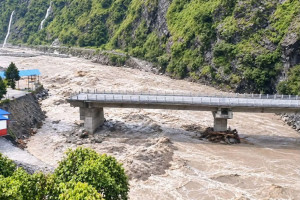
The devastating flash flood that swept through Rasuwa on Wednesday has shattered hopes of a strong tourism recovery, particularly for the lucrative Kailash Mansarovar pilgrimage market. The disaster struck the Rasuwagadhi-Timure area, a major gateway for pilgrims travelling from Nepal to Tibet.
More importantly, it has raised a much bigger question for Nepal’s tourism-dependent economy: are the country’s mountains becoming an increasingly dangerous destination because of climate change?
A full assessment of Wednesday’s disaster is under way. But the destruction has already highlighted the potentially devastating consequences of glacial outbursts and other climate-induced hazards for communities, infrastructure and tourists in the Himalayan region.
“Our tourism practically depends on mountains,” said environment expert Vijay Kumar Singh. “There is also risk associated there, which needs to be assessed properly to prevent future disasters.”
Nepal’s exposure to climate-related disasters is becoming increasingly difficult to ignore.
The catastrophic floods that struck the Kathmandu valley in late September 2024 were among the country’s most severe urban flood events. The September rains were the heaviest Nepal had experienced in four decades, according to assessments. The flooding caused widespread damage and, according to a recent World Bank report, killed 249 people, injured 177 and displaced more than 10,000 families.
The tourism industry was also shaken by two major aviation accidents.
In January 2023, an ATR 72 operated by Yeti Airlines crashed while landing at Pokhara, killing all 68 passengers and four crew members. In July 2024, a Bombardier CRJ200 operated by Saurya Airlines crashed shortly after takeoff from Kathmandu airport, killing 18 people.
These disasters came on top of the unprecedented disruption caused by the Covid-19 pandemic, which brought Nepal’s tourism industry to one of its worst periods in decades.
And the industry had barely begun recovering when political unrest struck.
Now, the Rasuwa disaster threatens to add another layer of uncertainty, one that is directly linked to the vulnerability of Nepal’s mountain environment.
Experts have identified 42 glacial lakes in Nepal as being at critical risk of bursting because of rapid ice melt and rising temperatures in the Himalayas. Most of these lakes are in the Everest region, one of the world’s best-known mountain tourism destinations.
Scientists warn that global warming is accelerating glacier melt and causing Himalayan lakes to expand. As these glacial lakes grow, their unstable natural dams can fail, releasing huge volumes of water and debris downstream.
The consequences can be catastrophic for settlements, roads, bridges, hydropower projects and tourism infrastructure.
Nepal contributes less than 0.1 percent of global carbon dioxide emissions but is among the countries highly vulnerable to climate change because of its fragile mountain ecosystem.
“This disaster will be good evidence to document to claim resources from international climate funds for communities facing high climate risks,” Singh said. “Such a fund can help Nepal to make its tourism sustainable. Otherwise, it keeps on repeating and people keep on dying.”
The World Bank and Asian Development Bank have repeatedly warned that intensifying climate shocks are among the major downside risks to Nepal’s economic growth, particularly because of their impact on tourism and agriculture.
Climate change, experts say, is changing the risk profile of Nepal’s most important tourism asset—the mountains.
Former environment minister Ganesh Shah said Nepal needs to invest in more precise technologies to protect mountain tourism and improve disaster preparedness.
“The new generation worldwide loves adventure, and Nepal could be a big draw in the future,” Shah said. “That’s why we need satellite communication, at least for mountain regions, which will help faster rescue operations.”
“So, Nepal needs more precise technology to make tourism sustainable.”
The Rasuwa disaster has also exposed the growing international dimension of Nepal’s mountain tourism.
As of Thursday evening, Nepal Police said 644 tourists travelling towards Tibet for the Kailash Mansarovar pilgrimage had been reported missing, including 127 Nepalis. Indian nationals accounted for the largest group, with 178 missing, followed by 55 Americans, 53 Ukrainians, 51 Malaysians, 35 Australians and 33 Britons, among others.
The figures underscore how heavily international visitors now rely on Nepal’s corridors to Tibet.
Tour operators say demand for the Kailash Mansarovar pilgrimage surged this year. Beijing capped the number of Indian pilgrims travelling to Kailash Mansarovar through Nepal at 24,000, even though demand exceeded 40,000.
The pilgrimage season officially began in mid-May, bringing a surge of activity to major transit hubs such as Hilsa, Simikot and Nepalgunj.
Basu Kumar Adhikari, managing director of Touch Kailash Travel and Treks, said the increase in demand was driven partly by the Chinese Year of the Horse, which began on February 17, 2026.
In Tibetan astrology and religious tradition, the Horse Year is considered particularly auspicious for pilgrimage. Devotees believe that completing one kora—the 52-kilometre circumambulation around Mount Kailash—during the Horse Year brings spiritual merit equivalent to completing 12 or 13 koras in an ordinary year.
The three-day Kailash Kora, or parikrama, takes pilgrims through some of the world’s most challenging high-altitude terrain.
The pilgrimage for Indian citizens resumed last year after Beijing and New Delhi agreed to restore the journey following a five-year suspension linked to diplomatic tensions.
India facilitates the Kailash Mansarovar pilgrimage through the disputed Lipulekh Pass and Nathu La Pass in Sikkim but limits the annual number of pilgrims to about 1,000-500 through each route.
As a result, most Indian pilgrims prefer travelling privately through Nepal.
For Nepali travel companies, the pilgrimage has become an increasingly valuable business.
The 10-day Rasuwagadhi-Kerung package costs around $1,700 per person.
Tour operators describe Kailash Mansarovar as one of the most profitable pilgrimage packages for Nepali travel companies. The annual season provides a major boost to hotels, airlines, restaurants, guides and porters while also generating tax revenue for the government.
Hotels in Nepalgunj have also seen increased bookings during the pilgrimage season. Tourism entrepreneurs say the growth in Indian visitors has encouraged investment in hospitality infrastructure in Banke and in northern destinations such as Simkot.
But Wednesday’s disaster could abruptly reverse that momentum.
“Yes, the industry will suffer post-disaster. Effects could last at least six to seven months,” said Deepak Raj Joshi, former chief executive officer of the Nepal Tourism Board, the country’s tourism promotional body.
“We need a dedicated tourism recovery team to send the message that the rest of Nepal is intact,” he said.
Nepal’s tourism industry has repeatedly demonstrated its ability to recover from crises.
Three decades ago, political instability was perhaps the biggest threat to tourism.
“Obviously, if we observe Nepal’s tourism three decades back, it has been entangled in political chaos,” Joshi said.
The Maoist insurgency from 1996 to 2006 claimed more than 17,000 lives and disrupted economic activity across the country. The 1999 Indian Airlines hijacking and the global decline in international travel after the September 11, 2001, attacks also severely affected Nepal’s tourism industry. The 2001 Royal Massacre, which killed King Birendra and members of his family, further deepened political uncertainty.
Frequent strikes and bandas after the comprehensive peace accord in 2006 disrupted businesses and discouraged visitors and investors.
Then came years of power shortages, including periods of up to 18 hours of daily load-shedding.
The 2015 earthquake was another devastating blow, killing nearly 9,000 people and causing billions of dollars in economic losses. Tourism infrastructure and heritage sites were badly damaged, while international arrivals plunged.
Yet the industry recovered.
Amid all this, there is one reason to cheer, Joshi said. “Nepal has the capacity to recover quickly.”
The Covid pandemic tested that resilience again, effectively shutting down international tourism for almost two years. Since then, visitor arrivals have recovered steadily.
Wednesday’s disaster, however, is different because it points to a threat that cannot simply be addressed through political stability or marketing.
Rajendra Lama, general secretary of the Nepal Mountaineering Association, said the disaster was a major blow to a tourism industry that had only recently begun recovering from the pandemic gloom.
The World Travel and Tourism Council estimates that travel and tourism contributed 6.6 percent to Nepal’s gross domestic product. The sector is also a major source of employment, particularly in remote hills and mountain communities where alternative economic opportunities are limited.
That dependence makes the sector especially vulnerable to disasters.
Natural disasters can destroy roads, bridges, airports and hotels, disrupt supply chains, force cancellations and damage a destination’s reputation for safety. But the Rasuwa disaster also offers a warning that disaster preparedness can no longer be separated from tourism policy.
For Nepal, the challenge is no longer simply to attract more tourists.
It is to make sure that the mountains that attract them remain safe enough to visit.
That will require better early-warning systems, stronger infrastructure, reliable communication networks, satellite-based monitoring and faster rescue capacity in remote areas. It will also require a clearer assessment of the risks posed by glacial lakes and other climate-induced hazards around major tourism destinations.
Nepal’s tourism industry has survived political turmoil, terrorism, aviation accidents, earthquakes, pandemics and protests.
But as the Himalayas warm, the country may be entering a new era in which nature itself becomes one of the biggest uncertainties facing tourism.
“Climate change is changing everything, and Nepal cannot afford to ignore it,” said Singh, the environment expert.
Sangam Prasain is Business Editor at The Kathmandu Post, covering tourism, agriculture, mountaineering, aviation, infrastructure and other economic affairs. He joined The Kathmandu Post in October 2009.




 15.34°C Kathmandu