The classrooms that once drew aspiring reporters from across Nepal are falling quiet. Fewer students are choosing journalism, a sign of growing troubles in the country’s media industry.
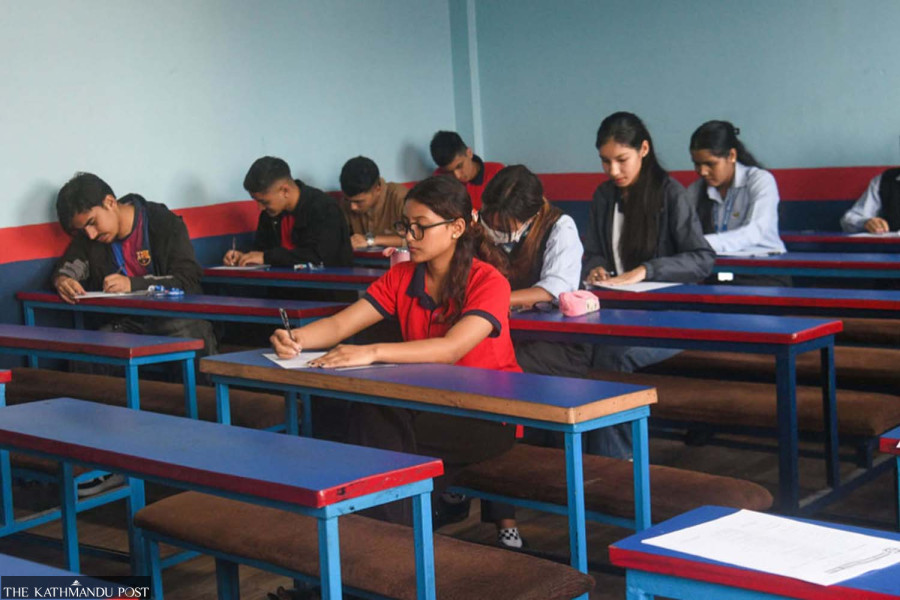
At Janapremi World School in Bhaktapur, journalism was once one of the college’s defining programmes. Since it began offering journalism at the plus-two level in 2009, students from 57 districts have studied there. At its peak, 76 students enrolled in a single batch.
Many alumni went on to work in mainstream media. But the programme has not admitted a new student for four years.
“We ran the programme even when there were only 19 students in the last batch,” said Nilesh Acharya, principal of Janapremi World School. “But as the student numbers kept falling, we had no option but to shut down the department.”
The college continues to attract a significant number of students to its science, management and law programmes at grades 11 and 12, he said.
The experience is not isolated. Data from the National Examination Board show that the number of schools offering journalism and mass communication at grades 11 and 12 fell from 209 in academic year 2022-23 to 105 in 2026-27. Student enrolment also dropped from 4,303 students to 1,303 over the same period.
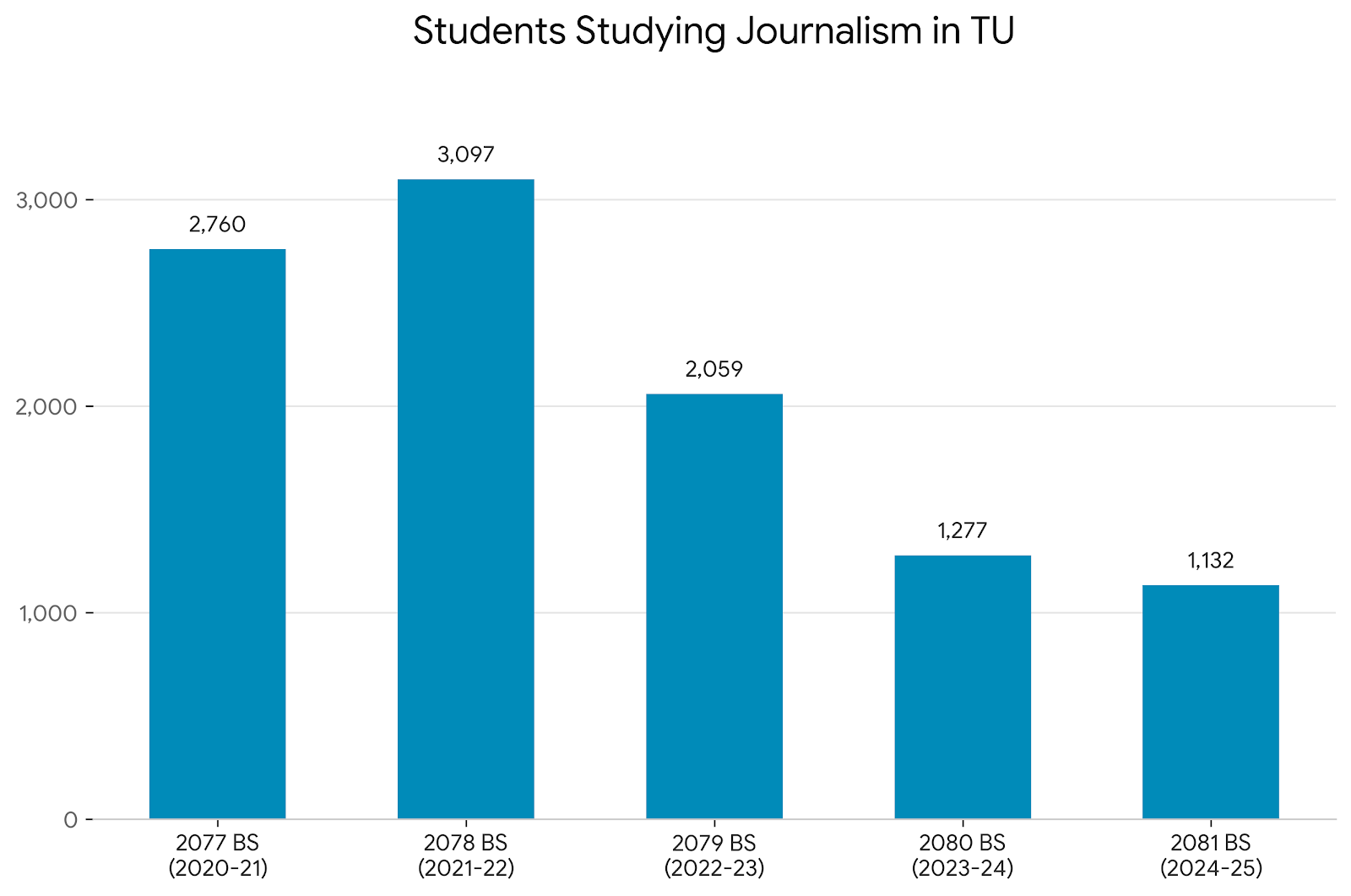
The decline extends to university education. Tribhuvan University’s Office of the Controller of Examinations recorded 2,760 students enrolling in journalism and mass communication at bachelor’s level in 2020-21. By 2024-25, the figure had fallen to 1,132.
Enrolment followed the same downward path: 3,097 in 2021-22; 2,059 in 2022-23; 1,277 in 2023-24 and 1,132 in 2024-25.
In the academic year 2020-21, journalism and mass communication were taught at 74 campuses affiliated with Tribhuvan University across the country. The number fell to 61 in 2023-24 and declined further to just 57 by 2024-25.
Purbanchal University has seen a similar trend. Its journalism and mass communication enrolment fell from 122 students in 2021-22 to 74 in 2025-26.
At St Xavier’s College in Maitighar, journalism department head Chun Bahadur Gurung has seen the change in his own classroom. “We have taught as many as 34 students in a batch, but now the average is around 14 or 15,” he said.
Teachers and college administrators point to several reasons: shrinking number of media outlets, low salaries, delayed payments, insecure jobs, the growing preference for overseas education, and stronger demand for subjects perceived to offer clearer career paths.
“Most students who come to us for counselling ask which subject would be best if they want to go abroad,” said Acharya. “Out of 1,000 students, perhaps only one shows interest in journalism.”
For many students, the attraction of foreign education is reinforced by the perception that journalism offers few secure career opportunities at home. The wider media industry has struggled to create stable jobs and decent working conditions.
“Journalism itself is in a problematic state,” said Rishikesh Dahal, an associate professor at TU’s Department of Journalism and Mass Communication. “Many media outlets have disappeared and there is no longer the competition we saw before. It is natural for students to turn away from such an uncertain profession.”
According to Dahal, the media sector is struggling not only with a shrinking business model, but also with a severe erosion of public trust. "The 2015 earthquake served as an early warning for the media industry, but we failed to prepare, and the Covid pandemic subsequently hit us hard," he said.
The economic difficulties have also changed how journalists work and how audiences consume news. Social media has made publishing and distributing information easier than ever, while weakening the traditional boundaries between journalism, commentary, entertainment and influence.
Nepal’s media sector came under severe pressure during the Covid pandemic, while the September 2025 Gen Z protests brought further destruction. Journalists were injured and several newsrooms were attacked or burned during the unrest.
Dipesh Acharya, proprietor of the College of Journalism and Mass Communication (CJMC), however, argues that this should strengthen rather than weaken the case for professional journalism.
“Access to information has expanded greatly, but misleading information and clickbait content have also increased,” he said. “In such a situation, the role of professional journalism is even more important. But we need to create an environment in which the new generation entering the field can stay.”
The challenge, educators say, is that journalism education has not kept pace with changes in the industry.
Manju Mishra, founding principal of CJMC, said social media and new technology had transformed the way information was produced and distributed, but universities and journalism programmes had not adapted at the same speed.
“There is a wide gap between what is taught in classrooms and what happens in real newsrooms,” said Mishra. “Without regular internships, newsroom-based practice and access to modern communication tools, it is difficult to make journalism education relevant and market-oriented.”
Gurung agrees that the curriculum needs a major overhaul. “We need to ask what kind of curriculum we are teaching,” he said. “Is the course suited to the times, or are we still following an old syllabus? A market-oriented and contemporary curriculum is essential.”
In his experience, students are increasingly more interested in content creation than traditional journalism. That shift, he said, should not simply be treated as a threat. Journalism education could use it to teach students how to report, verify and distribute credible information across multiple platforms.
“Journalism is not just an academic subject,” said Gurung. “It produces skilled people who protect citizens’ right to information, uphold accountability and keep public debate alive.”
The history of journalism education in Nepal is much older than today’s digital media landscape. The institutional development of Nepali journalism is generally traced to the publication of Sudha Sagar in 1898 and Gorkhapatra in 1901. Formal academic journalism education began later at Ratna Rajya Laxmi Campus, where journalism was introduced at certificate level in 1976. Bachelor’s-level study followed in 1981 and master’s-level study in 2001.
Prateek Pradhan, editor-in-chief of news website Baahrakhari, said the weakness of media institutions themselves was partly responsible for the declining appeal of journalism as a career. “Media organisations have not been able to properly operate financially, so they could not pay salaries on time,” said Pradhan. “As a result, the idea has grown that perhaps one should not study journalism.”
He also warned that the public image of journalism suffers when people without a clear understanding of professional ethics become prominent through social media.
“If people can do whatever they want without understanding journalism’s principles and values, and those people gain prominence, it discourages students from studying journalism,” he said. “There has been little effort to say that journalism is worth studying or that journalism must be kept alive.”
On paper, Nepal is doing better than most of its neighbours. In practice, the space for journalism is tightening.
As the world marked World Press Freedom Day on May 3, Nepal’s position in the latest World Press Freedom Index 2026 offered a measure of reassurance. Published by Reporters Without Borders (RSF), the index places Nepal 87th out of 180 countries, the highest in South Asia.
“Journalism must not die, especially at a time when democracy is under pressure globally,” said Gurung. “It is not dead. I would rather say it is changing. We need a multidisciplinary approach that matches the times and responds to what the market needs.”




 25.92°C Kathmandu