



 14.69°C Kathmandu
Sat, Oct 24, 2026
Money
Why did finance minister revise tax rates after presenting Economic Bill to Parliament?
Lawmakers question repeated revisions to the bill through which tax rates and fiscal provisions were altered. Opposition demands parliamentary investigation.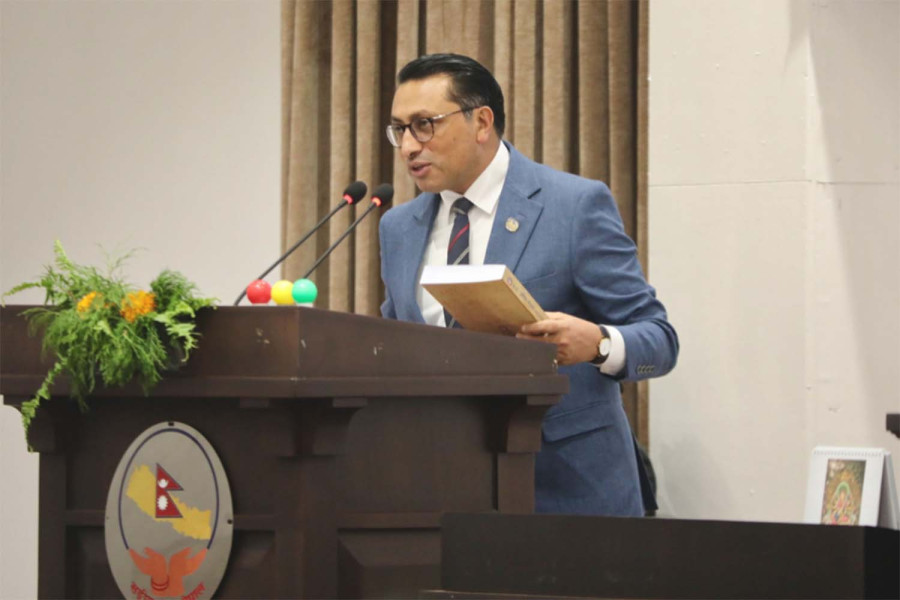
bookmark
Yagya Banjade
Published at : June 10, 2026
Updated at : June 10, 2026 06:49
Kathmandu
Lawmakers have demanded a parliamentary probe into Finance Minister Swarnim Wagle after tax rates were revised multiple times through the Economic Bill. The controversy has raised questions about transparency, legal authority and the process through which tax rates were altered after the budget was tabled in Parliament.
When Minister Wagle unveiled the budget for the upcoming fiscal year 2026-27 on May 29, few anticipated that the accompanying Economic Bill would become the centre of a political and legal controversy.
Within days of budget presentation, lawmakers began questioning repeated revisions made to the bill through which tax rates and fiscal provisions were altered. Opposition parties have gone a step further, demanding a parliamentary investigation into the minister’s actions.
The issue has triggered debate over whether the government had the legal authority to revise tax provisions after the budget and Economic Bill had already been presented in the federal parliament.
The controversy deepened after the Economic Bill uploaded to the Ministry of Finance website on May 29 was removed the following day and replaced several hours later with a revised version. The version currently available on the ministry’s website is a third revision of the bill.
Each revision introduced changes—some reducing taxes, some increasing them, and others adding entirely new provisions that were absent from the original document. Here is a look into the issue.
What changes were made to the bill?
A comparison between the version first uploaded on May 29 and the latest version reveals several significant differences.
The first major change concerns value-added tax (VAT) on electricity. Initially, the government revised the VAT Act to exempt household consumers using up to 50 units of electricity per month from VAT.
However, the provision still allowed VAT to be charged when electricity producers sold power to other electricity-related businesses, such as when hydropower developers sold electricity to the Nepal Electricity Authority.
In the latest revision, the exemption has been expanded. The revised provision now exempts both electricity transactions between electricity businesses and household consumption of up to 50 units per month from VAT. Consumers using more than 50 units will continue to pay VAT on electricity.
The second change relates to electric vehicles (EVs). Under the latest version of the bill, EVs valued at less than Rs2 million at customs clearance will be charged a road construction charge of 2.5 percent. Previously, the standard rate was 5 percent, and the original Economic Bill had retained that rate.
The revision effectively reduces the road construction charge for lower-priced electric vehicles, a move likely to benefit buyers in the entry-level EV market.
“Motor vehicles classified under subheadings 8703.80.91 and 8703.80.99, with a transaction value of up to Rs2 million as determined by customs at the time of import, shall be subject to a road construction levy of 2.5 percent,” reads the latest bill.
The third modification involves fuel imports and the green tax. The original bill stated that petrol and diesel imports would attract a green tax at a rate of 10 percent per litre. The revised bill changes this to a fixed levy of Rs10 per litre. It seems that the earlier provision may have been a drafting error in which a percentage rate was mistakenly used instead of a monetary amount.
Several provisions announced by the finance minister during his budget speech were not included in the original Economic Bill but appeared only after subsequent revisions.
One such provision concerns cinema halls. During the budget speech, Wagle announced a full income tax exemption for ten years for newly established cinema halls outside metropolitan and sub-metropolitan cities. However, the original bill contained no such clause.
The revised version incorporates the provision by amending the Income Tax Act. Cinema halls established outside metropolitan and sub-metropolitan areas will receive a ten-year tax holiday from the date they begin commercial operations.
Another addition relates to insurance premiums. The revised bill allows individuals who insure privately owned residential buildings with a resident insurance company to deduct either the annual insurance premium paid or Rs10,000—whichever is lower—from their taxable income. This incentive was mentioned in the budget speech but was absent from the first version of the bill. It has been included in the final bill.
Similarly, a new tax deduction has been introduced for education expenses. Under the revised provision, resident taxpayers can deduct 25 percent of annual tuition fees paid for their children’s education, or Rs25,000, whichever is lower, from taxable income before tax calculations are made. This measure was also not included in the original bill despite being announced in the budget address.
Finance minister’s maneuvering under scrutiny
The repeated revisions have triggered intense discussion in parliament, mainstream media and social media platforms. Critics argue that changing tax rates and fiscal provisions after the budget has been presented undermines transparency and raises questions about who benefited from the alterations.
Opposition lawmakers have claimed that tax provisions cannot be changed informally after they are tabled in Parliament and have sought a parliamentary investigation into the matter.
The issue has gained further traction because some of the changes directly affect major sectors such as electricity, fuel imports and electric vehicles, where even minor tax adjustments can have substantial financial implications.
Facing growing criticism, Finance Minister Wagle has defended some of the changes in public forums, describing them as corrections and updates. On May 31, two days after presenting the budget, he submitted a revised Economic Bill to the House of Representatives.
According to records in the parliamentary document, corrections were incorporated into the Economic Bill following a letter from the finance minister dated May 31.
Ekaram Giri, spokesperson for the House of Representatives Secretariat, said the Economic Bill is a government bill and that the Secretariat updated the document after receiving a correction letter from the government.
“The bill was tabled on May 29. Later, the government informed us that certain errors needed correction. Upon receiving the revised version along with the official communication, the Secretariat updated the document,” Giri told Kantipur, noting that substantive parliamentary discussion on the Economic Bill has not yet begun because House proceedings remain obstructed.
However, Giri acknowledged that the House of Representatives Regulations, 2026, contain procedures for registering and processing bills but do not specifically address alterations to tax rates after a bill has been tabled.
What is the legal basis?
The controversy has exposed a legal grey area in Nepal’s budget-making process.
Alongside the annual budget, the finance minister also tables the Appropriation Bill, the National Debt Bill and the Economic Bill. These bills become law only after parliamentary approval.
However, the Economic Bill presented on May 29 differs in several respects from the latest version available on the Finance Ministry website. Legal experts point out that no law clearly states whether a finance minister may or may not revise tax provisions in a bill after it has been tabled in parliament but before it is passed.
Section 18 of the Economic Act allows the finance minister to reduce, increase or waive taxes under certain circumstances. Yet those provisions apply only after the budget comes into effect and before the presentation of the following year’s budget.
Even then, changes must follow a formal process involving decisions by the Ministry of Finance, approval by the Cabinet and endorsement by Parliament. The law also grants limited authority to ministries to make adjustments in specific situations, but these powers similarly apply only during the budget implementation period.
Did the finance minister revise tax rates without legal authority?
There is no explicit legal provision governing whether tax rates can be revised after a budget has been tabled in parliament but before it is approved. As a result, there appears to be no clear legal basis for the revisions Finance Minister Wagle has made to the Economic Bill.
This is, however, not the first time that an Economic Bill has been revised after being presented. Minor corrections were made to such bills in previous years as well. Wagle himself told Kantipur that budget-related bills have been revised on as many as 40 occasions in the past.
Yet the absence of a clear legal framework raises questions about the basis on which such revisions are made. Former finance ministers and former finance secretaries acknowledge that technical errors and drafting mistakes have been corrected in previous bills. However, they maintain that past revisions were largely limited to minor corrections and did not involve altering tax rates, exemptions or major fiscal provisions in the manner seen this time.
What is the legal basis for revising the bill?
The House of Representatives Regulations, 2026, set out procedures governing the drafting, amendment and endorsement. Section 17 of the regulations specifically deals with the procedures relating to Appropriation Bills and Economic Bills.
The section outlines the process for tabling, deliberating and endorsing budget-related legislation in Parliament. However, it does not contain any provision authorising the revision of tax rates or fiscal measures after a bill has already been presented to the House.
Yagya Banjade
Banjade covers government finance, banking, capital markets, and the economy for Kantipur Daily.





Most Read from Money

Why does an hour long flight to Dhangadhi cost more than a flight to New Delhi?

Nepal travel agents threaten to stop selling Thailand trips over visa rules
Malaysia rejects Nepal’s demand to open recruitment to all manpower agencies

No school, but a graduation cap for women dairy farmers
Nepal arrests four medical service providers as Malaysia recruitment row deepens
Editor's Picks




E-PAPER | October 24, 2026

×