Nepal Police calls attention for unwarranted arrests
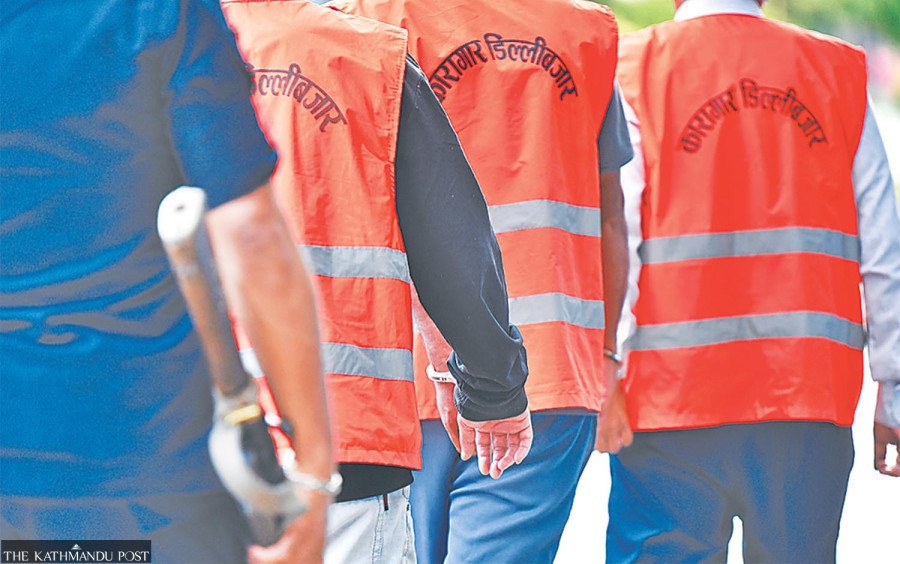
A series of high-profile detentions followed by releases has sparked debate on investigative practice and due process.Handcuffed detainees in orange fluorescent vests being escorted to Kathmandu District Court in this undated photo. Post file photo
A basic principle of criminal justice holds that arrest must follow assessment, not precede it. The safeguard is rooted in a long-standing belief that it is better for many guilty people to go free than for one innocent person to be wrongly detained. In Nepal, however, recent policing practices are raising concerns that this sequence is being reversed, with arrests in some cases coming before clear evidence or charges are established.
A growing pattern of taking individuals into custody first and searching for legal grounds afterwards is now drawing scrutiny from courts, legal experts and civil society. Critics say the trend risks undermining due process and blurring the line between investigation and arbitrary detention.
The concern is not limited to isolated incidents. It reflects a broader debate over how far investigative agencies can go before crossing into misuse of authority.
The most recent flashpoint came on May 4 when a team from the Valley Crime Investigation Office, a unit tasked with probing serious crimes, detained Krishna Hari Pushkar, secretary at the Vice President’s Office, from his residence in Kathmandu.
The action was linked to an alleged message he had sent to Prime Minister Balendra Shah, which authorities viewed as a breach of administrative discipline and the chain of command.
However, once taken to the Teku-based office, investigators found no clear legal basis to proceed with formal charges.
After around four hours of questioning, Pushkar was released and handed over to his wife, Abha Shrestha. Even during the process, he was not informed of the specific offence under which he had been detained.
“Was I brought here for something related to the Ministry of Labour, Commerce or Finance?” he asked investigators during questioning, according to officials present.
He was met with vague responses, with officers indicating he would “find out later”, even as preparations for a detention warrant were reportedly underway. A directive from higher authorities later ordered his release the same night.
A day later, Prime Minister Shah posted a satirical remark on social media, further fuelling public discussion around the incident.
Pattern of arrests before evidence
The Pushkar case is not an isolated occurrence. Officials and records from the Valley Crime Investigation Office show several similar operations in recent months where suspects were detained before evidence was fully established.
On May 17, police carried out coordinated raids on 95 educational consultancies across Kathmandu Valley, accusing them of facilitating illegal foreign employment under the guise of student placements. A total of 69 operators were arrested.
However, only 30 individuals were ultimately charged.
Investigators said the consultancies were operating outside regulatory frameworks, including expired registrations and unauthorised training and language classes. Yet, during post-arrest scrutiny, officers began analysing mobile phones and digital records to establish links to criminal activity.
Because no formal complaints had been filed by victims at the time of the operation, authorities later concluded that evidence was insufficient to proceed against all detainees. The remaining individuals were released while registration-related reviews were pending.
Earlier, on May 11, the same office detained two construction entrepreneurs, Ramesh Sharma of Sharma & Company and Pitambar Badu of Lama Construction, reportedly acting on instructions linked to the Ministry of Physical Infrastructure. The firms were engaged in road projects along the Nagdhunga and Dhulikhel sectors, respectively.
Concerns over mandate expansion
Former security officials say such interventions reflect a growing tendency to use police force in matters that may not strictly fall under criminal jurisdiction.
Former Deputy Inspector General Hemanta Malla Thakuri, who once headed the Central Investigation Bureau, said the trend risks distorting institutional roles.
“The police appear to be deployed in almost every administrative or contractual dispute, which is not appropriate. If there are issues in infrastructure projects, those should be handled by the relevant departments such as the Department of Roads,” he said. “If every problem is turned into a policing matter, it raises questions about the purpose of specialised agencies.”
During these incidents, the home administration was under Prime Minister Balendra Shah. Coordination with law enforcement agencies was reportedly handled through his chief personal secretary, Som Sharma. Officials said James Karki, who had also served under Sudan Gurung during his previous tenure, remained involved in administrative coordination.
Senior police officials also confirmed that Minister for Physical Infrastructure Sunil Lamsal maintained communication with security agencies on certain operational matters.
On Tuesday, Rastriya Swatantra Party leader Gurung assumed office again as home minister on Tuesday. His previous tenure had already seen repeated instances where arrests were followed by court-ordered releases.
Speaking earlier to journalists on April 16, Gurung had expressed frustration over the limits of executive authority over policing outcomes.
“I thought being a minister meant I could fix everything. It turns out judges now appear more powerful than ministers,” he had said.
He also noted that a legal review team had been formed to study procedural gaps in investigations.
However, police officials argue that operational decisions are often influenced by executive pressure.
“When instructions come from the top, refusing them is rarely an option. If an officer resists, transfer orders follow, and someone else implements them,” a senior police official said. “That creates unavoidable pressure.”
The judiciary has increasingly intervened in detentions, examining investigative procedures and remand decisions, particularly where concerns arise over the legality and manner in which arrest powers have been exercised.
In one case, Jyoti Prakash Pandey, chief executive officer of Nepal Investment Mega Bank, was arrested by the Central Investigation Bureau on May 12 on allegations of fraud and criminal breach of trust. The banking sector objected, arguing that loan recovery disputes were being mischaracterised as criminal offences.
Four days later, a Supreme Court bench ordered that Pandey be released and allowed to remain outside custody during the investigation.
In another case, former FNCCI president Shekhar Golchha was arrested on April 23 in Naxal in relation to alleged insurance violations, based on preliminary findings from the Securities Board of Nepal.
His wife, Seema Golchha, filed a habeas corpus petition at the Supreme Court. The court later ruled that investigators had bypassed legal provisions requiring them to first seek bail or guarantees before ordering detention. The bench quashed earlier remand orders, stating that custody procedures had not followed due process.
Golchha was later released after the district court declined to extend custody.
Former minister and Nepali Congress leader Deepak Khadka was also arrested on March 29 in a money laundering investigation. He was later released following a Supreme Court order on April 16 after a habeas corpus petition filed by his wife.
Similarly, UML provincial lawmaker Rekha Sharma was arrested on April 29 over allegations linked to child labour exploitation. However, since the case had already been closed through a prior decision not to prosecute, the Supreme Court ordered her release, citing double jeopardy principles.
Longstanding debate over police use
Analysts say Nepal’s political history shows repeated use of police forces as tools of state or party interest.
Former deputy inspector general Pitaram Adhikari said the pattern has persisted across political systems.
“During earlier political eras, police were used to spy on political actors. After the democratic transition, the same structure was used by parties in power to track opponents or influence investigations,” he said.
He pointed to earlier cases, including the arrest of then-lawmaker Sunil Sharma during the Pushpa Kamal Dahal-led government and the forced relocation of medical activist Dr Govinda KC from Jumla in 2018 under the KP Sharma Oli administration.
Legal experts aligned with governance reforms argue that continued misuse of state institutions was one of the triggers for last year’s Gen Z-led political movements.
Advocate Majid Ansari said law enforcement must operate strictly within legal frameworks, not political instructions.
“Police must not function based on political directives. They are bound by the Penal Code and procedural law. The fact that past governments misused institutions does not justify repeating it now,” he said.
Former DIG Hemanta Malla Thakuri also said arrests often depend on political alignment, with action taken when individuals lose power and delayed when they are in office.
“That shows the lack of operational independence. The law clearly distinguishes between civil disputes and criminal offences. Police should be allowed to operate within that boundary,” he said.
Former National Human Rights Commission member Mohna Ansari said successive governments have failed to allow the police to function independently.
“If police are allowed to work without interference, many problems would resolve themselves. Accountability for wrongdoing is necessary, but investigation must remain a professional responsibility,” she said.
Deputy Inspector General Abhi Narayan Kafle, Nepal Police spokesperson, said investigations are conducted strictly under legal provisions and based on evidence.
“We carry out investigations under the law, collect physical and digital evidence, and submit reports to the government attorney,” he said. “The attorney then evaluates the case before it goes to court. The judiciary is the final authority on justice.”
He added that not all arrests lead to prosecution.
“In some cases, evidence does not support charges and individuals are released. Sometimes courts do not extend custody. But our focus remains on impartial investigation supported by technical evidence,” he said.




 17.6°C Kathmandu