Twenty-one Pulchowk graduates join Airbus this year
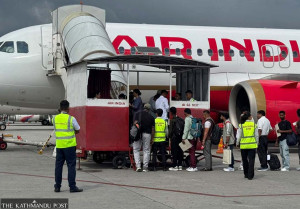
Nepal’s first aerospace engineering programme has placed about 44 graduates at the global aircraft manufacturer over the past three years. Twenty-one students from the Institute of Engineering, Pulchowk Campus, have begun their international careers at Airbus after being recruited by the global aerospace manufacturer. Courtesy of Sudip Bhattarai/X
Twenty-one graduates from the Tribhuvan University’s Institute of Engineering (IOE), Pulchowk Campus have been selected by Airbus, one of the world’s leading aircraft manufacturers, and have begun their international careers at the company’s Bengaluru centre in India.
According to Sudip Bhattarai, assistant professor and head of the Department of Mechanical and Aerospace Engineering, the graduates are currently undergoing orientation and initial training in Bengaluru. Airbus uses the Indian city as its entry point for newly recruited engineers from across Asia, so Nepali graduates also begin their careers there before being assigned to projects elsewhere.
“This year, 21 students have been selected. They have already arrived in Bangalore and started work,” Bhattarai told Kantipur. “Graduates from our programme have been joining Airbus regularly in recent years.”
Bhattarai said Pulchowk Campus launched Nepal’s first Bachelor of Aerospace Engineering programme in 2018. Although the Covid pandemic delayed the graduation of the inaugural batch, the first group completed their studies in 2023. Since then, Airbus has recruited graduates from the programme every year.
Six graduates from the first batch joined Airbus in 2024, followed by another 17 in 2025. With 21 students selected this year, about 44 Nepali graduates have joined the company over the past three years.
According to Bhattarai, Airbus initially coordinated directly with the department to recruit students, but the hiring process has since become more structured and institutionalised.
Selected graduates first undergo training in Bangaluru, with Airbus covering their travel, accommodation and initial onboarding expenses. They are then assigned to projects and locations in different countries based on the company’s operational requirements.
The department says interest in aerospace engineering has grown steadily since the programme was introduced. The programme admits 48 students each year, including 12 on full scholarships and 36 fee-paying students. Around 250 students are currently enrolled in the programme.
Because the Covid pandemic disrupted the academic calendar, two batches had to be run in the same year, resulting in five batches studying simultaneously.
Despite the programme’s growing international profile, Bhattarai said the department continues to face a shortage of qualified faculty.
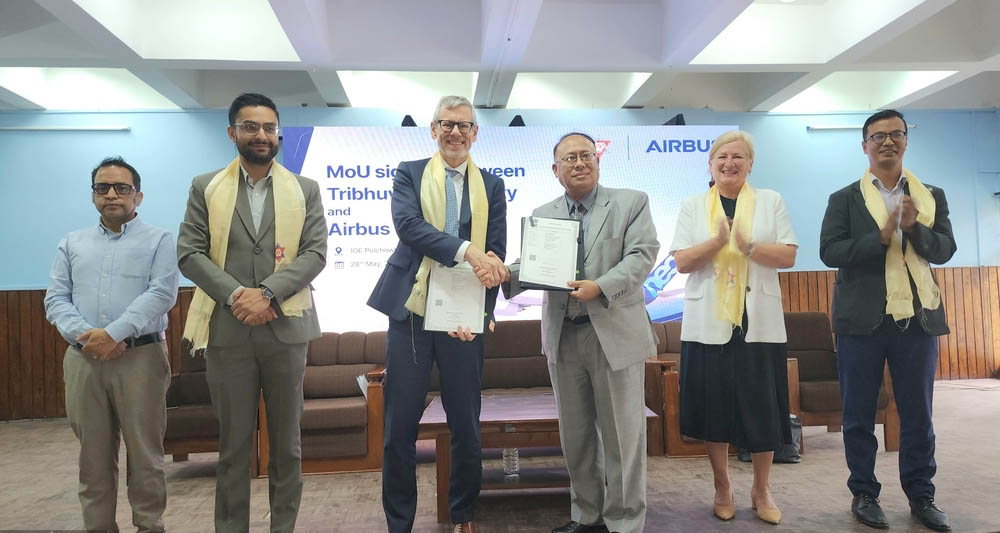
Airbus South Asia President and Managing Director Jurgen Westermeier and then Vice-Chancellor of Tribhuvan University Prof Sushil Bahadur Bajracharya sign a memorandum of understanding (MoU) to develop aerospace human resources in Nepal. Courtesy of Airbus
Although the department has four permanent teaching positions, only one is currently filled. The remaining courses are taught by contract faculty and part-time instructors from Nepal Airlines Corporation, Buddha Air, Himalaya Airlines, and the Civil Aviation Authority of Nepal, including both serving and retired professionals.
“International companies have begun recognising the calibre of our students,” Bhattarai said. “But sustaining that momentum over the long term will require greater investment in human resources, research and infrastructure.”
Meanwhile, on June 11, Airbus and Tribhuvan University signed a memorandum of understanding (MoU) to establish long-term cooperation in developing Nepal’s aerospace workforce.
The agreement was signed by Jurgen Westermeier, president and managing director of Airbus in India and South Asia, and Prof Sushil Bahadur Bajracharya, the then vice-chancellor of Tribhuvan University.
The MoU provides a framework for collaboration in aerospace and aviation curriculum development, research, training, digital technologies, artificial intelligence, machine learning, cybersecurity, industry-academia partnerships, internships and student placements.
Bhattarai said Airbus had already begun recruiting Nepali graduates before the agreement was signed, but the MoU formalised and institutionalised the partnership.
“Earlier, coordination took place largely at an individual level,” he said. “Now that Airbus and the university have entered into a formal partnership, it creates a long-term foundation for collaboration on curriculum development, capacity building, joint training programmes and stronger engagement with the aerospace industry.”
Suraj Kunwar is a senior correspondent with over two decades experience covering Aviation, Tourism and Mountaineering. He received the IFJ Tolerance Award in 2005.




 19.27°C Kathmandu