



 22.94°C Kathmandu

Thu, Oct 22, 2026
Money
8 million Demat accounts later, Nepal’s stock market is still missing the tools of a modern market
The surge in public participation has not yet been matched by a more mature market, wider instrument options, or stronger institutional foundations.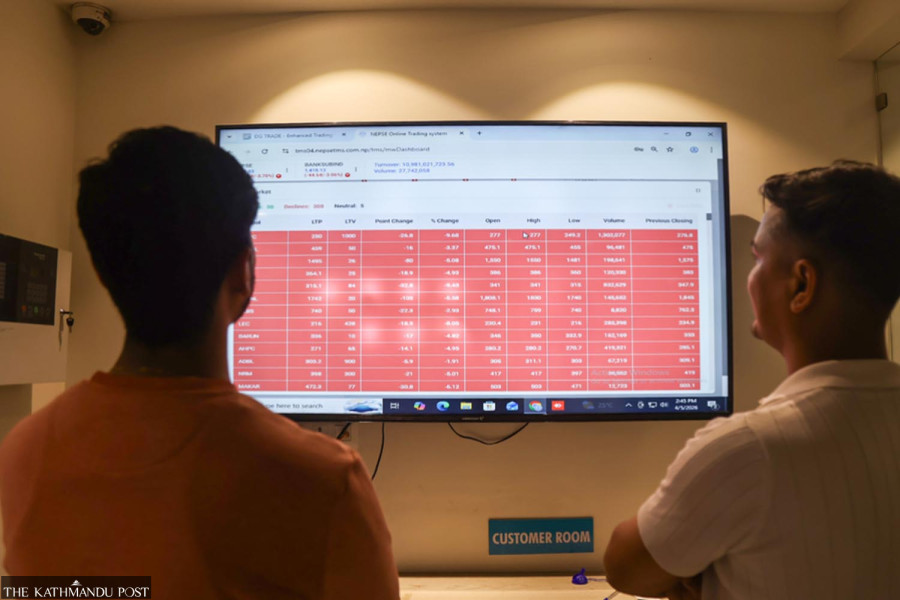
bookmark
Yagya Banjade
Published at : July 27, 2026
Updated at : July 27, 2026 06:29
Kathmandu
Nepal’s stock market has achieved a notable user milestone, with the total number of beneficiary accounts nearing eight million. Yet behind this rapid surge in public participation lies a capital market struggling with fundamental structural limitations, reliance on a single trading instrument, and regulatory frameworks that have failed to keep pace with digital expansion.
According to data released by Central Depository System and Clearing Limited (CDSC), the total number of Demat accounts—essential for storing securities electronically—reached 8,009,623 on Sunday. Since a Demat account is compulsory for applying to Initial Public Offerings (IPOs) and trading on the secondary market, official analysts treat this metric as the primary barometer of overall retail investor engagement.
Despite this numeric leap, financial experts and market stakeholders warn that the structural depth of the Nepal Stock Exchange (Nepse) remains remarkably shallow. While international financial markets offer complex hedging tools—such as financial derivatives, option contracts, forward agreements, and short-selling capabilities—Nepal remains strictly an equity-only market.
The rapid uptake of retail investing has been fueled largely by user-friendly digital tools. CDSC records show that 7,096,083 individuals have registered for 'Mero Share', with active users standing at 5,148,893. MeroShare is an online platform that allows shareholders to manage their shares and Demat accounts digitally. Four years ago, during the fiscal year 2022-23, total registered users stood at 4.82 million. The number rose steadily to 5.36 million and 5.97 million over subsequent years.
Furthermore, roughly 4.7 million investors have established Trading Management System (TMS) accounts to execute trades on the secondary market. However, Nepse classifies only around 400,000 of these as active traders—defined as account holders who execute at least one buying or selling transaction within a twelve-month period. Active market participation remains closely tied to prevailing index trends, expanding during bullish phases and contracting during market downturns.
Ambika Prasad Paudel, former chairman of Nepal Investors Forum, stressed that retail enthusiasm must not be mistaken for structural maturity. “While public participation in our stock market relative to overall population size represents a remarkable achievement, we rank among the weakest globally in terms of trade execution, regulatory supervision, and risk management,” said Paudel. “Our single biggest structural flaw is the continued promotion of the mandatory 10-kitta (10 units) allotment policy. Over the past seven to eight years, institutional investors have been discouraged rather than incentivised—at times facing restrictions that virtually limit their trading flexibility.”
Paudel urged policymakers to abandon retail-centric distribution schemes in favour of attracting institutional capital. “To ensure sustainable market development, we must encourage quality institutional investors to enter the fold. We need to focus instead on building a clean, transparent, and predictable marketplace,” he added.
The 10-kitta policy, introduced to broaden public access by ensuring small applicants receive a minimum allotment of ten shares, initially succeeded in democratising primary market entry. However, market veteran Niraj Giri, former executive director of the Securities Board of Nepal (Sebon), believes the policy has outlived its intended utility.
“The policy was introduced when C-ASBA was first implemented to build market access, with an understanding that it would be reviewed every five years,” said Giri. “Yet it remains unchanged. The time has come to revise this policy. A capital market carries inherent risk; it cannot function like a welfare state where equity is divided equally among every applicant.”
Giri also pointed out that while digital infrastructure enables citizens to apply for IPOs from any place, regional investor support mechanisms remain severely lacking. “We taught citizens how to apply for shares, but we failed to educate them on price volatility and potential financial loss,” said Giri. “Despite adding new brokerage firms, market services remain heavily centralised in practice.”
The structural evolution of Nepal’s capital market spans several decades. Formal share trading originated in 1936 with Biratnagar Jute Mills, established with a capital of Rs160,000 under a joint initiative between Prime Minister Juddha Shumsher Rana and Indian trader Radha Kishan Chamaria. Modern statutory regulation began in 1976 with the establishment of the Securities Exchange Centre, which initiated bond trading before transitioning to equity trading in 1984 under the Securities Exchange Act. Formal secondary market trading took shape in 1993 with the establishment of Sebon and Nepse.
The market moved from open-outcry trading to an electronic trading system from 1994 to 2007, fully dematerialised securities in 2015, and introduced full online trading systems in 2018. Over the past two decades, index metrics have expanded substantially: the Nepse index climbed from 222 points in 2003-04 to 2,794.79 points by mid-July 2025.
Annual capital gains tax collection rose from Rs310,000 on a trading volume of Rs 2.14 billion in 2003-04 to over Rs18 billion in tax revenue as annual turnover exceeded Rs2.1 trillion in 2024-25.
Niranjan Phuyal, chief executive officer of NRN Infrastructure and Development Limited, said how the composition of listed entities has gradually diversified. “A decade ago, the market was almost exclusively dominated by banks, financial institutions, and insurance companies that were legally required to issue shares,” said Phuyal. “Today, hydropower firms, manufacturing entities, and hospitality businesses are entering the market.”
By mid-June 2024, Nepse listed 297 companies, with equity instruments accounting for 99.4 percent of secondary market trades. Financial institutions and insurance companies represent 50.9 percent of total market capitalisation, followed by hydropower at 17.5 percent, manufacturing at 8.7 percent, investment companies at 6.8 percent, and hotels at 3.3 percent.
Various reports highlighted similar challenges facing Nepal’s financial market infrastructure, particularly the persistent failure to operationalise secondary trading for government debt securities and the delayed introduction of specialised commodity exchanges. Regulatory inertia, combined with lingering political uncertainty, has frequently hindered structural reforms designed to attract foreign institutional investment.
As of mid-June 2025, total market capitalisation stood at 71 percent of gross domestic product (GDP), down from 72.5 percent in mid-July 2016. The drop reflects recent corrections in share valuations across listed firms.
During the first eleven months of the 2024-25 fiscal year, NEPSE listed new securities worth Rs147.15 billion, including ordinary shares worth Rs48.27 billion, bonus shares worth Rs40.44 billion, rights issues worth Rs9.64 billion, and mutual funds worth Rs27.50 billion. During the same period, SEBON approved public issuances totaling Rs53.73 billion across various asset categories.
Yagya Banjade
Banjade covers government finance, banking, capital markets, and the economy for Kantipur Daily.

Most Read from Money

Nepal travel agents threaten to stop selling Thailand trips over visa rules

Why does an hour long flight to Dhangadhi cost more than a flight to New Delhi?
Malaysia rejects Nepal’s demand to open recruitment to all manpower agencies

No school, but a graduation cap for women dairy farmers
Nepal arrests four medical service providers as Malaysia recruitment row deepens
Editor's Picks




E-PAPER | October 22, 2026

×