Land disputes stall final phase of Rs51 billion Rani Jamara Kulariya irrigation project
Disagreement over canal alignment in Kailali delays irrigation expansion to 17,500 hectares, casting doubt on the project's 2028-29 completion target. A testing of an irrigation canal conducted in 2017. Photo: Courtesy of the project’s Facebook page
The third and final phase of the Rani Jamara Kulariya Irrigation Project, a national pride project in Kailali, has stalled due to land acquisition disputes and the lack of assured funding, prolonging a wait that farmers in far-western Nepal have endured for decades.
While most infrastructure under the first and second phases has been completed, work on the final phase has yet to begin.
Although the government aims to complete the project by the fiscal year 2028-29, construction remains uncertain after authorities failed to reach an agreement with residents of Ghodaghodi Municipality-2 over land acquisition.
The final phase includes the Patharaiya-Kandra extension, which is expected to bring year-round irrigation to an additional 17,500 hectares of farmland, benefiting thousands of farmers in Kailali. However, the land dispute has become the project's biggest hurdle.
Compensation has already been determined in Bardagoriya Rural Municipality wards 1, 2 and 4.
But in Ghodaghodi-2, local residents have refused to hand over land, arguing that the canal alignment was changed without their knowledge and that the revised route would cut through productive farmland.
Ram Krishna Ghorasaini, the project's information officer and senior divisional engineer, said around half of the affected landowners have agreed to provide land, while the rest continue to oppose the project, preventing authorities from completing the compensation process.
Kumar Raj Shahi, chairman of the project main users' committee, said locals had expected the final phase to begin immediately after the second phase was completed last year. Instead, unresolved grievances have left the project stranded at its final stage.
"We held several rounds of discussions with the district administration, the Forest Office and the Land Revenue Office, but we have not been able to address the concerns of local residents," Shahi said. "If the current situation continues, completing the project within the target deadline will become increasingly difficult."
Prem Malla, a resident affected by the project in Ghodaghodi-2, said the dispute is less about compensation than the canal's alignment.
"We are not against development. In 2018, it was agreed that the canal would pass above the Chure Conservation Area. But only after our land was frozen last December did we learn that the canal would instead pass through the middle of our village," Malla said.
He said the community's objection centres on the route change.
"We have no issue with compensation. If the canal is constructed through the upper route, more farmers will benefit. If it passes through the lower route, the village will be divided into three parts," he said.
Project officials, however, deny that the route has been altered.
Ankur Subedi, a project engineer, said several alternatives were examined during preparation of the Detailed Project Report (DPR), but the current alignment is the one that was ultimately approved.
"Different alignments are examined during surveys, but the final route is selected based on the shortest distance and the lowest cost. It is not true that the route was initially planned in one location and later shifted elsewhere," Subedi said.
He acknowledged, however, that local residents were not directly consulted during the preparation of the DPR.
"There may have been some shortcomings because local residents were not directly consulted," he said.
The project was launched in the fiscal year 2009-10 with an estimated cost of Rs12.37 billion.
As its scope expanded and construction deadlines were repeatedly extended, the estimated cost climbed to more than Rs51 billion, according to Subedi.
The first and second phases alone are expected to cost Rs29.59 billion, while the Patharaiya-Kandra extension will require another Rs21.74 billion, taking the total estimated cost to about Rs51.33 billion.
Originally, the project was designed to irrigate 14,300 hectares and be completed by the fiscal year 2017-18. The deadline was later pushed to 2023-24 and then to 2028-29 after the command area was expanded by an additional 6,000 hectares.
Subedi said the expanded scope, rather than construction delays alone, explains the extended timeline.
So far, the project has achieved 76 percent physical progress and 74 percent financial progress.
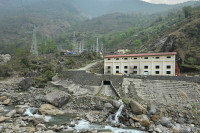
The first phase included construction of an intake on the Karnali river, an eight-kilometre main canal and hydropower infrastructure.
The second phase completed the main and branch canals under the Rani, Jamara and Kulariya irrigation systems, extending irrigation to 14,300 hectares.
However, key components remain unfinished, including branch and distributary canals under the Lamki extension, the Patharaiya-Kandra extension, irrigation expansion to another 17,500 hectares, and the operational management of the project's hydropower plant.
The project ultimately aims to provide reliable year-round irrigation to 38,000 hectares of farmland.
The project was initially allocated Rs2.14 billion in the current fiscal year, but the budget was later revised down to Rs1.43 billion.
By the end of the fiscal year, only Rs730 million, or 51.34 percent of the revised allocation, had been spent.
According to Subedi, spending remained low because contracts could not be awarded before funding assurance procedures were completed.
The project has already spent more than Rs879.6 million on land acquisition and compensation.
Compensation procedures are underway in Bardagoriya, but the process in Ghodaghodi remains stalled by the unresolved dispute.
The largest compensation payments have been made for acquiring registered land under the Lamki branch canal.
Project records also show that, despite clearing part of previous audit observations, around Rs700.5 million in unsettled audit observations remain outstanding.
Subedi said the pending audit observations stem from a combination of technical and procedural issues.
"Some are technical in nature. There are many factors contributing to the outstanding audit observations," he said.
Despite the setbacks, project officials say the scheme has already delivered tangible benefits.
Around 14,300 hectares of farmland now receive reliable year-round irrigation, while construction of the 4.71-megawatt hydropower plant has been completed and its operational modality is being finalised.
Mitra Baral, director general of the Department of Water Resources and Irrigation, said the project's rising cost and extended timeline should be viewed in light of its expanded scope.
"It is not only the timeline that has been extended; the scope of work has also increased. As the scope expanded, both the time required and the overall cost naturally increased," Baral said.




 17.48°C Kathmandu