What makes food sold in most Nepali stores ‘organic’? The label
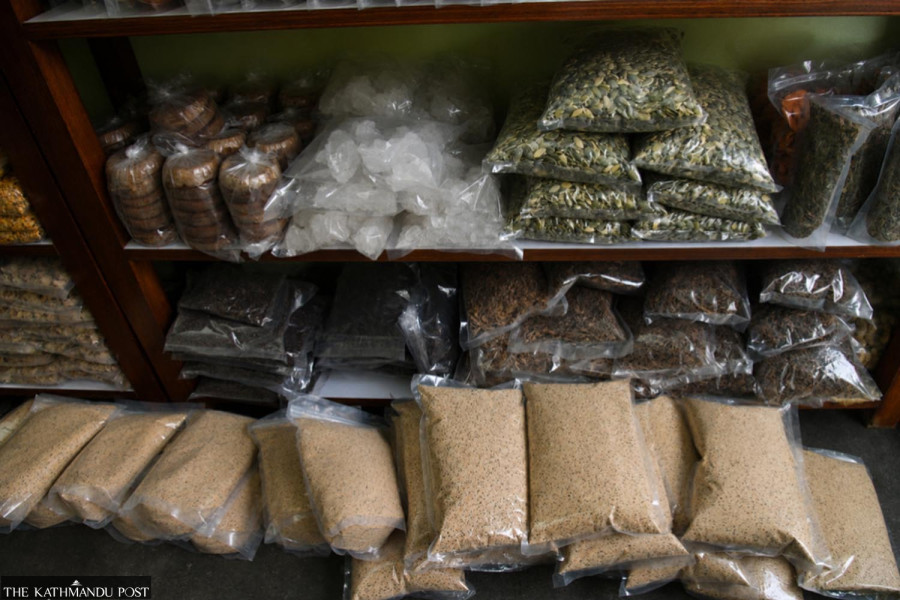
Buyers have developed a habit of trusting the tag on a package rather than demanding proof of the product’s actual quality. A grocery claiming to sell organic products pictured at New Baneshwar, Kathmandu. Deepak KC/TKP
For urban residents navigating Kathmandu’s grocery stores, regional delicacies from specific districts carry an almost magical appeal. Beans from Jumla, cliff-bee honey from Surkhet, ginger from Salyan, apples and potato from Mustang evoke pictures of pristine mountain soil. Yet behind the idyllic images printed on slick packaging lies a stark reality—much of what is sold with the labelled ‘organic’, ‘pure’, or ‘100 percent natural’ is nothing more than unverified marketing hype.
Consumer rights activists and agricultural experts have long warned that the city’s appetite for indigenous foods has spawned a lucrative grey market. Urban shoppers willingly pay premium prices for items labelled with revered geographic identities—such as Pokhara’s Jethobudho rice, Jumla’s Simi and Marsi rice, Khopasi’s khuwa, Ilam’s tea, Gulmi’s coffee, or Mudhe’s potatoes—without any guarantee of their origin or chemical purity.
“City dwellers searching for organic and native flavours are ready to empty their pockets without a second thought, lured by beautiful labels and charming product names,” said Bhupendra Nirajan, general manager and food inspector at NEPCERT, one of Nepal's accredited organic certification bodies. “The uncomfortable truth today is that neither the seller nor the consumer can verify whether these goods actually come from the soil of those remote villages.”
According to Nirajan, consumers have developed a habit of trusting the tag on a package rather than demanding proof of the product’s actual quality.
The systemic disparity between actual agricultural output and market availability was underscored on Friday by Ram Bhakta Adhikari, acting chief of the Agriculture Development Office in Jumla.
“Jumla produces approximately 3,600 tonnes of beans annually, out of which only around 55 tonnes are exported outside the district,” said Adhikari. “Yet in Kathmandu’s supermarkets, online stores, and vegetable outlets, so-called ‘Jumla beans’ are sold in massive quantities all year round.”
This glaring discrepancy points to widespread mislabelling across the supply chain, where produce grown in low-altitude districts using fertilisers is routinely packaged and passed off under high-value mountain brands.
“It astounds us as well. Most of the beans harvested in Jumla are consumed locally. While our beans are renowned for their distinct taste and quality, produce from entirely different districts is clearly being passed off under Jumla's name in Kathmandu,” said Adhikari.
This regulatory vacuum is hardly a new phenomenon in the country’s food market. Various studies show how toxic pesticide residues routinely exceed permissible levels in produce entering urban centres from major farming belts. Despite periodic public outcry over chemical contamination, state mechanisms have consistently failed to implement integrated tracking systems, leaving city markets vulnerable to fraudulent labelling practices.
The Department of Food Technology and Quality Control (DFTQC), the primary state entity responsible for enforcing food safety, has urged consumers not to rely solely on labels when purchasing food items sold as ‘organic’ in the market. The department stated that consumers must check whether products claiming to be organic possess valid certification, warning that traders making false claims will face legal action under existing laws.
The department acknowledges the pervasive nature of false labelling but places the burden of proof partly on buyers. “Writing ‘organic’ on a label does not make a product organic,” said Bal Kumari Sharma, spokesperson and senior food research officer at the DFTQC. “For a product to be legally sold as organic, it must undergo formal certification from an authorised body and display an official certified logo on its packaging.”
Sharma clarified that the government itself does not directly issue organic certificates to individual farmers. Instead, certification is handled by registered private agencies supervised by the Department of Agriculture.
“During market inspections, if our officers encounter products labelled as organic, we immediately demand legal certification,” said Sharma. “If a business labels its goods as organic without valid paperwork, it constitutes consumer deception and is subject to prosecution under existing food safety and consumer protection laws.”
While existing legal provisions lack a dedicated standalone clause defining the word 'organic', authorities rely on general provisions against misleading labelling and consumer fraud to penalise offenders.
“Our primary mandate is to monitor quality, safety, and label compliance,” said Sharma. “We inspect samples, verify certification for special claims like organic or halal (Arabic word meaning permissible), and act upon public complaints. Consumers must not rely blindly on claims printed on a bag; they must check for official logos and report suspicious products directly to us.”
Nepal’s legal framework for organic farming is anchored in the Guidelines for Group Certification Internal Control System of Organic Agriculture Production 2012 formulated by the Ministry of Agriculture Development. The guidelines set the regulatory protocol for certifying organic produce, processed foods, and agricultural exports.
At present, only eight private agencies are officially registered with the government to provide organic certification services in accordance with national and international standards. These include Organic Certification Nepal, NEPCERT, Sakura Herbs and Agro Pvt Ltd, Certification of Environmental Standards Nepal Pvt Ltd, Himalayan Certification Nepal, Nepal Organic Certification International Surkhet, IMO Kathmandu, and Environment Food and Agriculture Certification Pvt Ltd.
However, industry insiders argue that the monitoring framework exists largely on paper. Yam Kumari Shrestha, senior horticulture development officer at the Division of Agricultural Productivity under the Department of Agriculture, noted that state oversight is mostly confined to administrative check-ins.
“We monitor these agencies during their annual registration renewals and maintain records of the products they certify,” said Shrestha. “Certification activities dropped noticeably following the Covid-19 pandemic. Currently, tea and coffee make up the vast majority of certified organic goods because they are primary export commodities bound for international markets. Herbs, timur (Sichuan pepper), ginger and vegetables follow.”
Shrestha revealed that certified organic livestock and dairy products remain virtually non-existent in Nepal. “There is no organic certification for eggs or meat in the country. Within the dairy sector, only a single variety of cheese produced by the Dairy Development Corporation holds organic certification. Cardamom was certified once years ago, but that status has since lapsed.”
A severe bottleneck in the state’s enforcement capability is the complete absence of an integrated government laboratory equipped to verify organic authenticity or perform specialised chemical analyses. Neither the Department of Agriculture nor the accredited private certification agencies possess state-of-the-art testing facilities. Consequently, agencies must outsource sample testing to private laboratories, which charge exorbitant rates.
According to food inspectors, conducting even a basic laboratory test can cost anywhere between Rs15,000 and Rs16,000. “When combined with official audit fees, the total cost for obtaining an organic certificate ranges from Rs60,000 to Rs150,000, as confirmed by certification directors,” said Bhola Shrestha, director of Organic Certification Nepal.
For Nepal’s smallholder farmers—who form the backbone of the rural economy—these prohibitive costs create an insurmountable barrier. Bhola Shrestha confirmed that certification fees remain well out of reach for average producers.
Furthermore, the rigorous bureaucratic procedures demand meticulously updated farm diaries, paper logs of every seed and fertiliser source, strictly maintained soil buffer zones, and specialised transport protocol.
“For small farmers working two or four katthas of land, individual certification is financially impossible,” said Nirajan. “Even when farmers form cooperatives to share costs, they face immense risk. Under strict organic standards, if just one out of a hundred farmers in a group secretly uses chemical fertiliser or pesticide, the entire group’s organic certificate is instantly revoked.”
Compounding these structural hurdles is the total lack of financial guarantees. Farmers who invest time and capital to secure genuine organic certification are rarely offered a guaranteed premium price by middle-tier traders or urban retail chains. Deprived of technical support from local governments and facing uncertain market returns, smallholders naturally abandon formal certification altogether—leaving the market wide open for unverified, falsely labelled goods to flourish across the country.
Suraj Kunwar is a senior correspondent with over two decades experience covering Aviation, Tourism and Mountaineering. He received the IFJ Tolerance Award in 2005.




 18.11°C Kathmandu