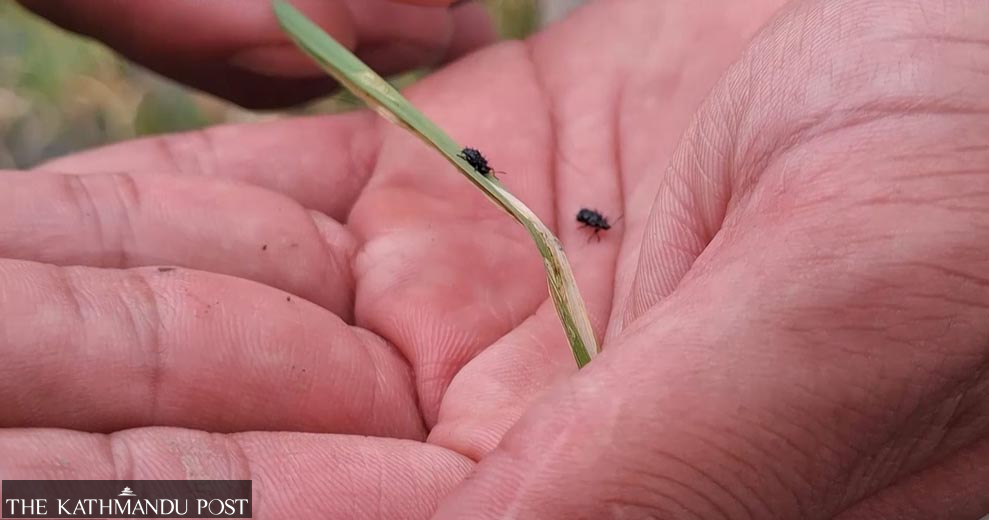
A rapidly spreading outbreak of rice hispa, a destructive beetle that feeds on rice leaves, has damaged paddy fields across parts of Palpa district, prompting local authorities to launch emergency pest control measures.
The infestation has spread across several farming areas in Purbakhola Rural Municipality, where farmers say newly transplanted rice crops have been severely affected. In many fields, the insects have stripped the leaves, causing the plants to turn yellow and raising concerns over significant crop losses if the outbreak is not contained quickly.
According to the municipality's agriculture section, rice hispa has been reported in wards 1 through 5, including Siluwa, Jalpa, Ringneraha, Devinagar and Birkot. Paddy fields in Alkichaur, Tamakhani and other lowland farming areas have been among the hardest hit.
In response, the municipality has deployed agricultural technicians to inspect affected fields and advise farmers on pest control. Authorities have also distributed pesticides, sprayers and personal protective equipment to help contain the outbreak.
“We have mobilised agricultural technicians to conduct field inspections in the affected areas and distribute pesticides wherever necessary,” said Mohan Dhakal, the municipality's information officer.
The municipality has supplied 7.5 litres of a chemical pesticide containing 10 percent thiamethoxam and 5 percent lambda-cyhalothrin EC for heavily infested fields. Another 7.5 litres of a biological pesticide containing 0.15 percent azadirachtin EC (1,500 ppm) has been distributed for areas with lighter infestations. Five PPE kits, along with five electric and manual pesticide sprayers, have also been provided.
Agricultural technicians have been training farmers to identify the pest, apply pesticides safely and adopt integrated pest management practices to minimise further damage.
Officials have also detected rice leaf folder, another insect pest that folds and feeds on rice leaves, in some fields in Siluwa, adding to concerns over this season's paddy crop.
Bhagirathi Bhattarai, vice chair of the rural municipality, said cooperation among farmers, agricultural technicians and the local government would be critical to containing the outbreak before it spreads further.
House of Representatives member Sandip Rana has also distributed additional pesticides through his parliamentary secretariat. Agricultural technicians assigned by the secretariat have provided pesticides and technical guidance to farmers in Purbakhola and neighbouring Rambha Rural Municipality.
The parliamentary office had previously supplied pesticides to farmers in wards 2 and 3 of Purbakhola.
Agricultural technician Nirjal Pandey attributed the outbreak to excessive use of urea fertiliser, dense planting, high humidity, prolonged wet conditions and the practice of transplanting rice immediately after harvesting winter crops, all of which create favourable conditions for rice hispa to multiply rapidly.




 21.92°C Kathmandu