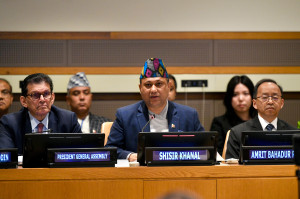
Foreign Minister Shisir Khanal has clarified that Nepal has not sought the mediation of any third country to resolve the border dispute with India, and reiterated Kathmandu’s longstanding position that all outstanding issues should be settled through bilateral dialogue and established diplomatic mechanisms.
Addressing journalists at the Nepali embassy in New Delhi on Sunday before heading for Kathmandu, Khanal sought to dispel confusion arising from recent remarks by Prime Minister Balendra Shah regarding historical documents related to Nepal's territorial claims.
Speaking in parliament on May 31, Prime Minister Shah had said that the United Kingdom should also take an interest in the Nepal-India boundary dispute, given its historical link to the 1816 Sugauli Treaty.
Responding to lawmakers’ queries, Shah had said, “Our view is that England [UK] should also take an interest, as the issue dates back to British India.” He further said such disputes should ultimately be resolved through dialogue and diplomatic negotiations.
The Lipulekh issue is a longstanding dispute that resurfaced in 2019, when India, without consulting Nepal, released a new political map incorporating Kalapani, Lipulekh and Limpiyadhura. Nepal’s objections were ignored and in May 2020, the KP Sharma Oli government responded with its own revised administrative map, which placed the three areas within Nepal.
The border issue regained prominence last month after India and China agreed to resume the Kailash Mansarovar pilgrimage through Lipulekh. Kathmandu subsequently conveyed its objections to both countries through diplomatic channels. Earlier, in August last year, Nepal had also sent separate notes to both sides following their agreement to reopen trade through Lipulekh.
While trying to clarify the prime minister’s remark, Foreign Minister Khanal said, “We need historical evidence, and we simply wanted to explore whether we could gain access to certain documents that may be available in libraries or archives in the UK. However, this does not mean that we have sought mediation. That is not what he [PM Shah] intended to convey.”
“If you listen to what he said in Parliament, he stated very clearly and specifically that we want to resolve our border disputes through dialogue and diplomatic channels. This has been Nepal’s longstanding position, and it remains our position today,” Khanal said.
Khanal mentioned that many of the border disputes stem from historical developments linked to the 1816 Treaty of Sugauli, which defined the modern boundary between Nepal and India.
“When we sit down at the negotiating table, these issues will be resolved through discussions between the two sides and through diplomatic mechanisms. We want to settle our differences through diplomatic processes,” he said.
The clarification came a day after Khanal held bilateral talks with Indian External Affairs Minister S Jaishankar. Statements issued separately by the foreign ministries of Nepal and India following the meeting did not explicitly mention the long-standing border disputes, prompting questions in Nepal amid growing domestic pressure on the government to raise the issue with India.
Diplomatic sources, however, said the matter figured prominently in closed-door talks involving the two ministers and senior officials from both sides ahead of the delegation-level talks.
According to two Nepali officials familiar with the discussions, the two foreign ministers agreed to reactivate existing bilateral mechanisms on border issues and ensure their meetings are held more regularly.
“As we have dedicated and well-established mechanisms to address boundary issues, both ministers agreed to resolve differences through dialogue. If necessary, the top political leaderships of the two countries will provide guidance," one Nepali official closely following developments in New Delhi, told the Post.
As part of that effort, the Survey Officials’ Committee (SOC), a technical mechanism under the Boundary Working Group (BWG), is expected to meet on August 24-25. The BWG, the highest bilateral mechanism dealing with technical matters, will convene thereafter to review progress.
Established in 2014, the BWG is responsible for the construction, restoration and maintenance of boundary pillars and other technical aspects of border management. Both countries have agreed to complete all remaining boundary-related technical work by 2028, except for the disputed areas of Kalapani and Susta.
Khanal acknowledged that several bilateral mechanisms had been inactive in recent years.
“There is no harm in sitting at the table and discussing these issues,” he said. “The mood on both sides is positive.”
Talking to Indian media representatives, Khanal said Nepal has formally conveyed its position to both India and China through diplomatic notes, objecting to their decision to use the Lipulekh route for the Kailash Manasarovar pilgrimage.
“We’ve clearly said to both countries that the land belongs to us. That's been our historical claim….Many of these border disputes are part of a long historical legacy, especially the Nepal-India border. We want to solve our disputes through diplomatic processes. We just want to see if we can access some of the documents that might be in libraries or museums in the UK. Our position was not that we were asking for mediation..."
“Our concerns relate to the renewal of the agreement between India and China [to trade] through the Kalapani and Lipulekh area, where we have maintained for a long time that the land belongs to Nepal,” Khanal told Indian journalists. “Without Nepal’s consent, the two countries cannot make such agreements.”
Jaishankar, according to a senior Nepali official who spoke to the Post requesting anonymity, assured Khanal that he would visit Nepal ahead of the UN General Assembly session in September.
Beyond boundary issues, the ministers also discussed ways to expedite cooperation in trade, connectivity, energy, civil aviation, agriculture and water resources.
Nepal once again raised the issue of securing additional air entry routes from India to facilitate operations of Gautam Buddha International Airport in Bhairahawa and Pokhara International Airport. According to officials, both sides agreed to convene a meeting of the relevant technical committee within a month.
Khanal also urged India to consider establishing accredited testing labs in Nepal to facilitate exports of Nepali tea and agricultural products and reduce recurring trade disruptions.
The ministers reviewed progress on cross-border transmission lines, flood management, irrigation cooperation, rail connectivity and energy trade. Nepal also pressed for the early operationalisation of the proposed Janakpur-Ayodhya rail link.
Reflecting on his first official visit to India as foreign minister, Khanal said one of his primary objectives was to restart high-level political engagement between the two countries after a prolonged gap.
“The last high-level visit was almost two years ago, and a lot has changed in Nepal over the past year,” he said.
Khanal also reiterated that the report prepared by the Eminent Persons Group (EPG) on Nepal-India relations can only be formally received by the prime ministers of the two countries, as the body was established by mutual agreement between them.
“I have no authority to accept it or make it [the report] public,” he said.
On Prime Minister Shah’s expected visit to India, he said, “I hope that high-level visits will now commence from both sides. And I believe we can expect these visits to become part of regular exchanges between the two countries.”
He added that he was returning to Kathmandu with high optimism.
When asked about the ongoing Gen Z movement in India, Khanal chose not to comment.
Anil Giri is a Chief Sub Editor covering diplomacy, international relations and national politics for The Kathmandu Post. Giri has been working as a journalist for more than two decades, contributing to numerous national and international media outlets.




 24.79°C Kathmandu