Nepali political solidarity visible in times of crisis
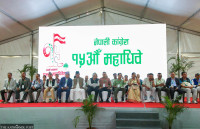
From the 12-point understanding to the recent communal tensions, Nepal’s political parties have repeatedly put aside deep political differences to confront national crises together.Leaders of opposition parties attend a meeting convened by RSP chair Rabi Lamichhane (second right) in Kathmandu on Wednesday. Courtesy of Lamichhane’s secretariat
When communal tensions erupted in Sunsari’s Dewanganj and threatened to spread to neighbouring districts, it was not only the government and security agencies that moved to contain the situation.
Political parties in government and the opposition and those outside Parliament also stepped in.
Parties that routinely attack the government closed ranks, reinforcing a familiar pattern in Nepali politics: when the country faces a major crisis, political rivals often put aside their differences and act together.
The ruling Rastriya Swatantra Party (RSP), Parliament’s strongest and youngest political force, followed a path long taken by Nepal’s legacyparties. Recognising that communal unrest required a coordinated political response, RSP chair Rabi Lamichhane convened an all-party meeting with urgency.
The initiative drew support across party lines. Leaders attending the emergency meeting included Gagan Thapa, president of the main opposition Nepali Congress; Pushpa Kamal Dahal, coordinator of the Nepali Communist Party; Shankar Pokhrel, general secretary of the CPN-UML; Mahantha Thakur, chairman of the Loktantrik Samajbadi Party; Aren Rai, general secretary of the Shram Sanskriti Party; Rajendra Lingden, chairman of the Rastriya Prajatantra Party; CK Raut, chairman of the Janamat Party; and Prakash Adhikari, leader of the Janata Samajbadi Party Nepal. The participation of the opposition leaders at a meeting called by the ruling party was widely viewed as a positive sign.
The meeting put out a joint statement in which leaders appealed for social harmony, peace and dialogue. They also urged party organisations at the provincial, district and local levels to organise all-party and multi-stakeholder meetings to help ease tensions on the ground.
Following the Wednesday meeting, political parties instructed their organisational units to engage in community outreach and mediation efforts. Opposition leader Thapa took a particularly active role in mobilising the Congress network.
The combined efforts of political leaders, security agencies, religious figures and civil society groups helped restore calm across the affected districts.
Prime Minister Balendra Shah initially faced criticism over what many viewed as a slow response to the unrest in Madhesh. Critics accused him of remaining confined to Singha Durbar, failing to respond publicly to the deteriorating situation and not engaging directly with stakeholders in the affected region.
As criticism intensified, Shah became more active.
He addressed the nation, calling for religious and social harmony, visited Sheetal Niwas to meet President Ramchandra Paudel in his first formal meeting with the head of state since taking office, and held consultations with Madhesh-based political leaders as well as lawmakers from his own party representing the region.
Those meetings helped address concerns over the government’s position on the crisis. Shah reiterated his commitment to the federal democratic republic and sought to dispel misconceptions about his government’s approach to key national issues.
Political analysts say that while security measures were crucial in containing violence, the visible cooperation among political parties was equally important in stopping the crisis from escalating further.
“Political competition, changes in government, parliamentary obstruction, street protests and political mudslinging are all part of everyday politics. But coming together during a national crisis is a distinctive feature of Nepal’s political culture,” said Nilamber Acharya, a former diplomat and politician.
“There is an established culture in Nepali politics of respecting and making space even for those against whom parties have fought elections or organised street protests.”
Acharya said the tradition dates back to the 1950 revolution.
“Our political culture is based on tolerance, dialogue, interaction and cooperation. Compared with other countries in South Asia, Nepal has developed a healthy tradition of consultation between the government and the opposition and of building multi-party consensus,” he said.
He also praised Lamichhane for continuing that tradition despite leading a relatively new political force.
“It is encouraging that new political forces are carrying forward long-established political practices,” Acharya said. “The ruling party took the initiative to convene the meeting, which was the right step, and opposition parties set aside their differences to attend, which is equally commendable.”
At the same time, Acharya said such initiatives should ideally be led by the prime minister.
“Although there was some delay, the prime minister has gradually become more engaged. That is a positive development, but it needs to continue,” he said.
A long tradition of crisis consensus
The political unity displayed during the communal strife in Sunsari is only the latest example of a recurring pattern in Nepal’s modern political history. At key turning points, including the 12-point Delhi understanding of 2005, the subsequent peace process, constitution writing, the 2015 earthquake, the border dispute with India in 2019, the Covid-19 pandemic and successive constitutional crises, political parties have consistently set aside partisan interests to protect national stability and social cohesion.
After King Gyanendra Shah assumed direct rule on February 1, 2005, a seven-party alliance comprising the Nepali Congress, the CPN-UML, the Nepali Congress (Democratic), Janamorcha Nepal, the Nepal Majdoor Kisan Party, Nepal Sadbhawana Party (Anandi Devi) and the United Left Front joined hands with the CPN (Maoist), which at the time was waging an armed insurgency.
The alliance was widely regarded as improbable. While the seven parties were operating within the constitutional political system, the Maoists were fighting a decade-long armed conflict. Few believed the parliamentary parties and the rebels could find common ground.
The 12-point understanding overturned that assumption.
United by the shared objective of restoring democracy and ending the King’s direct rule, the seven-party alliance and the Maoists forged a common political platform. The agreement laid the foundation for the 2006 People’s Movement, which forced the monarchy to relinquish power, restored the dissolved House of Representatives and paved the way for the Comprehensive Peace Accord, formally ending the decade-long conflict.
The consensus also brought the Maoists into mainstream politics and ultimately led Nepal’s transition to a federal democratic republic.
The culture of political cooperation during national crises, however, predates the peace process.
During the 1989 movement against the Panchayat regime, the Nepali Congress and the United Left Front joined forces despite profound ideological differences. Their joint movement restored multi-party democracy, resulting in an interim government representing both sides, the promulgation of the 1990 Constitution and parliamentary elections in 1991.
Although the Congress and communist parties became fierce electoral rivals in the years that followed, the democratic system accommodated former Panchayat leaders who had previously opposed the pro-democracy movement, reflecting a broader political culture of inclusion rather than exclusion.
The same spirit resurfaced during the constitution-writing process.
When the first Constituent Assembly convened in 2008, political parties unanimously voted to abolish the monarchy on May 28 that year. The consensus, however, soon gave way to bitter disputes over federal boundaries, the system of governance, electoral arrangements, judicial structure and state restructuring.
Despite extending the Constituent Assembly’s term several times, political parties failed to bridge their differences. The assembly was dissolved on May 27, 2012 without delivering a constitution, triggering a deep constitutional crisis.
With no agreement on who should head the government or oversee fresh elections, the parties eventually reached an unprecedented compromise by appointing sitting Chief Justice Khil Raj Regmi to lead an interim cabinet.
The arrangement drew criticism because it blurred the separation between the executive and the judiciary. Even so, political parties accepted the proposal as an exceptional measure to preserve the constitutional process. The agreement enabled elections to the second Constituent Assembly in 2013.
Political consensus again became crucial after the devastating earthquake of April 25, 2015.
Even as parties remained divided over the contents of the new constitution, they worked together on rescue, relief and reconstruction efforts. Seeking to restore political stability, the Nepali Congress, the CPN-UML, the UCPN (Maoist) and the Madhesi Janadhikar Forum (Loktantrik) signed a historic 16-point agreement on June 8, 2015, breaking years of political deadlock and clearing the way for the promulgation of the Constitution of Nepal on September 20 that year.
Subsequent crises prompted similar cooperation.
Political parties presented a united front during the nearly six-month border blockade later in 2015. They jointly endorsed the first constitutional amendment on January 23, 2016 to address concerns raised in Madhesh and later worked together to hold local, provincial and federal elections in 2017 under the new constitutional framework.
Another striking example came on June 13, 2020, when the House of Representatives unanimously approved a constitutional amendment updating Nepal’s map to include Kalapani, Lipulekh and Limpiyadhura. The amendment was endorsed by all 258 lawmakers present, with no votes against.
More recently, major political parties closed ranks against campaigns advocating the restoration of monarchy, demonstrations organised by the Durga Prasai-led group and the renewed political activities of deposed king Gyanendra, maintaining that safeguarding the federal democratic republic transcended partisan competition.
Even after the Gen Z uprising of September 8 and 9, 2025, which led to the collapse of the UML-Congress coalition, attacks on the party headquarters and the homes of senior leaders, and the formation of an interim government led by former chief justice Sushila Karki, political parties ultimately prioritised constitutional continuity.
Although several parties initially questioned the constitutionality of the interim arrangement, they later joined consultations convened by prime minister Karki and the Election Commission before participating in the March 5 general elections, helping return the country to constitutional rule.
Political analyst Bhaskar Gautam said Nepal’s political culture has increasingly relied on dialogue to overcome major structural crises, particularly since the end of the armed conflict.
“Following last year’s youth uprising, there was deep mistrust and anxiety among traditional political parties and leaders,” Gautam said. “Yet despite those reservations, everyone ultimately accepted elections as the way forward. Because all stakeholders took ownership of the process, the transition succeeded.”
He said Nepal’s experience contrasts with that of many other countries.
“In many countries, crises deepen political divisions. In Nepal, they often create opportunities for dialogue and consensus,” Gautam said. “No government can resolve complex socio-political challenges alone by treating its opponents as enemies. Institutionalising this culture of dialogue and collective action will remain essential for the country’s long-term stability.”




 15.26°C Kathmandu