A prime minister who does not call on the President
Prime Minister Shah’s engagement with President Paudel has remained limited to formal occasions. No substantive consultations have taken place in four months. President Ramchandra Paudel and Prime Minister Balendra Shah during the latter's oath function. Post file photo
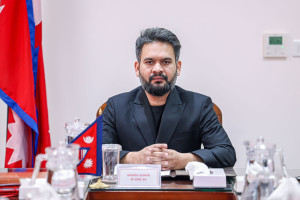
Four months after taking office, Prime Minister Balendra Shah has maintained almost complete distance from Sheetal Niwas, leaving his relationship with President Ramchandra Paudel virtually non-existent except mandatory official ceremonies.
Apart from swearing-in events and state functions, Shah has avoided direct meetings with the President. Major decisions—such as Cabinet reshuffles, the summoning and prorogation of parliament, and issuance of ordinances—have all moved forward without the traditional one-on-one briefings expected between the head of government and the head of state.
At Sheetal Niwas, the official residence of the President, officials view this behaviour as a clear noncompliance of established democratic practices. A senior official at Sheetal Niwas, speaking on condition of anonymity, confirmed that PM Shah has not visited to discuss governance, policy, or state affairs since taking his oath.
The official expressed disappointment over the government's failure to present the annual performance report of the Council of Ministers. “Past prime ministers personally submitted the Cabinet's annual report to the President before it was forwarded to parliament. The report for the previous fiscal year, which was due by mid-July, has still not been submitted,” said the official.
According to the official, the constitutional framework requires the prime minister to remain accountable not only to Parliament but also to the head of state. “The prime minister must personally inform the President about the law and order situation in the country, economic situation, diplomatic activities, Cabinet decisions, and bills under consideration in Parliament. This obligation applies to executive authorities and heads of constitutional bodies alike. That is the essence of constitutionalism. By ignoring these duties, the prime minister signals a disregard for our democratic system and the constitution itself.”
Article 81 of the constitution explicitly directs the prime minister to inform the President about Cabinet decisions, bills to be introduced in the federal parliament, specific details requested by the President, and current domestic conditions or foreign affairs.
Furthermore, Rule 36(A) of the Government of Nepal (Work Performance) regulationdetails nine specific areas for presidential updates. Beyond the four core constitutional points, these include treaties with foreign countries, the annual budget, major internal security developments, the government's policies and programmes, and decisions based on National Security Council recommendations.
While neither document sets a rigid timetable for face-to-face meetings, standard practice dictates that the prime minister consults the President whenever important national issues arise.
Recent unrest in Sunsari district offers a stark example. Under the governing rules, major security developments must be reported directly to Sheetal Niwas. Yet, rather than the prime minister providing the briefing, ruling Rastriya Swatantra Party Chairman Rabi Lamichhane visited President Paudel on Wednesday following an all-party meeting to discuss the situation. Lamichhane had previously briefed the President on June 8 after returning from India.
Opposition leaders have openly criticised the prime minister's behaviour. During Wednesday's all-party meeting, Nepali Congress chief Gagan Kumar Thapa voiced strong objections to the prime minister's conspicuous absence from key discussions.
The Prime Minister's Secretariat dismisses claims of friction. When asked via WhatsApp about the growing distance between the two leaders, Asim Shah, political advisor to the prime minister, offered a curt reply: "That is simply not the case."
Another member of the prime minister's secretariat rejected rumours that Prime Minister Shah had called for the President's resignation, calling such reports entirely baseless.
Despite those official denials, records show a growing physical and operational gap. Prime Minister Shah has visited Sheetal Niwas only six times over the past four months, with every visit strictly confined to mandatory state functions.
His visits include attending his own Cabinet swearing-in on March 26, the Speaker of the House of Representatives' oath on April 4, the National Assembly Vice-Chair's oath on April 6, a Cabinet reshuffle on the same day, Chief Justice Manoj Kumar Sharma's swearing-in on May 19, and a Cabinet reshuffle and portfolio reassignment on June 9.
No public record exists of any private meeting called by the prime minister to brief the President on national affairs.
Rajendra Dahal, former press advisor to Nepal's first President Ram Baran Yadav, considers the public debate over this gap deeply troubling for state stability.
“When the executive ignores the head of state, it reflects a collapse of trust. That inevitably pushes the country into further institutional breakdown,” said Dahal. “The prime minister serves as the President's chief political advisor and primary source of information. Without those briefings, the President is left completely uninformed, creating confusion at the highest levels of government.”
Dahal noted that convention requires the prime minister to meet the President at least once a month, even during quiet periods. “During crises, updates should occur daily. If the prime minister is unavailable, a Cabinet minister should be dispatched. The current lack of trust between these two key offices is a serious political problem.”
Key government moves have proceeded without direct consultation. On April 21, the cabinet decided to summon the second parliamentary session for April 30 and the President issued the call accordingly. But just two days later, the government abruptly asked the President to cancel the call, only to ask for another session on May 10 after issuing ordinances, including one on the Constitutional Council. Sheetal Niwas officials noted that the prime minister never met the President to explain the reasoning behind those sudden reversals.
President Paudel had explicitly sought a personal consultation regarding the Constitutional Council Ordinance. Sources confirm that Sheetal Niwas sent word to the prime minister's official residence in Baluwatar. After the prime minister declined to meet, the President sent the ordinance back on May 4, requesting reconsideration.
On May 5, Prime Minister Shah sent a written reply to the President's queries but still chose not to meet him in person. "An earlier version of the Constitutional Council Bill had been returned by the President to parliament,” said a senior presidential staff member. “When the ordinance arrived without addressing those original concerns, the President asked for a face-to-face discussion. The message was delivered, but the prime minister simply did not show up.”
In another departure from convention, the Cabinet decided that the President, rather than the prime minister, would deliver the official address on Republic Day. Former Chief Secretary Suman Aryal delivered the Cabinet decision directly to Sheetal Niwas without the prime minister's presence. Since the declaration of the republic in 2008, prime ministers had consistently delivered the address at Tundikhel. This year, President Paudel delivered it instead.
Constitutional experts emphasise that smooth collaboration between both offices is vital for parliamentary democracy. Senior Advocate Chandra Kanta Gyawali stated that executive actions must rely on close consultation. “The constitutional president performs duties based on the recommendation and consent of the prime minister. Regular meetings are necessary to review state actions, and because these consultations are political, they remain outside judicial review. The constitution requires a close working relationship between both offices. If they are not even meeting, it points to a serious rift that damages the parliamentary system.”




 14.81°C Kathmandu