Power sharing deal fails to break deadlock in Koshi, Bagmati and Sudurpaschim
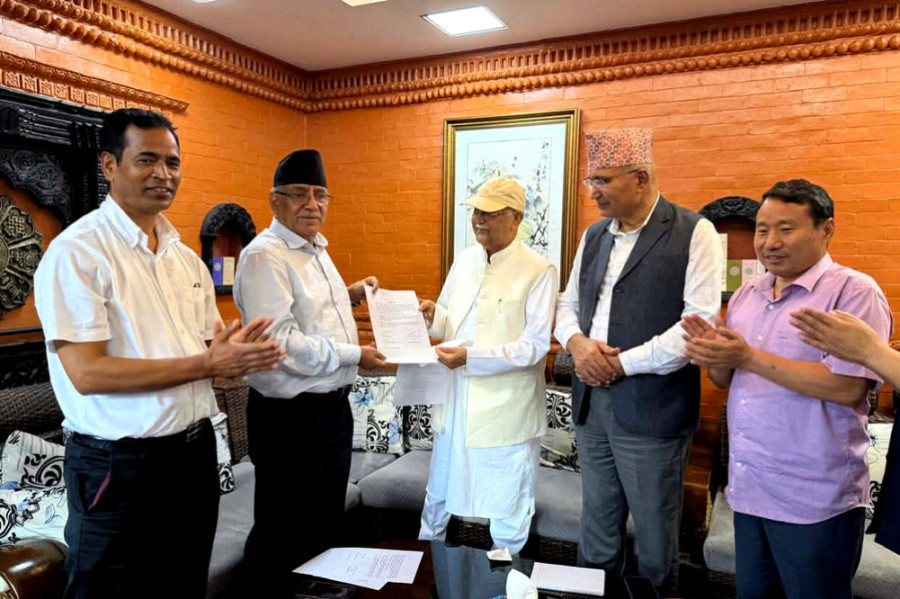
More than a week after the UML and the NCP agreed to restructure provincial governments, only Karnali has installed a new chief minister. NCP chair Pushpa Kamal Dahal (second left) and CPN-UML chair KP Sharma Oli seal a deal to form coalitions in the provinces in this July 25 photo. Photo: Courtesy of Pushpa Kamal Dahal's Secretariat
More than a week after the CPN-UML and the Nepali Communist Party (NCP) agreed on July 25 to restructure provincial governments in all provinces except Gandaki and Madhesh, only Karnali has installed a new chief minister. Political disagreements, coalition negotiations and constitutional concerns have delayed government formation in Koshi, Bagmati and Sudurpaschim.
The coalition agreement envisaged the UML leading the governments in Koshi and Bagmati and the NCP taking charge in Sudurpaschim. However, party insiders say internal disputes and difficulties in securing stable majorities have prevented the agreement from being implemented.
In Koshi, the biggest obstacle has emerged from within the UML itself. Party chairman KP Sharma Oli is understood to favour replacing Chief Minister Hikmat Kumar Karki with deputy parliamentary party leader Til Kumar Menyangbo. But several senior leaders have warned that removing Karki could create constitutional complications because he was appointed under Article 168(5) of the Constitution after securing majority support in the Provincial Assembly.
Karki insists there is no justification for replacing him unless the party makes an institutional decision.
"No serious questions have been raised about my performance as chief minister," said Karki. "There is not much time left before the next provincial elections. I believe continuity is appropriate. If the party still wants to replace me, it should do so through proper procedures."
Karki continues to enjoy the support of the Nepali Congress, whose backing enabled him to win a vote of confidence after his appointment. Within the UML, leaders are divided over whether replacing him could trigger constitutional uncertainty and pave the way for fresh elections if a new government fails to secure a vote of confidence.
According to party leaders, Oli has tasked UML secretary and Koshi in-charge Sherdhan Rai with resolving the dispute. Rai confirmed that discussions were continuing but said no final decision had been made.
"We are still discussing whether the current chief minister should continue," said Rai. "The party leadership has asked us to hold consultations before making a decision."
NCP Koshi parliamentary party leader Indra Angbo said the delay stemmed entirely from disagreements within the UML.
"We have already asked the UML to make an institutional decision on its chief ministerial candidate," said Angbo. "Government formation has been delayed because the UML has not resolved its internal differences."
The constitutional debate has become central to the negotiations. Article 168 provides different procedures for appointing a chief minister depending on the composition of the Provincial Assembly. UML leaders fear that replacing Karki without careful legal consideration could complicate the process of forming a new government and create fresh uncertainty in a province that has already experienced repeated political instability.
Coalition seeks RPP, other fringe parties
Coalition partners in Bagmati are focusing on securing a majority by bringing the Rastriya Prajatantra Party (RPP) and the Hamro Nepali Party into the new government.
The UML and the NCP have already agreed that the UML will lead the provincial government in Bagmati. In the 104-member Provincial Assembly, 53 lawmakers are needed for a majority. Together, the UML and the NCP command 51 seats.
However, UML lawmaker Apsara Chapagain serves as deputy speaker and cannot vote unless she resigns, making support from smaller parties crucial. UML chief ministerial candidate Jaganath Thapaliya said discussions with the RPP were progressing positively.
"If the RPP supports us, we will have a clear majority," said Thapaliya. "The party has shown a positive attitude towards joining the coalition government."
RPP parliamentary party leader Uddhav Thapa said his party had not ruled out joining the government.
"We have not decided against participating," said Thapa. "The central leadership has yet to make a decision, but discussions are continuing."
Hamro Nepali Party lawmaker Shailendraman Bajracharya said his party was also open to supporting the coalition if negotiations reached a conclusion.
CM Shah's resignation holds up new government in Sudurpaschim
In Sudurpaschim, coalition leaders are waiting for Chief Minister Kamal Bahadur Shah, a Nepali Congress leader, to resign before moving ahead with government formation.
The UML withdrew its support from Shah's government on July 15, leaving it in the minority. Shah subsequently dismissed four UML ministers from his Cabinet. Despite losing majority support, he has yet to step down.
The NCP has already chosen parliamentary party leader Khagraj Bhatta as its chief ministerial candidate.
"The new government can be formed as soon as the chief minister resigns," said Bhatta. "There are no disagreements between the NCP and the UML. We expect the chief minister to facilitate the transition."
Congress chief whip Saraswati Khadka, however, rejected suggestions that Shah was delaying the process.
"The UML and the NCP already have a clear majority," she said. "If they wish, they can stake a claim to form the government. The delay is not because of the chief minister. They may still have internal issues to settle."
The prolonged negotiations underline the challenges of implementing power-sharing agreements despite clear understandings at the federal level. Political bargaining, constitutional concerns and internal rivalries continue to shape provincial politics, reflecting the instability that has characterised several provincial governments since the federal system was introduced.




 15.34°C Kathmandu