Lumbini master plan remains unfinished after 48 years
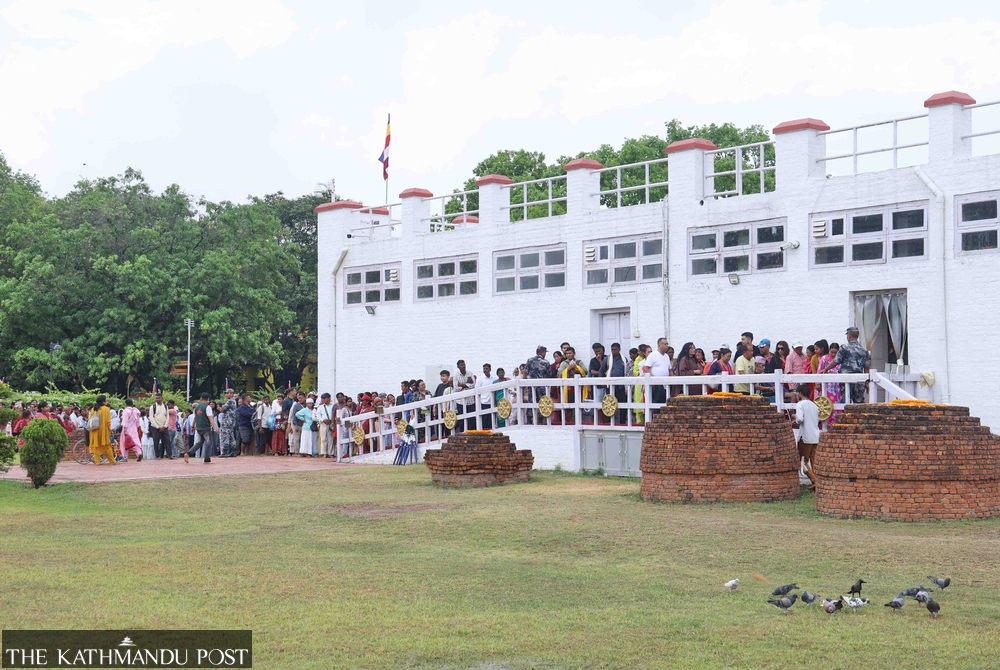
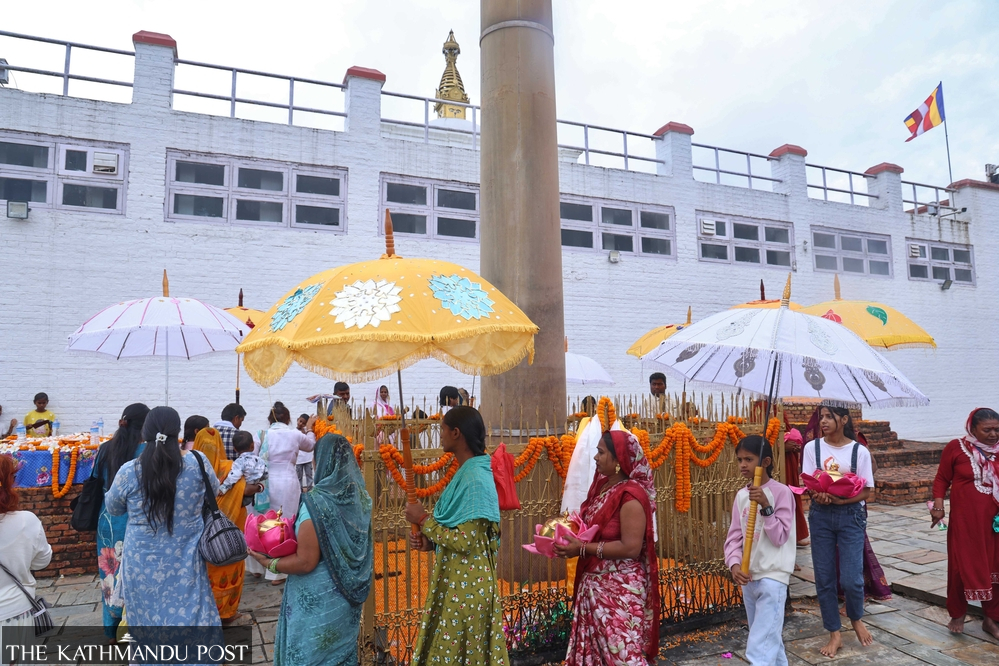
Stakeholders say legal hurdles, political interference, weak coordination slow efforts to develop Buddha’s birthplace into a global spiritual hub. Maya Devi Temple in Lumbini’s master plan area. Manoj Paudel/TKP
Nearly five decades after it was launched, the Lumbini Master Plan remains incomplete, missing its original timeline to transform the birthplace of the Buddha into a global centre of peace and spirituality.
The project, originally planned to be completed within 17 years, has now extended to 48 years, with key components still unfinished despite repeated commitments from successive governments and international partners.
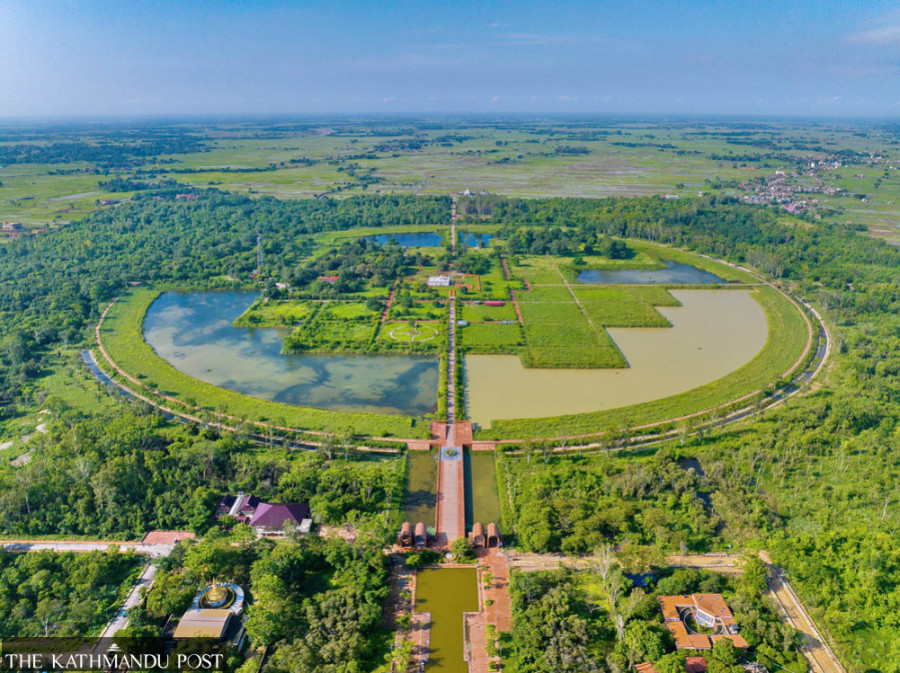
Prepared in 1978 by renowned Japanese architect Professor Kenzo Tange, the master plan covers an area of three square miles in the southern plains. Tange spent six years designing the blueprint, which was approved the same year by the then Lumbini Development Committee (now the Lumbini Development Trust). Implementation began soon after.
Since then, however, progress has been slowed. Officials at the Trust say discussions around the master plan have been frequent, but tangible outcomes on the ground remain limited.
Observers and stakeholders point to legal and procedural hurdles, political interference, weak coordination among agencies and resource constraints as the main factors behind the prolonged delays.
An attempt to speed up progress came in April 2021, when the Ministry of Finance, under then finance minister Bishnu Prasad Paudel, assured Rs7 billion in funding following lobbying. However, the release of funds has been inconsistent.
Although the project was initially expected to be tendered internationally, former vice-chairperson of the Trust Abhadesh Kumar Tripathi and project manager engineer Saroj Bhattarai opted to award contracts to domestic contractors. Following this decision, the Finance Ministry delayed disbursement of the committed funds.
In 2021, contracts worth Rs3.60 billion were awarded for the first phase. Full payments, however, have yet to be made. In the current fiscal year 2025/26, Rs410.9 million has been allocated, but according to accounts officer Bhim Basnet, a short of Rs600 million remains to settle existing liabilities.
A second-phase contract worth Rs2.89 billion was signed two months ago, but work orders have not been issued as the required budget has yet to be released by the Finance Ministry.
Slow progress
According to Trust Member Secretary Dipak Shrestha, more than 88 percent of the master plan has been completed. He said most of the remaining work could be finished if the second phase proceeds.
However, this claim has been questioned. In 2020, then member secretary Sanu Raja Shakya had said 84 percent of the work had already been completed. The marginal increase suggests that only about four percent progress has been made in six years.
“There is no scientific basis to determine the exact level of progress,” said expert Prahlad Yadav. “Each official interprets progress differently. It requires independent evaluation.”
The master plan incorporates Buddhist philosophy into its design, embedding symbolism of peace and harmony in its layout. While not always visible at first glance, researchers say the deeper structure reflects a carefully conceived spiritual narrative.
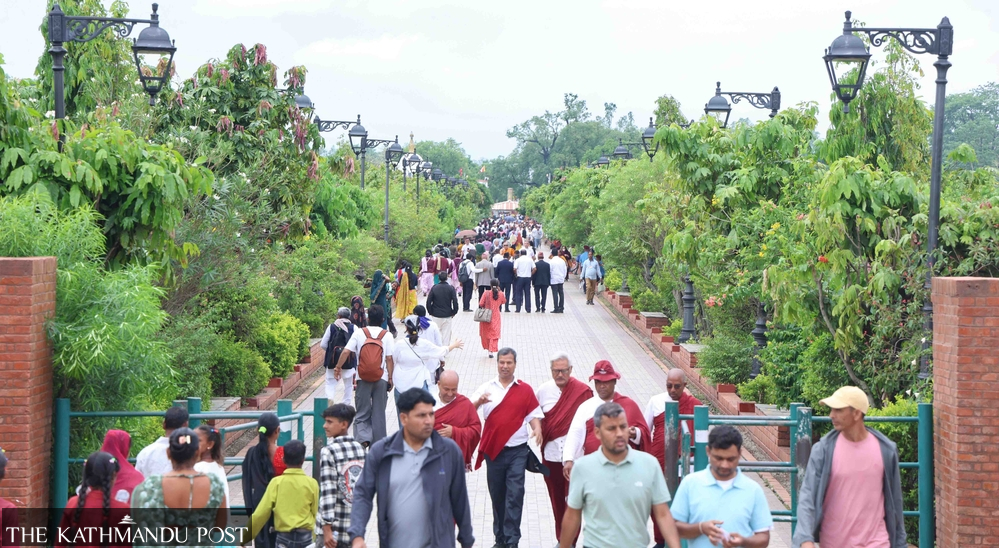
Several major components have been completed. These include landscaping of the Sacred Garden, construction of the central canal, a symbolic pavilion, and the north and south ponds.
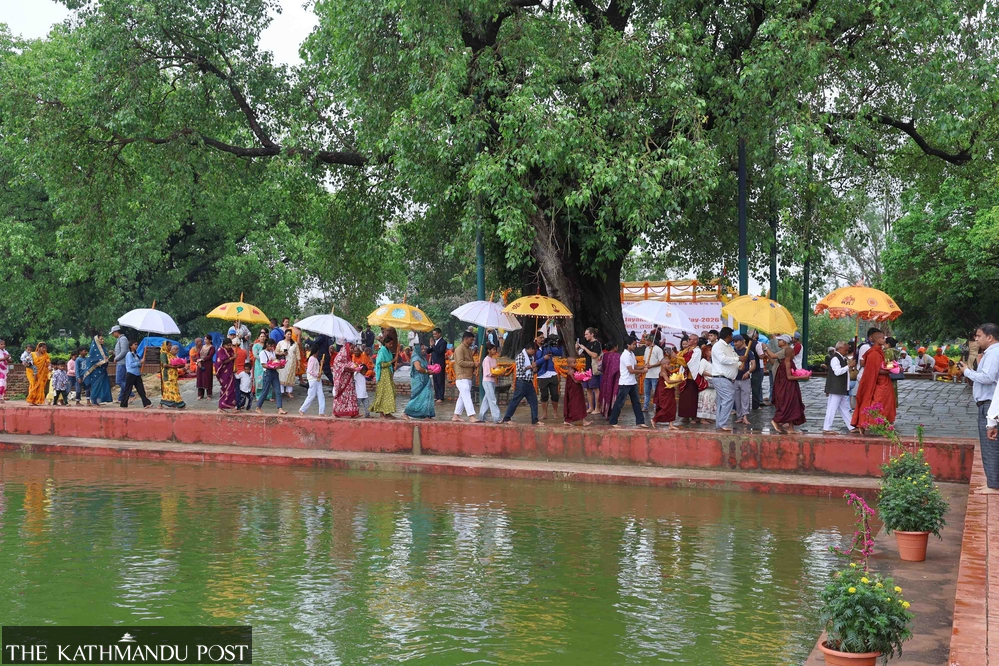
The Sacred Garden, located at the southern end of the site, remains the most significant area. It houses the Maya Devi Temple and the Ashoka pillar, along with archaeological remains from the Ashokan and pre-Mauryan periods, including ancient monastic ruins.
Green spaces around the World Heritage Site, smaller landscaped areas and staff housing have also been developed.
Between the Sacred Garden and the New Lumbini Village lies the International Monastic Zone, often described as a miniature global Buddhist landscape. Monasteries representing Theravada traditions are located to the east of the central canal, while Mahayana monasteries lie to the west.
Countries including Sri Lanka, Myanmar, Thailand and Cambodia have established monasteries on the eastern side. On the western side, China, Singapore, Japan, South Korea, France, Germany, Vietnam and Canada are represented. The diversity in architecture and artistic expression reflects a wide spectrum of Buddhist traditions.
Origins of the master plan
The efforts to develop Lumbini gained momentum after then United Nations Secretary-General U Thant visited the site in April 1967. Deeply moved by its neglected condition, he proposed a development initiative to King Mahendra Shah, who agreed to support the plan.
Thant subsequently raised the issue at the international level and secured backing from the United Nations. A mission of experts, including specialists in tourism, infrastructure and groundwater from the United Nations Development Programme and UNESCO, conducted detailed studies.
Based on their findings, Thant appealed to the international community at the United Nations General Assembly, leading to the formation of the Lumbini International Support Committee in 1970.
Initially comprising 13 countries, including Nepal, India, Japan and Sri Lanka, the committee later expanded to 16 members with the inclusion of South Korea, Bangladesh and Bhutan.
Thant invited Kenzo Tange to design the master plan, officially commissioning him in 1972. Tange visited Lumbini the same year and carried out extensive field surveys before submitting the final plan in 1978. The Government of Nepal approved it soon after.
The project was divided into two phases, with completion targets set for 1985 and 1995. Both deadlines passed without the project being completed.
Gaps remain
The master plan is structured around three main zones: the Sacred Garden, the International Monastic Zone and the New Lumbini Village. Much of the unfinished work is concentrated in the New Lumbini Village.
Planned structures such as a 420-seat U Thant auditorium and six large two-storey circular buildings remain unbuilt.
Basic infrastructure is also lacking. Management of the Harahewa river, which runs through the project area, remains incomplete. Facilities such as a primary health centre, souvenir shops, a bus park, a high school and restaurants have yet to be developed.
Crucial amenities for pilgrims, including accommodation, meditation spaces and areas for religious recitation, are still pending. Waste management systems have not been established, and a water tower and distribution network are yet to be constructed.
Although a colonnade structure designed to highlight Lumbini’s architectural identity has been completed, it is not operational.
Some facilities have been developed, including pilgrim guest houses such as Hokke, Kasai and Sri Lankan. Work on blacktopping roads, service roads, drainage systems and electrification is ongoing.
The master plan area spans approximately 1,055 bighas, or 770 hectares, stretching one mile east-west and three miles north-south.
Why progress has stalled
Observers cite a combination of political interference, weak institutional leadership and vested interests as key obstacles.
Former provincial assembly member Fakhruddin Khan said the governance system remains outdated. He pointed to frequent policy shifts, political appointments and the practice of replacing officials with each change in government as major concerns.
Khan said the Trust is now struggling with overstaffing, while transparency and quality control remain weak. “I have repeatedly called for a public audit of the Trust’s work, but there has been no response,” he said. “Ignoring local representatives has reduced accountability.”
Local resident Arjun Kurmi accused the Trust of arbitrary decision-making and called on the new government to intervene.
Lila Mani Sharma, president of the Lumbini Hotel Association, said the Trust often fails to coordinate with local stakeholders, further weakening accountability.
Concerns have also been raised over irregularities, including reports of fake ticket sales, unauthorised objects placed inside the Maya Devi Temple, and construction activities that violate the master plan.
Questions have also emerged over financial practices, including the charging of entry fees to Nepali visitors.
Frequent protests and unrest have further undermined Lumbini’s image as a peaceful destination.
“Turning Lumbini into a political arena is a mistake,” said Bhikkhu Maitri Mahasthavir, former chair of the All Nepal Bhikkhu Association. “Development will not be possible unless it is freed from politics.”
Buddhist teachings emphasise Lumbini as one of four sacred pilgrimage sites, alongside the place of enlightenment, the site of the first sermon and the place of nirvana.
Bhikkhu Siribajir, associate professor at Lumbini Buddhist University, said it is deeply concerning that such a significant site remains neglected. He urged authorities to protect Lumbini’s heritage and called on people to visit at least once, recognising its global spiritual importance.
Despite its status as a UNESCO World Heritage Site and a symbol of peace, Lumbini continues to fall short of its envisioned transformation.




 15.09°C Kathmandu