Tourism surge spills into security concerns along Nepal border towns
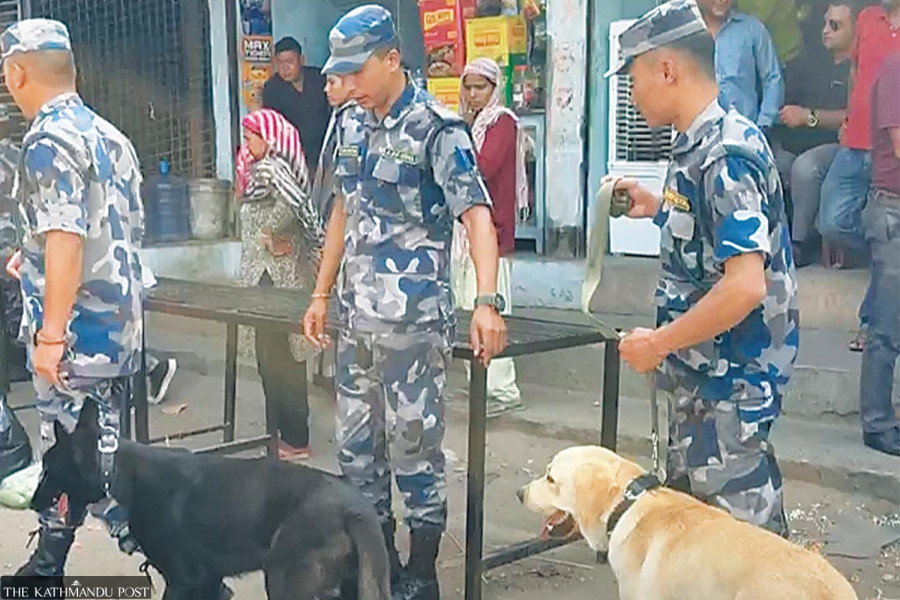
Rowdy behaviour, cross-border crime and weak monitoring along the open border are posing growing challenges for local authorities in border districts. Armed Police Force personnel with sniffer dogs at Jamunaha border point in Nepalgunj recently. Rupa Gahatraj/TKP
The growing number of Indian visitors travelling to Nepal’s border towns for gambling and alcohol consumption is emerging as a security concern for local authorities.
Police say the open border makes it difficult to regulate movement, while long-standing social and family ties between communities on both sides have further blurred the no-man’s-land in several border areas.
For decades, nationals from India and Nepal have crossed the border for family visits, work and trade. In recent years, however, border towns in Nepal have increasingly developed into centres for cross-border tourism, with hundreds of Indian nationals arriving daily to visit casinos, hotels and liquor outlets.
While the influx has boosted local businesses and tourism revenue, police say it has also led to a rise in criminal incidents, with suspects often slipping back across the border to India immediately after committing offences.
One such incident took place in the early hours of November 13, 2025, when a shooting inside Hotel Nirvana Luxury International in Bhairahawa injured one person. According to Rupandehi police, the shooting followed a dispute between two groups visiting the casino. CCTV footage showed an Indian national opening fire before fleeing the scene. Police have yet to recover the weapon used in the attack.
Superintendent of Police Janak Bahadur Shahi of Rupandehi district police, said Indian visitors entering through the border for casinos and nightlife have not yet created a major organised security threat, although isolated incidents continue to occur.
“A shooting incident did occur inside a casino recently, but that alone does not mean the district is facing a permanent security problem,” Shahi said. “We are monitoring the situation closely and increasing vigilance where necessary.”
Netra Prasad Acharya, president of the Siddhartha Chamber of Commerce and Industry, said incidents involving intoxicated visitors occasionally create public concern, but security agencies have so far managed the situation.
“We should welcome tourists respectfully, but security checks at border points also need to be effective,” Acharya said. “If screening is carried out properly at entry points, unnecessary problems later can be avoided.”
He said Indian visitors should not be harassed in the name of security checks, adding that most disturbances stem from isolated incidents involving drunken individuals.
Residents living near border points, however, say the situation has increasingly affected daily life. Rupa Pun, chairperson of a local mother’s group in Darakhashwa in ward 3 of Siddharthanagar Municipality near the Sunauli-Belahiya border point, said some Indian visitors entering local bars and spas often harass women and girls in the area.
“Some men use abusive language, harass girls and try to lure them with money,” Pun said. “Young women returning from college or tuition classes often feel unsafe.”
Further west in ward 10 of Dodhara Chandani Municipality in Kanchanpur, a group of intoxicated Indian nationals vandalised a house and assaulted local residents on February 27 before fleeing after looting cash from the settlement. The dispute was later settled through mediation involving security personnel and local representatives from both sides of the border.
The incident came just two months after another clash involving intoxicated Indian visitors in Kutiyakabar in the same ward. Locals say such incidents have become increasingly common in settlements along the border.
Authorities and residents say the availability of alcohol in Nepal continues to draw large numbers of Indian nationals, especially from bordering Indian states, often resulting in fights and disturbances. The issue is particularly visible along the 129.5-kilometre border Kanchanpur shares with India, covering Bhimdatta, Dodhara Chandani, Belauri and Punarbas municipalities, along with Beldandi Rural Municipality.
“Many people cross the border to drink and some of them get involved in fights,” said Kishor Limbu, mayor of Dodharad Chandani Municipality. “Some come specifically to create trouble, while others are attracted by cheap alcohol.”
Limbu said the growing liquor trade in border areas was affecting both security and social harmony.
Police say many liquor outlets operating in border settlements sell homemade alcohol without registration. Superintendent of Police Khadak Bahadur Khatri, chief of Kanchanpur police, said the illegal liquor trade has added to policing challenges.
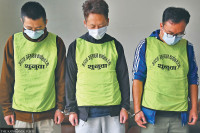
The problem is not limited to street brawls. On September 8, 2025, 26-year-old Pradeep Sharma from Jharkhand shot 18-year-old Nisha Kumari from Bihar inside a hotel near the customs area in Birgunj-16. The bullet injured her. Police later said the incident followed an argument after drinking. Sharma was arrested.
Police in Parsa say the alcohol ban in the neighbouring Indian state of Bihar has significantly increased the number of Indian youths crossing into Nepal to drink. Many offenders manage to escape across the border before police can verify their identities.
Large numbers of Indian visitors continue to frequent liquor shops, restaurants, hotels and casinos in Birgunj and surrounding areas. The trend has also spread to nearby districts, including Bara and Makwanpur.
Deputy Superintendent of Police Bikash Adhikari, chief of the Armed Police Force’s Customs Security Unit in Birgunj, said the situation remains under control despite the steady inflow of visitors.
“The Nepal Police have instructed liquor outlets in border areas to close by 8 pm,” Adhikari said. “We are also coordinating with the metropolitan city to remove illegal liquor shops operating directly along the border.”
He added that security agencies have recently noticed Indian smugglers increasingly using Nepali minors to transport popular Nepali liquor brands such as Ambition and Kasturi into India.
Heera Shrestha, operator of Hotel Delight Go in Birgunj, said the local hospitality sector heavily depends on Indian customers.
“From small restaurants to casino hotels, businesses here rely largely on Indian visitors,” Shrestha said. “Although road expansion work has recently affected business activity, Indian tourists remain the backbone of the local hospitality industry.”
In Rautahat, residents say movement across the border trails increases sharply after dusk as groups of Indian nationals enter Nepal to consume alcohol. Narendra Sah, a resident of Mahadevpatti in Gaur-2, said many liquor shops in the area cater specifically to Indian customers.
“If people came quietly, drank and returned, there would be fewer problems,” Sah said. “But fights often break out after drinking, creating insecurity in the community.”
Locals say drunken behaviour, verbal abuse and physical altercations have become common in border settlements, but business owners continue operating because of the profits involved.
Deputy Superintendent of Police Bishnu Pradip Basyal, spokesperson for Rautahat police, said police regularly conduct surprise checks in border markets.
“Some individuals involved in criminal activities also try to cross the border under the pretext of visiting for drinking,” Basyal said. “That increases security challenges, so we have stepped up patrols in border areas.”
Security officials say cross-border alcohol trade is often linked to other crimes, including theft, smuggling and drug trafficking.
A similar situation can be seen near the Maryadpur border point in Kapilvastu, where liquor shops become crowded in the evenings. Residents say Indian border guards are aware that most visitors crossing into Nepal are coming to drink alcohol.
More than 15 retail liquor shops and five wholesalers operate in Maryadpur alone. Business owners say most customers are Indian labourers seeking cheap Nepali liquor.
“Most customers buy low-cost liquor priced between Rs30 and Rs60 per serving,” said Shyam Yadav, owner of Kamala Liquor Store. “Business is good because almost all customers are from India.”
Hari Prakash Chaudhary, who runs Abhimanyu Restaurant, said nearly 90 percent of his customers are Indian nationals. Similar crowds gather in border areas such as Krishnanagar, Chakalchauda, Rangapur, Hathihawa-Dohani and Kushahwa-Badhni.
Deputy Superintendent of Police Ripendra Kumar Singh, spokesperson for Kapilvastu police, said the increasing movement across the border has made policing more difficult.
Businesspeople and residents in Nepalgunj have also raised concerns about rising security risks linked to Indian visitors arriving for gambling and alcohol consumption. While casinos and hotels have boosted the local economy, some fear criminal elements are exploiting the open border.
Krishna Prasad Shrestha, a businessman in Nepalgunj, said open-border vulnerabilities are beginning to affect the wider tourism sector.
“We have noticed the cases involving weapons, narcotics and human trafficking linked to border areas,” Shrestha said. “Security agencies and the local administration need to take the issue seriously.”
He said the rapid expansion of casinos and hotels in Banke and Bardiya has increased Indian tourist arrivals, but warned that criminals could also misuse the same route.
“We should not treat every tourist with suspicion,” he said. “But authorities must ensure that criminal groups do not exploit the open border and the hospitality sector.”




 12.97°C Kathmandu