Chaos at Bir Hospital after office-bearers removed
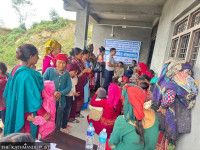
No reagents available for crucial tests, CT scan services halted for a month, and the hospital pharmacy is running short of most medicines. People wait outside the radiology department at Bir Hospital on April 27. Removal of dozens of administrative officials by the government in May has disrupted essential services at Bir Hospital due to unpaid bills, supply shortages, and procurement delays. Suryams Upreti/TKP
Some two weeks ago, a man in his late 30s was brought to Bir Hospital’s emergency department, after complaining of severe chest pain. Doctors in the ward examined the patient and concluded that a prothrombin time/international ratio (PT/INR) test is required to monitor blood-thinning medication.
However, the hospital had not procured the reagent required for the test for a long time, so the test was not carried out. The patient, who suffered a massive heart attack and felt restless, was placed in an emergency bed, which two other patients already shared. The patient died after half an hour.
“After death, a kind of chaos engulfed the hospital. It took two days for the relatives of patients to convince them to take the body,” said a doctor serving at the emergency department, asking not to be named as he feared retribution for speaking out. “I don’t know much about the agreement they reached, but relatives were demanding a job for a family member at the hospital and compensation.”
Along with PT/INR, the hospital’s CT-scan service has been halted for weeks. The hospital’s pharmacy does not have most of the medicines—not even envelopes or plastic bags needed to pack them.
The list of complaints is long. Dental prosthetic service has been halted. Nurses are requesting patients' relatives to provide gloves and face masks for use.
Experts say that the absence of PT/INR results may delay some treatment decisions. Without them, doctors cannot accurately determine whether the patient’s blood is over-anticoagulated, which increases the risk of bleeding or makes it harder to decide on treatment.
Around 90 patients used to get CT scans at the hospital every day. Patients could get the service at Rs2,500 to 4,000 at the hospital, but due to a halt in service at the hospital, they have been forced to pay up to Rs9,000 at a private facility. Patients have to wait until October to undergo a magnetic resonance imaging (MRI) scan at the hospital or get it done at a private clinic, paying twice the charge.
Both elevators at the hospital have been out of service, worsening the plight of patients. Several beds in the hospital's intensive care unit are not in use, which means seriously ill patients are forced to seek intensive care at a private hospital, which is much costlier than the charge at Bir. Contract employees and hundreds of resident doctors have not been paid their salaries and monthly allowances for two months, which forced the staffers to protest.
What concerns doctors and hospital officials more is the number of patients, which has almost doubled following the halt in health insurance services at the Shahid Gangalal National Heart Centre, the Tribhuvan University Teaching Hospital, the Manmohan Cardiothoracic Vascular and Transplant Centre, and private hospitals.
Contractors have stopped supplying medicines, devices and reagents to the hospital as their dues remain unpaid for long.
“We are trying to reduce the problems and ease the suffering of patients,” said Dr Prakash Budhathoki, spokesperson for the hospital. “We have already contracted representatives of the company that supplied us with the CT-scan machine, and we will fix the problems at the earliest.”
Budhathoki conceded a lack of medicines in hospital pharmacies, long queues of patients for MRI, a lack of reagents for PT/INR tests and plastic bags, and the failure to pay contract workers and resident doctors. But he denied doctors’ negligence in the death of a young patient at the hospital’s emergency department, a lack of PT/INR tests at the hospital and having placed multiple patients in a single emergency bed.
“We are in regular touch with officials at the health ministry and will provide salary once the ministry allocates us the budget for the contract health workers it sent to Bir Hospital,” said Budhathoki. “Allowances of resident doctors will be given once the Medical Education Commission releases the amount.”
An official at the hospital said that a verbal agreement had been reached with the relatives to give priority in jobs to the deceased’s family member in future, when vacancies open at the hospital. They had agreed to take the body for funeral only after the understanding.
Associate Professor Dr Prabha Chapagain Koirala, acting director at the hospital, said she had not started any new work since assuming that role.
“I have tried to continue the regular work, as I am appointed for a short term,” said Koirala. “We are facing a shortage of reagents for the PT/INR test, as their procurement was missed in the previous tender. We have initiated the process, and they are likely to be supplied by next week.”
On the health insurance issue, she said the hospital has yet to get around Rs800 million in reimbursements.
An official at the hospital said that previous office bearers simply ordered emergency medicines, reagents, and consumables—gloves, masks, and others—and the contractors also supplied in the hope of getting paid later.
But with the government removing office bearers—director, vice-chancellor, rector and registrar—and suppliers worried about their past dues, problems in procurement have persisted. The new acting director is said to be unwilling to take the risk of placing new orders.
Office-bearers at the National Academy of Medical Sciences, which runs Bir Hospital, were removed after the Rastriya Swatantra Party government introduced an ordinance to sack officials appointed by earlier governments.
Arjun Poudel is a health reporter for The Kathmandu Post. Before joining the Post, he worked for Sagarmatha Television, Naya Patrika, Republica and The Himalayan Times.




 13.68°C Kathmandu