Nepal’s postal service searches for a new role in the digital age
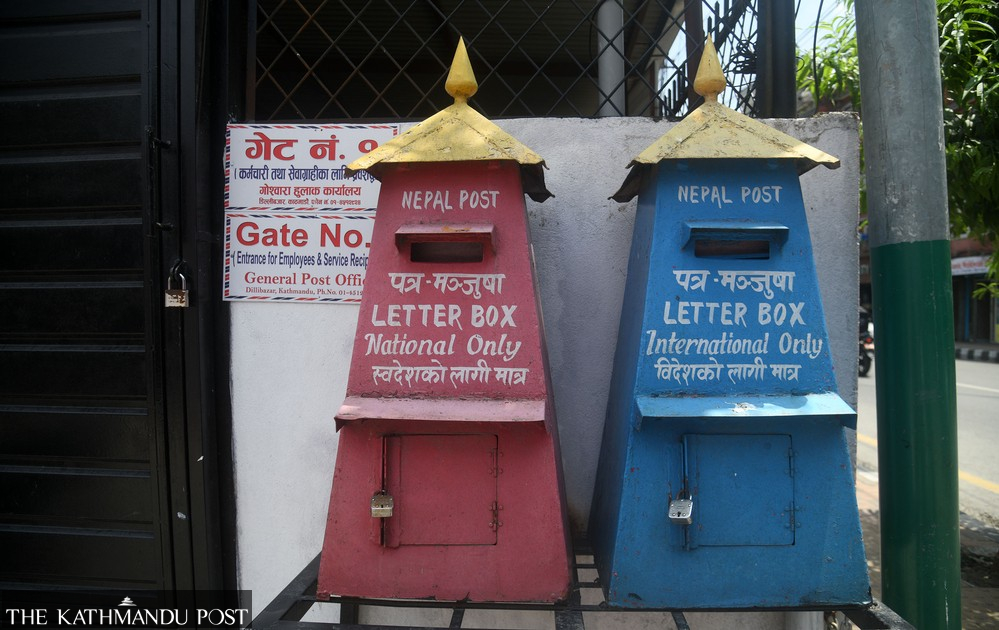
Once the backbone of communication, the postal system now relies largely on government business.A man walks in front of the General Post Office at Dilli Bazar in Kathmandu on Sunday. Deepak KC/TKP
When a fire swept through the Supreme Court complex during the September 9 protests, large sections of the building were destroyed. Courtrooms were damaged, offices were gutted, and countless legal records were lost.
Yet one small corner survived almost untouched.
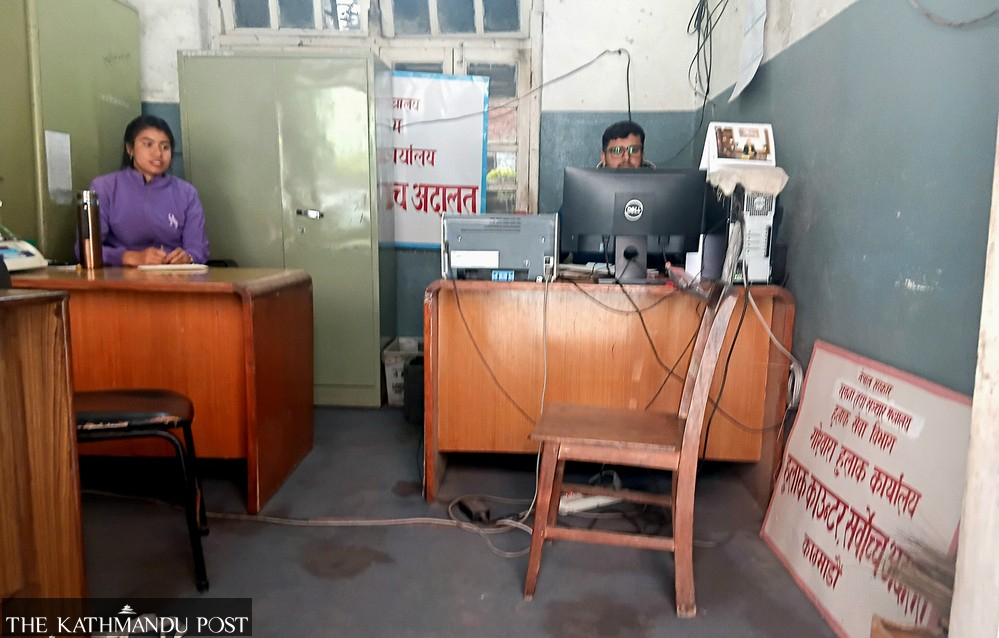
A modest postal counter tucked inside the court compound remained standing. A half-filled blue water jar still rests near its entrance. Its signboard lies on the floor beside a narrow doorway. Surrounded by blackened walls and fire-scarred corridors, the tiny room continues to perform a task that remains essential to Nepal’s judicial system.
From here, court documents continue to travel between the Supreme Court, high courts and district courts across the country.
Inside the office, Hridayanarayan Jha, a non-gazetted second-class officer, and postman Manisha Tharu carry out the daily work of dispatching case files, court orders and official correspondence.
Following the 2015 earthquake, the counter was moved from a location near the Office of the Attorney General to its current space. As construction of the Supreme Court’s new building nears completion, preparations are underway to relocate it again.
Jha has worked at the counter for eight years. Tharu joined two and a half years ago.
Their responsibilities extend well beyond the small room in which they work. They help ensure that documents exchanged among courts in all 77 districts reach their destinations safely and on time.
“We don’t handle documents within Kathmandu Valley,” Jha said. “But when documents need to be sent outside the Valley, we arrange delivery so that they reach the respective courts within seven days.”
If court orders and case files fail to arrive on time, judicial proceedings can be delayed. Though rarely noticed by the public, the postal service remains a vital administrative link connecting courts throughout the country.
The work itself has changed considerably over the years.
Until recently, incoming mail was registered manually. Receiptswere written by hand. Every envelope required a postage stamp. Tracking a document often meant making phone calls or contacting another office directly.
Today, much of that process is digital.
“Earlier, we had to put stamps on every letter,” Jha said. “Now we use software with tracking numbers. We can see where a document has reached.”
The small office inside the Supreme Court reflects a broader transformation taking place across Nepal’s postal network.
For generations, the postal service carried personal letters, greetings and family news. Today, those functions have largely disappeared. Mobile phones, internet access and social media have replaced handwritten correspondence.
But the decline of personal mail has not made the post office irrelevant. Instead, its role has shifted.
The postal system now handles much of the exchange of official government documents. Through its Government Courier Service, the Department of Postal Services transports papers between government agencies and increasingly delivers state-issued documents directly to citizens.
According to Jamuna Mishra, a director at the department, the postal service is now being positioned as a key component of public service delivery.
The small office inside the Supreme Court reflects a broader transformation taking place across Nepal’s postal network. Post Photo
Bringing government services closer to citizens
For years, the postal service transported passports from the Department of Passports to 33 district administration offices.
Its responsibilities have since expanded.
As part of efforts to modernise public services, the government has been developing the postal system into a nationwide government courier network capable of delivering official documents directly to people's homes.
The aim is to make services such as passports, citizenship certificates, driving licences and other government-issued documents more accessible.
According to Mishra, the government courier service currently operates in 61 districts.
“We have already started delivering passports directly to people's homes in many districts,” she said.
Of the 7,916 passports handled through the service so far, 2,626 have been delivered directly to recipients.
The initiative gained additional momentum after the government formally decided on April 16 to modernise the postal service and expand the government courier service.
Mishra said the department had been performing many of these tasks long before they were formally included in government plans.
“The postal service never stopped working,” she said. “Many people simply were not aware of the services we were providing.”
Yet government documents were only one part of the postal service’s long history.
For much of the twentieth century, letters carried personal stories, family news and emotional connections across vast distances.
For 78-year-old Rangalal Upadhyaya, those memories remain vivid.
Upadhyaya moved from Doti to Kailali in 1965. At the time, communication between distant relatives often depended entirely on the post office.
Many men from western Nepal travelled to India for work. Letters were often the only means of contact between families separated by hundreds of kilometres.
A letter could take more than a month to arrive.
Receiving a reply required even more patience.
People waited anxiously for the arrival of the postman, hoping for news from their dear ones or relatives living far away.
In the late 1960s and early 1970s, a postage stamp cost only 10 to 20 paisa.
Rules governing delivery were strict. Recipients were generally required to sign before receiving letters. If the intended recipient could not be found, the letter was returned.
Upadhyaya recalls one incident that captures the slow pace of communication at the time.
His uncles once sent a letter to a relative in India informing him that they were coming to visit.
The traveller arrived before the letter.
Nearly two weeks after the visit had ended and the guest had returned home, the letter finally reached its destination.
The memory still makes Upadhyaya laugh.
Today, he says, mobile phones allow people to communicate instantly, but something has been lost along the way.
The excitement of waiting for a letter and the personal touch of handwritten correspondence have largely disappeared.
More than a century of history
Nepal’s postal service has a history stretching back nearly 150 years.
Long before modern postal networks emerged, rulers relied on pigeons, horses and messengers to transmit information.
The institutional postal service began in 1878 during the premiership of Ranodwip Singh with the establishment of Nepal Hulak Ghar.
Later, Nepal joined the Universal Postal Union, linking its postal network to the global system.
Successive laws, including the Postal Act of 1954 and the Postal Service Act of 1962, provided the legal framework for postal operations.
For decades, postmen carried letters, newspapers, government notices and money orders across the country.
Among them was Baburam Bharati of Bhojpur.
Now 61, Bharati spent more than 37 years as a postman before retiring in May 2023.
His career coincided with enormous political and social change.
He worked through the Panchayat era, the restoration of multiparty democracy, the Maoist insurgency and the transition to a republic.
In those days, carrying mail often meant walking for days through steep hills and remote settlements.
Delivering letters from Bhojpur to Dhankuta involved a three-day journey on foot.
Routes through Pyauli, Leguwa and Hile became familiar terrain.
Even though letters sometimes took weeks to reach recipients, people waited eagerly.
“There was always anticipation,” Bharati said.
The post office did not deliver only happy news.
During the Maoist conflict, postmen sometimes carried letters demanding donations or extortion payments from local businesspeople.
Bharati remembers merchants becoming visibly nervous whenever postal staff appeared.
“They feared we were bringing letters demanding money,” he recalled.
As labour migration increased, the nature of the mail also changed.
After the early 1990s, increasing numbers of international letters arrived from countries where Nepalis had gone for work.
Many contained news from family members living abroad.
The postal service also handled financial transactions.
Under the insured mail system, cash could be sent through specially secured envelopes stitched with thread and sealed with wax.
Money orders provided another trusted means of transferring funds.
In many places, the post office functioned as an essential financial service long before modern banking became widespread.
A service adapting to change
Technology has transformed the postal service more dramatically than any other factor.
Personal letters have almost disappeared.
According to Nima Rai Basnet, a 33-year-old postman in Bhojpur who has worked in the service for 17 years, mailbags now contain very different items.
When she joined the service, personal correspondence remained common.
Today, much of the mail consists of notices from banks and microfinance institutions regarding loan repayments, as well as verification codes and documents linked to digital services.
The change reflects wider shifts in Nepali society.
Once the country’s primary communication network, the postal service now plays a more specialised role.
In some districts, postal offices even use social media to locate recipients whose addresses are incomplete or outdated.
On June 3, for example, the District Post Office in Chitwan posted a notice on Facebook seeking a recipient after a letter could not be delivered at the listed address.
Despite the decline in personal correspondence, postal workers say official documents and institutional mail continue to generate significant workloads.
In some districts, postal offices even use social media to locate recipients whose addresses are incomplete or outdated. Post Photo
The larger challenge lies elsewhere.
According to postal officials, limited resources and outdated systems have prevented the service from realising its full potential.
Chintamani Regmi, postal officer at the District Post Office in Salyan, believes the institution must undergo major reform if it is to remain relevant.
“The post office carries a long history,” he said. “It now needs to be modernised and developed as a commercial service. The institution should survive even if the structure changes.”
One major obstacle is transportation.
The postal service lacks sufficient vehicles of its own and often depends on other means of transport.
As a result, deliveries can be slow.
A package sent from Salyan to Kathmandu may take between seven and fifteen days to arrive.
Private courier companies often complete the same journey within two days.
“When private couriers are delivering much faster, it becomes difficult for us to compete,” Regmi said.
He believes the postal service would have remained more central to public life had it been integrated earlier into programmes such as the distribution of social security allowances.
Despite these difficulties, officials point to one advantage that private couriers cannot easily replicate.
The postal service possesses a nationwide network extending deep into rural Nepal.
No other organisation has comparable reach.
A nationwide network
The Department of Postal Services currently operates under the Ministry of Communication and Information Technology.
Its network includes the General Post Office and the Postal Training Centre at the central level, six regional postal directorates, 70 district post offices and 676 local-level post offices.
Meanwhile, 3,074 additional post offices established in previous decades are being phased out under government policy.
The department now offers parcel services, philatelic services, Express Mail Service, mobile services within Kathmandu Valley and digital tracking systems that allow users to monitor deliveries online.
The financial contribution of the postal service has also increased.
According to department spokesperson Sapana Kumari Bhattarai, annual revenue has more than doubled over the past five fiscal years.
Revenue rose from Rs240.9 million in the fiscal year 2020-21 to Rs685.7 million in 2024-25.
Officials attribute much of this growth to government requirements that official documents be registered and dispatched through the postal system.
The department also operates its own digital platform, known as the Post Internal Tracking System, enabling users to track consignments remotely.
Postal officials argue that further investment could significantly improve performance.
They say a dedicated fleet of 15 to 20 vehicles would greatly reduce delivery times and allow the service to compete more effectively with private courier companies.
Membership in the Universal Postal Union also provides access to a global network that could be used more effectively.
Officials believe the postal service could become an affordable option for millions of Nepalis living abroad if customs procedures and international shipping regulations were simplified.
The future of the institution, they argue, depends on diversification, professionalisation and technological modernisation.
Government policy appears to support that direction.
The government’s latest Policies and Programmes include commitments to modernise, diversify and digitise postal services as part of broader reforms in the communication sector.
However, while policy documents emphasise digital transformation, postal officials note that the latest budget contains no major investment plan capable of accelerating that transition.
For now, Nepal’s postal service remains caught between two eras.
The age of handwritten letters has largely passed. Yet the institution that once carried news, affection and hope across mountains and plains continues to serve a different purpose.
From a small counter inside the fire-damaged Supreme Court complex to remote post offices scattered across the country, the network remains active.
Its challenge now is not survival alone, but finding a place in a rapidly changing Nepal.




 13.9°C Kathmandu