Nepal’s diplomatic reach narrows as key envoy vacancies drag on
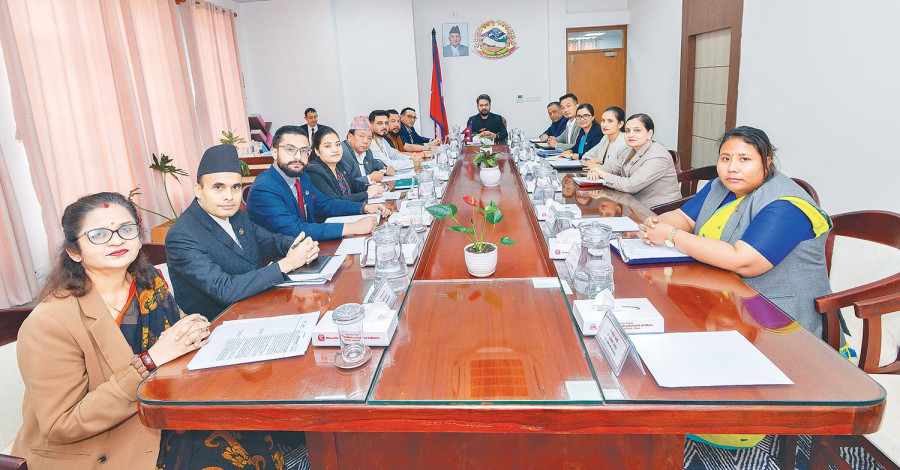
Ambassadorial posts in 21 countries are vacant or in transition. This has limited Nepal’s access to senior officials and its ability to advance key political, economic and strategic interests. Prime Minister Balendra Shah (at the head of the table) chairs a cabinet meeting, Tuesday. The government has yet to appoint envoys to 21 countries. RSS
Nepal’s practice of recalling ambassadors after changes of government, followed by long delays in appointing replacements, has left its diplomatic network facing a crippling leadership vacuum.
Ambassadorial posts in 21 countries are either vacant or in transition, including some of Nepal’s most important missions. Nepali envoys have been absent from 11 countries for the past 10 months, while six other missions have remained without ambassadors for four months. The four-year terms of career diplomats serving in seven more countries ended on July 21.
The vacancies have affected Nepal’s representation in the United States, China, India and other countries that are central to its political, economic and security interests.
Missions in Washington, Beijing, Berlin, Tel Aviv, Kuala Lumpur, Doha, Moscow, Riyadh, Madrid, London and Tokyo have lacked resident ambassadors since the Sushila Karki-led government issued a blanket recall on October 17.
The recalled ambassadors were among 17 political appointees nominated on July 29, 2024, by the government led by then-prime minister KP Sharma Oli, which was backed by the Nepali Congress and CPN-UML.
The recalls continued after Prime Minister Balendra Shah’s government came to power. On April 5, it recalled ambassadors serving in India, Australia, Sri Lanka, South Korea, Denmark and South Africa, less than two weeks after taking office.
The repeated recalls reflect a long-standing pattern in Nepal, diplomats say, whereby changes in government are followed by the removal of political appointees abroad, often without timely appointments of successors.
A separate group of career diplomats from the Ministry of Foreign Affairs has also entered a period of uncertainty. Ambassadors to Austria, Bangladesh, Bahrain, Egypt, Myanmar, Oman and Brazil completed their four-year, non-renewable terms on July 21.
The Cabinet on July 22 allowed the career diplomats to continue working on an interim basis until new ambassadors are recommended and receive agrement, or formal approval, from their host governments. The exception is Brazil, where the current ambassador’s term runs until October 17.
The situation has been further complicated by the government’s decision to close three missions. In its budget speech on May 29, it said the embassies in Brazil, Denmark and South Africa would be shut as part of an expenditure review. But none has yet been formally closed.
With those three missions excluded, the government now needs to nominate and appoint ambassadors to 21 missions.
The prolonged vacancies are weakening Nepal’s ability to pursue its political, economic and strategic interests abroad, diplomats and foreign-policy experts say. With ambassadors absent from some of the country’s most important missions, Kathmandu is increasingly relying on chargé d’affaires and back-channel diplomacy at a time when relations with major powers require sustained, high-level engagement.
Under Nepal’s Constitution, ambassadors are appointed by the President on the recommendation of the Council of Ministers after parliamentary approval.
Former secretary Arjun Bahadur Thapa, also former secretary-general of SAARC, said prolonged vacancies sent damaging signals to host countries.
“Leaving an ambassadorial position empty for an extended duration implies one of two things to the receiving state: either that bilateral relations have deteriorated, or that Nepal simply does not assign priority to that country,” Thapa said.
“Recalling envoys whenever there is a political change at home and failing to send replacements in a timely manner has become a chronic practice in Nepal.”
The consequences have become particularly visible during high-level diplomatic engagements.
Foreign Minister Shisir Khanal visited India from June 5 to 7 at the invitation of Indian External Affairs Minister S Jaishankar, before travelling to China from June 14 to 17 at the invitation of Chinese Foreign Minister Wang Yi.
Foreign Ministry officials said the absence of resident ambassadors in New Delhi and Beijing hampered preparations for both visits and also limited preliminary agenda-setting and Nepal’s ability to identify and pursue key issues in advance.
The absence of an ambassador was also conspicuous during Rastriya Swatantra Party chair Rabi Lamichhane’s five-day visit to India in June.
Indian authorities gave the visit considerable political attention, arranging meetings with Prime Minister Narendra Modi, Home Minister Amit Shah and Jaishankar, among others. But Nepal had no resident ambassador in New Delhi to provide official state-level representation alongside those engagements.
The diplomatic gap was further exposed when Indian foreign secretary Vikram Misri’s planned official visit to Nepal was abruptly cancelled on May 11.
Diplomats say the presence of a senior ambassador trusted by the political leadership could have helped resolve misunderstandings before the visit was called off.
Instead, Kumar Byanjankar (Ben), chief adviser to Prime Minister Shah, travelled discreetly to New Delhi in May to hold talks with senior Indian officials on the prime minister’s behalf.
Former diplomats describe such back-channel engagement as a symptom of weakened formal diplomatic channels. A fully empowered ambassador in New Delhi with the confidence of the prime minister, they argue, could have handled much of that work through established diplomatic mechanisms.
The prolonged absence of ambassadors is also exposing deeper weaknesses in Nepal’s foreign policy machinery, with officials and former diplomats warning that diplomatic representation cannot be sustained indefinitely through chargé d’affaires alone.
“Whether it concerns protecting the safety, labour conditions and wages of hundreds of thousands of Nepali migrant workers in the Gulf and Malaysia, or lobbying top officials in donor nations for development assistance, an ambassador can request and receive high-level meetings that are not normally accessible to lower-ranking officials,” said Thapa.
“A chargé d’affaires does not enjoy that level of institutional access. Consequently, the country suffers economic, political and strategic losses on multiple fronts.”
The vacancies are also putting Nepali diplomats in an awkward position. Officials from host countries routinely ask their Nepali counterparts when Kathmandu plans to appoint ambassadors to vacant missions, both in foreign capitals and at diplomatic functions in Kathmandu.
With no clear timetable from the Cabinet, Nepali diplomats are often left unable to provide a substantive answer.
International relations analyst Chandra Dev Bhatta said the vacancies reflected a broader erosion of Nepal’s foreign policy institutions at a time when geopolitical shifts were becoming increasingly complex.
“To navigate these complexities, protect national interest, and drive forward economic and development diplomacy, having active ambassadors is an absolute necessity,” Bhatta said.
He questioned why ambassadorial appointments had failed to become a government priority, arguing that the prolonged vacancies conveyed an image of a foreign policy weakened by domestic political interests.
Bhatta said one of the main problems was the tendency to treat ambassadorial appointments as political rewards rather than important state positions. Political quotas and factional bargaining, he said, often delay appointments and weaken institutional continuity.
He argued that Nepal needed to rely more heavily on experienced career diplomats, who could provide continuity regardless of changes in government.
Foreign ministry spokesperson Lok Bahadur Poudel Chhetri said the formal process of selecting and recommending ambassadors was still underway.
Officials at the ministry, however, said on the condition of anonymity that the process had moved into political negotiations. Foreign Minister Khanal has held several rounds of discussions with Prime Minister Shah and RSP chair Lamichhane over the proposed appointments.
But the leadership has yet to reach agreement on the allocation of political appointments and candidates for strategically important capitals, including Washington, Beijing, New Delhi and London.
The delays have persisted despite an effort to make the selection process more open. On May 28, the government invited applications from the public for ambassadorial positions, receiving around 2,700 applications from people with varied professional backgrounds.
The Foreign Ministry reviewed the applications and prepared a shortlist, but the names have not been made public and no further official action has been taken.
Former foreign secretary Thapa said the government could not afford to allow political negotiations to paralyse the process.
“It is time for the political leadership to move past the obsession with appointing political favourites outside the career diplomatic track,” he said. “The foreign service possesses qualified, highly trained personnel who are ready to serve immediately without requiring months of political negotiation.”
Nepal’s own rules provide a framework intended to prevent prolonged vacancies. The Ambassadorial Appointment Guidelines, 2018, require at least 50 percent of ambassadorial positions to be filled by career diplomats from the Ministry of Foreign Affairs.
The remaining positions can be given to distinguished individuals with demonstrated expertise in international relations, foreign policy and diplomacy.
The guidelines also require the administrative process for appointing a new ambassador to begin at least three months before the incumbent’s term expires.
Former foreign secretary and former chief secretary Shanker Das Bairagi said the requirement was designed specifically to prevent gaps between ambassadors.
“The rule requiring the appointment process to begin three months before a vacancy occurs was instituted specifically to ensure seamless transitions and eliminate gaps in representation,” Bairagi said.
Governments, however, have repeatedly failed to begin the process on time, he said, citing administrative delays and political considerations.
“This has become an entrenched practice in our governance, and it reflects very poorly on the state,” Bairagi said.
He said host governments often expressed their frustration diplomatically when Nepali missions remained without ambassadors for extended periods. Prematurely recalling envoys while failing to appoint replacements, he added, damaged Nepal’s credibility.
“Leaving our most critical international stations unmanned for nearly a year is simply indefensible,” Bairagi said.




 14.4°C Kathmandu