Foreign Minister Shisir Khanal pitches new chapter in Nepal-India ties
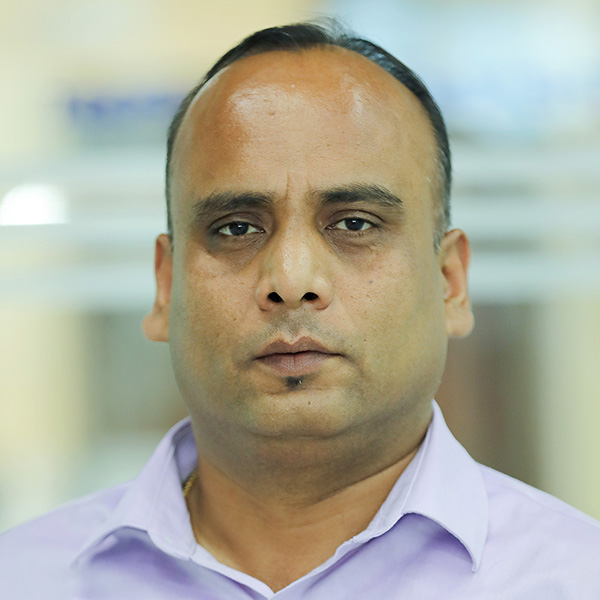
Foreign Minister Shisir Khanal says the prime minister is focused on demonstrating results at home, even as Kathmandu and New Delhi explore a new phase of cooperation and high-level engagement. Foreign Minister Shisir Khanal (right) with Bharatiya Janata Party's foreign department in-charge Vijay Chauthaiwale in New Delhi on Saturday. Photo: Courtesy of Shisir Khanal/X
Foreign Minister Shisir Khanal, who is on a three-day visit to India, said that the present leadership is free from the political baggage of the past and that the new government is ready to turn the page on years of political friction with India to build a relationship anchored in pragmatism, measurable outcomes, and mutual growth.
Khanal reached New Delhi on Friday on his first official foreign visit at the invitation of his Indian counterpart, S. Jaishankar. In an interview with NDTV, an Indian news channel, Khanal said Prime Minister Balendra Shah’s government is committed to resetting ties with India and fostering a partnership focused on practical cooperation and shared prosperity.
He outlined an ambitious vision for strengthening relations between the two neighbours while candidly acknowledging that Nepal had squandered valuable years of growth opportunity even as India surged ahead.
Referring to last year's Gen Z movement, Khanal said it was driven by widespread frustration among young people with business-as-usual politics. “They raised questions of accountability and transparency. They wanted a corruption-free Nepal,” he said.
Speaking about the rise of the Rastriya Swatantra Party (RSP), which displaced traditional political forces in recent elections just four years after its establishment, Khanal said the largely non-political backgrounds of its leaders make the government fundamentally different. “Most of us who came into the party came from non-political, mostly professional backgrounds,” he said. “That meant we were free, to a large degree, from certain ideological burdens of the past.”
In a moment of rare diplomatic candour, Khanal acknowledged that Nepal had failed to capitalise on India’s economic rise over the past decade.
“As India grew rapidly over the last few years, we stagnated,” he said. “Even in the last three decades, Nepal has had very few instances where GDP growth exceeded 5 percent. We believe the potential was there for double-digit growth, especially when we saw India growing at 8 to 9 percent year on year.”
He attributed part of this stagnation to the revolving door of coalition governments in Kathmandu, which he said often weaponised international relations for domestic political consumption.
“There was always the need to build coalition governments, and those coalitions changed very frequently. That friction often led to the use of international geopolitical issues for domestic consumption as well,” he said.
The RSP, he insisted, would not repeat that pattern. “We want to be very conscious about how we engage internationally so that our relationships are based on facts and evidence, not emotions.”
Khanal met National Security Adviser Ajit Doval, and attended a roundtable interaction organised by the India Foundation, among other engagements. During meetings with senior Indian officials, he laid out a focused agenda spanning five priority areas.
According to the interview, energy tops the list. Nepal, endowed with enormous hydropower potential, wants to move beyond a piecemeal, project-by-project approach toward a comprehensive sectoral framework.
“We have built a really good collaboration in the energy sector over the last few years, but we think there are ways to improve,” Khanal said. He added that a tripartite agreement involving Nepal, India, and Bangladesh could allow Nepali green energy to flow to Dhaka using Indian transmission infrastructure—a pilot project that has already been tested.
Connectivity is the second priority. Khanal spoke specifically about rail links between Janakpur and Ayodhya, new air connections through Nepal’s recently built airports in Bhairahawa and Pokhara, and road infrastructure upgrades.
“We want to see cities and towns in India and Nepal better connected by road, rail, and air,” he said.
On the digital front, Khanal expressed hope for a UPI-backed payments agreement—one of the MOUs expected to be formalised during his visit—that would allow seamless digital transactions across the border. He also highlighted collaboration between Nepali universities and Indian institutions on AI language models for regional languages as another near-term deliverable.
Education and technology round out the agenda. Most ambitiously, Khanal floated the idea of establishing an IIT or AIIMS campus in Nepal, a proposal that would mark an entirely new chapter in academic cooperation between the two countries.
During the interview, NDTV Senior Executive Editor Aditya Raj Kaul also questioned recent positions taken by Prime Minister Shah and the possibility of a high-level exchange of visits between Nepal and India. Indian Prime Minister Narendra Modi has already extended an invitation to Shah to visit India, but the trip has yet to materialise.
When asked when Shah’s visit to India would take place, Khanal said the prime minister remains focused on domestic priorities for now, having only recently presented Nepal’s first budget under the new administration.
“The Prime Minister is currently very focused on the domestic agenda and wants to show early outcomes,” Khanal said. “We do hope to see high-level exchanges take place on both sides.”
Anil Giri is a Chief Sub Editor covering diplomacy, international relations and national politics for The Kathmandu Post. Giri has been working as a journalist for more than two decades, contributing to numerous national and international media outlets.




 14.2°C Kathmandu