From forest to classroom, Parbat students learn by doing
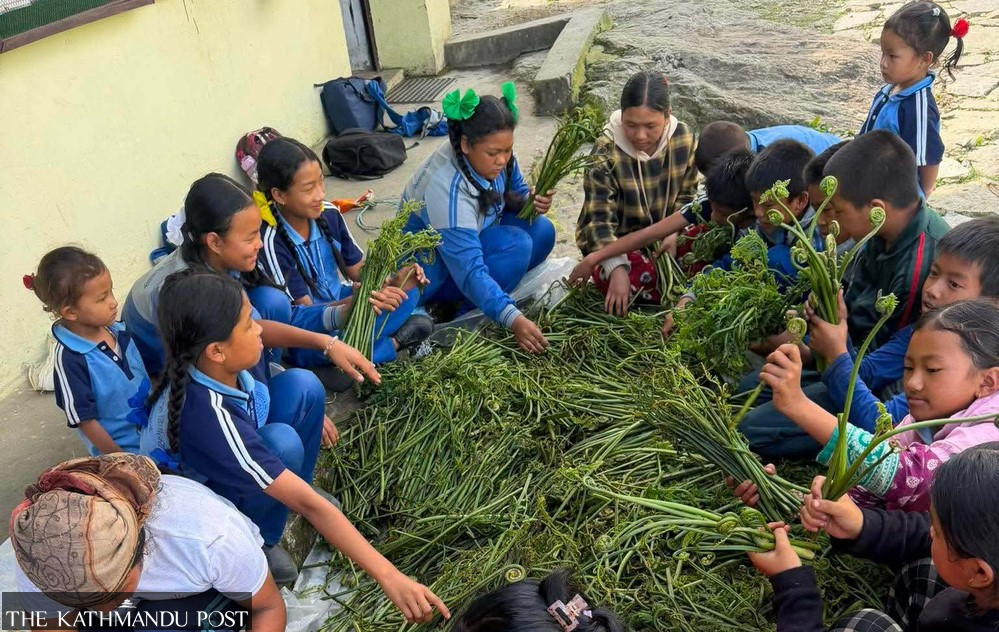
At Karbakeli Basic School, students forage for wild ferns, grow vegetables and sell their produce as part of a programme that blends education with rural livelihoods. Suman Jung Thapa/TKP
At Karbakeli Basic School in Kyang, Modi Rural Municipality-4, learning extends beyond textbooks and classrooms.
Students venture into nearby forests to harvest niuro (fiddlehead ferns), grow seasonal and off-season vegetables in greenhouse tunnels and learn how to prepare farm produce for sale. The income generated from these activities is used to support their education and extracurricular activities.
What began as an effort to make use of locally available resources has evolved into a hands-on learning programme that combines academic education with agricultural and basic business skills.
The school uses Fridays, when students attend extra classes, as well as weekends to collect seasonal forest produce such as niuro, bamboo shoots and lapsi (Nepali hog plum).
Headmaster Dipendra Chapagai said the activities are part of a local curriculum developed by the rural municipality to teach students how to market local products and generate income.
Last Saturday, the school sold 65 kilogrammes of niuro in Kushma Bazaar, the district headquarters. Students help with the entire process under teachers’ supervision, from identifying and harvesting the ferns to sorting and bundling them for sale.
“On Saturday morning, we dispatched another 120 kilogrammes of niuro to major market centres including Kushma and Patichaur,” Chapagai said.
The school had hoped to involve students in selling the produce as well, but the distance to Kushma Bazaar makes that difficult.
“We involve students in sales during local fairs and festivals,” Chapagai said. “But Kushma Bazaar is far, so it is not practical to take all the students there. Teachers handle the sales in urban markets.”
The school also sells products made by students, including lapsi and radish pickles and gundruk (fermented leafy greens), which Chapagai said have attracted buyers.
Students’ involvement in the programme is organised through the school’s Creative Child Club. Club members grow vegetables in plastic greenhouse tunnels and on unused plots of school land. Their crops include tomatoes, onions, ridge gourds, radishes, cabbages, cauliflowers and leafy greens.
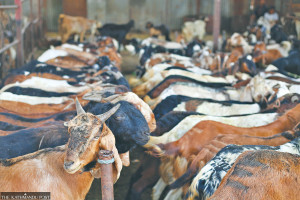
The school has expanded the programme beyond crops. Last year, it introduced a livestock distribution scheme for students from disadvantaged families who show an interest in farming. Suman Jung Thapa/TKP
Nisma Sepurja, president of the club, said the school takes its produce to local fairs and festivals for sale.
The proceeds are spent on student welfare and extracurricular activities, including uniforms, ties, belts and identity cards, as well as prizes for school competitions, she said.
The initiative has also attracted buyers in Kushma. Ram Paudel, a resident of Kushma Bazaar, bought two bundles of niuro from the school.
“I live alone, so one bundle would have been enough,” Paudel said. “But I bought another to encourage the students’ hard work and the teachers’ commitment.”
The school has expanded the programme beyond crops. Last year, it introduced a livestock distribution scheme for students from disadvantaged families who show an interest in farming.
Libiya Pun, a Grade 9 student who received a goat under the scheme last year, said the support brought happiness to her family.
Chapagai said livestock farming was added to the programme to help students stay connected to the local climate, soil and rural economy.
The school runs classes from early childhood development, including Nursery A and B, to Grade 8 and has 73 students.
Younger children learn flower planting and gardening in the school grounds, while older students take part in field and greenhouse farming under the government’s ‘Earn While You Learn’ programme.




 14.79°C Kathmandu