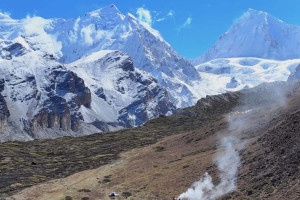
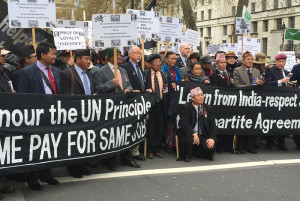
India and China have agreed to resume the Kailash Manasarovar Yatra via Lipulekh Pass—the high-altitude trijunction that Kathmandu has long claimed as its own—without consulting Nepal. The route, suspended after the Covid pandemic, is set to reopen from June to August, and the decision was made even as the foreign secretaries of both countries have nominal responsibility for resolving the border dispute.
Nepal’s new government, which came to power with a strong mandate after the March 2026 elections, has sent separate diplomatic notes to both neighbours and raised the issue at high-level political meetings. Neither has moved to accommodate its position.
According to current and former ministers and diplomats, the core of the dispute lies in the trijunction itself, which Nepal contests. Nepal claims the area under the Sugauli Treaty of 1816 and maintains that neither India nor China can conduct trade or transit through Lipulekh without its consent. The Rastriya Swatantra Party, now in government, has consistently held that Limpiyadhura, Lipulekh, and Kalapani are integral parts of Nepal’s sovereign territory.
“Our position is clear—it should be resolved through talks,” Foreign Minister Shisir Khanal told the Post. “On disputed issues, we want to resolve them through the established diplomatic mechanism.”
The Boundary Working Group, a joint body constituted by Nepal and India in 2014 to maintain boundary pillars and carry out technical work, continued to function in undisputed areas. But on the Kalapani and Susta disputes specifically, the two countries’ foreign secretaries were tasked during Indian Prime Minister Narendra Modi’s 2014 state visit to Nepal to negotiate a resolution—and not a single such meeting has since taken place.
The dispute entered a new phase in 2019, when India unilaterally released a new political map incorporating Kalapani, Lipulekh and Limpiyadhura, and refused to address Kathmandu’s concerns. Then in May 2020, the government of prime minister KP Oli issued its own administrative map, placing the three areas within Nepal’s borders. Parliament endorsed the map. Nepal subsequently amended its constitution in June 2020 to incorporate the new map into the national emblem.
India pushed back hard. According to former Foreign Minister Pradeep Gyawali, who was in office at the time, India had previously advised Nepal not to include the territorial dispute in its constitution and had offered to address the issue through political-level talks instead. Once the amendment was passed—by an overwhelming majority—New Delhi’s position hardened.
“Since it is almost impossible to amend the constitution, they had concerns over it,” Gyawali said. At the sixth meeting of the Nepal-India Joint Commission in New Delhi in 2021, Indian Foreign Minister S Jaishankar told Gyawali the boundary dispute had become “over-politicised on both sides” and pushed for dialogue. The two sides agreed that the issue would be raised at the prime ministerial level during a proposed Modi visit to Nepal. However, the visit never took place after the Oli government collapsed.
With a new government in power, the diplomatic calendar is busy in the coming weeks. Indian Foreign Secretary Vikram Misri is scheduled to visit Kathmandu on May 11-12, and Foreign Minister Khanal will travel to New Delhi later this month for the first summit of the International Big Cat Alliance. Interlocutors close to Prime Minister Balendra Shah have also relayed his interest in resolving the boundary dispute to the Indian establishment.
Former Indian ambassador to Kathmandu Ranjit Rae called it “a legacy issue left over from history” that has been complicated further by Nepal’s constitutional amendment. “The issue can only be resolved through negotiations—perhaps at track-two level in case track-one is not immediately feasible.”
China is the third party in this dispute, and Nepal has fared no better with Beijing. Despite repeated requests since 2015 that China not negotiate trade or transit arrangements with India via Lipulekh, Beijing has continued to do exactly that.
During former Prime Minister Oli’s meeting with Chinese President Xi Jinping in Tianjin last year, Oli raised the issue directly. Xi’s response, as relayed by Foreign Secretary Amrit Bahadur Rai, was that China has no objection to Nepal’s claim—but that the matter should be resolved bilaterally with India.
“That point has traditionally been used as a border point, but we don’t want to be a party to this dispute,” Xi told Oli, according to a participant in the meeting. “We don’t object to Nepal’s claim … but the issue should be resolved bilaterally.”
Gyawali, who dealt with China on this issue, said Chinese assurances have repeatedly not held. Initially, Chinese officials said they were not aware of Nepal’s claim over Lipulekh and promised not to reach any new understanding with India on the territory, pointing to Nathu La Pass as an alternative. “But their relations and business volume with India became important, so they also keep on reaching new understandings with India over time,” he said.
Gao Liang, the vice director of Nepal Study Centre at the Institute of South Asian Studies in Sichuan University, offered a standard opinion: the dispute is bilateral between Nepal and India and should be resolved through direct channels.
“China continues to work with the status quo. The relevant dispute should be properly resolved through bilateral channels between the two parties,” he said.
Nepal amended its constitution, updated its national emblem, and raised the issue with the highest authorities in both India and China. The result, by most expert assessments, is that the situation has reverted to something worse than where it started.
“Before 2020, the dispute had largely maintained the status quo. After we made it part of our constitution, it shifted back to a status quo ante, and resolving it will take considerable time,” said former Ambassador Shambhu Ram Simkhada. “We need out-of-the-box and creative thinking. Resolving such a dispute requires skilful diplomacy, but we cannot delay it indefinitely.”
A former foreign secretary, who agreed to speak on condition of anonymity, was more pointed, and put the onus of resolving the dispute on Nepal.
“We failed to appreciate the political acumen of Indian Prime Minister Modi, who can play a pivotal role in resolving this issue,” he said, noting that a gesture like a visit to the Ayodhya Ram Mandir during its consecration ceremony in January 2024 could have built goodwill. “With Indian politics moving further to the right, Nepal must internalise this ground reality. By engaging India in other areas, we can build trust, which will later be instrumental in resolving the dispute.”
(Editor's note: The article has been updated for clarity.)
Anil Giri is a Chief Sub Editor covering diplomacy, international relations and national politics for The Kathmandu Post. Giri has been working as a journalist for more than two decades, contributing to numerous national and international media outlets.




 24.79°C Kathmandu