Provincial alliances crumble as cracks develop in Congress-UML ties
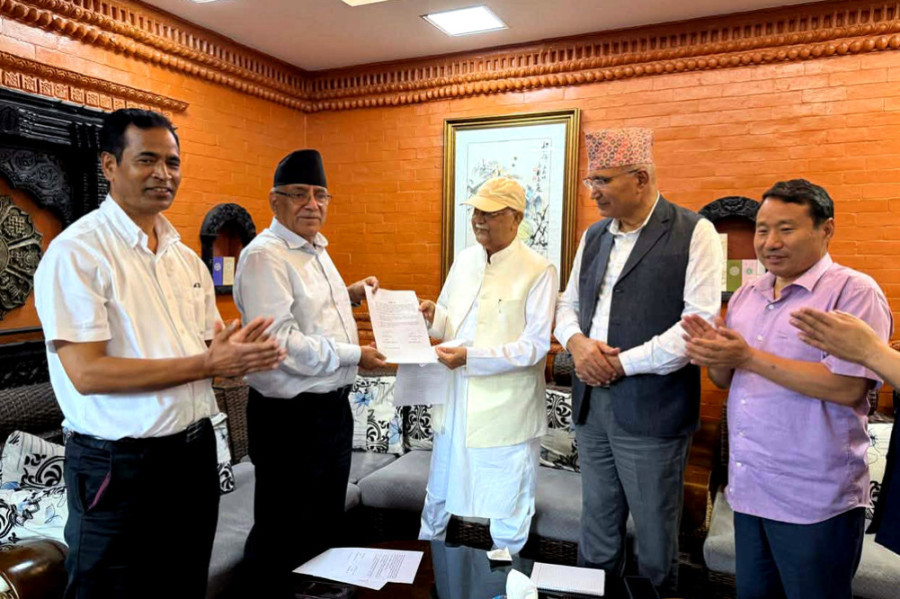
UML and NCP seal power-sharing deal, but coalition arithmetic means regional and fringe parties hold key. NCP chair Pushpa Kamal Dahal (second left) and CPN-UML chair KP Sharma Oli seal a deal on Saturday to form coalitions in the provinces. Photo: Courtesy of Pushpa Kamal Dahal's Secretariat
The Nepali Congress has decided to end its governing alliance with the CPN-UML in all seven provinces. With the party moving to break its partnership with the UML and explore new political alignments, provincial power equations are set for another major change.
The fallout from growing disagreements between the Congress and the UML leaderships at the centre over the future of their provincial alliance became visible on Wednesday.
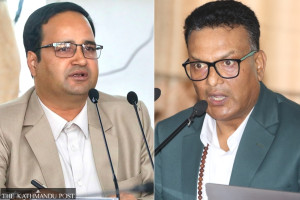
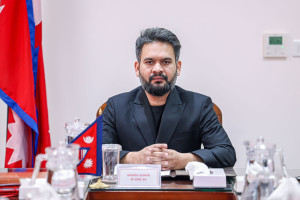
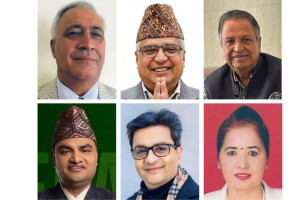
Shortly after Kamal Bahadur Shah, chief minister of the Congress-led Sudurpaschim Province, dismissed four UML ministers, the UML withdrew its support to his government. In Karnali Province, meanwhile, four Congress ministers submitted their joint resignations to Chief Minister Yamlal Kandel on Wednesday. Congress leaders said ministers serving in UML-led governments in other provinces are also expected to resign by Thursday.
Congress Vice-president Bishwa Prakash Sharma confirmed that the party has decided to walk away from the alliance with the UML. He said the decision followed the UML’s failure to show sincerity over its political approach to the Gen Z protests and the handling of provincial governments.
Under an earlier agreement to rotate leadership in the provinces, Congress had tasked Sharma with negotiating with UML chair KP Sharma Oli. Sharma had been holding both in-person and telephone discussions with Oli.
“When people stay together but no longer feel they truly are, even husbands and wives part ways. Our relationship with the UML had reached a point where it became suffocating, and we felt we had no option but to walk away,” Sharma told Kantipur.
Sharma said Congress would remain in the opposition in the provinces if it failed to reach an understanding with Pushpa Kamal Dahal, coordinator of the Nepali Communist Party (NCP). If an agreement is reached, however, the party would seek to remain in government.
At present, Congress and the UML jointly govern all seven provinces. Congress leads the governments in Madhesh, Bagmati, Sudurpaschim and Gandaki, while the UML heads the governments in Koshi, Lumbini and Karnali.
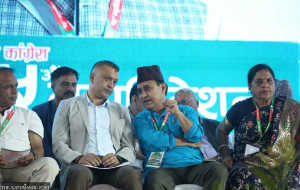
Amid discussions over a possible new coalition, Congress President Gagan Thapa and NCP coordinator Dahal met on Tuesday. With Congress now set to end its partnership with the UML, Dahal’s NCP has emerged as the decisive force in determining the next round of provincial governments.
During their hour-long meeting, Thapa and Dahal discussed power-sharing arrangements and leadership across all seven provinces. Dahal left for Sri Lanka on Wednesday for a three-day visit after meeting Thapa. Congress leaders said further negotiations on provincial power-sharing will resume only after his return.
NCP leader Narayan Kaji Shrestha said that while discussions had taken place with both Congress and the UML, they had yet to produce any concrete outcome.
“For some time now, both Congress and UML have proposed provincial partnerships. At the time, we were not interested in joining a government merely for power. Now, it seems circumstances may compel us to,” Shrestha said. “So far, we have not decided which party we will align with.”
The attention of both major parties is now centred on NCP coordinator Dahal. As the NCP's support is crucial to forming provincial governments, both Congress and UML have intensified parallel efforts to win over the party. During informal discussions, each side has proposed coalition models based on previous alliances.
Since the 2022 elections, four different coalition arrangements have taken shape: UML-Maoist Centre (now NCP), Congress-Maoist, UML-Maoist, and UML-Congress. Provincial governments have largely mirrored the coalitions formed at the centre.
“The talks have been positive. However, parallel discussions are also taking place between the UML and the NCP on possible left unity and cooperation, so it remains unclear which way Dahal will ultimately lean,” said another Congress office-bearer. “If we fail to reach an understanding with NCP coordinator Dahal, we will sit in the opposition in all provinces.”
Shrestha, however, dismissed suggestions that the NCP was moving towards cooperation or unification with the UML.
“The media has been talking about left unity. In reality, no such discussions or initiatives have taken place,” he said.
As tensions in Sudurpaschim pushed the Congress towards ending its alliance with the UML, Oli also stepped up his engagement with the NCP leadership.
Rajesh Bajracharya, a leader close to UML chief Oli, said the party had concluded that cooperation with the Congress could no longer continue after developments in Sudurpaschim and Karnali.
“I do not have details of what further discussions are taking place on this,” he said.
UML leader Mahesh Bartaula, however, said a section within his party still believes cooperation with the Congress remains necessary given the country’s complex political situation. He argued that collaboration should extend not only to the Congress but also to other parties, including the NCP.
Bartaula said the dispute in Sudurpaschim was triggered primarily by the provincial budget. The UML had demanded changes to the budget tabled by the Congress-led provincial government, arguing that it violated the spirit of the coalition. After the UML decided not to support the budget in the Provincial Assembly, Congress summoned Chief Minister Shah to Kathmandu for consultations.
“We have already called Chief Minister Shah to Kathmandu. You also call your representative and let us discuss a way forward,” another Congress leader recalled telling the UML during recent talks. “But UML chair Oli reportedly responded, ‘Let the Congress defeat the budget in Koshi. I will nominate another UML leader there. Meanwhile, the UML will defeat the budget in Sudurpaschim. Since the chief minister there is close to Sher Bahadur Deuba, you should also propose another name.’ Our leaders considered that approach deeply unpolitical and decided to withdraw from the alliance.”
The Congress had proposed changing leadership in six provinces, excluding Madhesh, in line with an agreement reached on July 1, 2025. The seven-point deal stated: “Provincial governments will be formed in accordance with the spirit of a national consensus government, and development works at the provincial and local levels will be expedited in line with public expectations.”
The agreement implied that changes in the governing arrangement at the centre would be reflected in provincial leadership as well.
Speculation over changes in provincial leadership intensified after the change in Congress leadership. As former president Deuba had appointed close allies as chief ministers, the new leadership under Thapa came under pressure from within the party to replace them.
Following Thapa’s election on March 5, and in line with the understanding between the two parties, preparations began for changes in provincial leadership. Congress Vice-president Sharma spent the past month negotiating with Oli. In earlier rounds of talks, both sides had agreed to go for leadership changes after budget sessions of provincial assemblies.
However, Congress leaders say Oli’s proposal to defeat the budgets in Koshi and Sudurpaschim, coupled with the UML's refusal to hand over the chief minister's post in Koshi, ultimately prompted the party to abruptly end the alliance.
Bartaula maintained that, given the common ground shared by Congress and the UML on key national issues in Parliament, continued cooperation in the provinces would remain beneficial.
“Discussions are ongoing, but nothing has been finalised. We are not in a position where we must distance ourselves from the Congress, and the party is still deliberating the matter,” he said. “The Sudurpaschim incident has certainly widened the rift, but it could have been resolved. We do not believe our relationship with Congress should end over that issue alone.”
The provincial arithmetic
In the 93-member Koshi Provincial Assembly, 47 seats are required to form a government. The Congress holds 29 seats and the NCP 17. Together, they command 46 seats—one short of a majority. With the Janata Samajbadi Party (JSP) holding just one seat, this coalition would have only a slim majority, making the Rastriya Prajatantra Party (RPP), with five seats, a potential kingmaker.
The UML currently leads the provincial government. If the NCP sides with the UML, the existing coalition would remain comfortably in power, with the UML’s 40 seats and the NCP’s 17 giving them a combined strength of 57.
In the 110-member Bagmati Provincial Assembly, 56 seats are needed for a majority. A Congress-NCP alliance would comfortably command 65 seats, with Congress holding 37 seats and the NCP 28.
A UML-NCP alliance, however, would fall one seat short of the majority mark, with a combined strength of 55 seats. It would therefore require the support of either the RPP, which has 13 seats, or the Hamro Nepali Party, which has two.
In the 60-member Gandaki Provincial Assembly, 31 seats are needed to form a government. A Congress-NCP coalition would enjoy a comfortable majority with 35 seats, comprising the Congress’s 27 and the NCP’s eight.
A UML-NCP alliance, by contrast, would have only 29 seats—22 from the UML and seven from the NCP—leaving it two short of the majority threshold. In that scenario, the RPP’s two seats would become decisive.
In the 83-member Lumbini Provincial Assembly, 42 seats are required to form a government. The Congress and the NCP together hold 40 seats—27 and 13 respectively—leaving them two seats short of a majority.
To form a government, the alliance would need the support of smaller parties such as the JSP, Janamat Party and Loktantrik Samajbadi Party (LSP), which hold two seats each, or the Janata Samajbadi Party-Nepal, which has one seat.
A UML-NCP alliance, on the other hand, would command exactly 42 seats, giving it the narrowest possible majority.
In the 40-member Karnali Provincial Assembly, 21 seats are needed for a majority. The Congress and the NCP hold 14 seats each, giving them a combined strength of 28, which makes a comfortable majority.
A UML-NCP alliance would also be able to form a government, with the UML’s 10 seats and the NCP’s 14 delivering a total of 24.
In the 53-member Sudurpaschim Provincial Assembly, 27 seats are required to form a government. A Congress-NCP alliance would comfortably secure a majority with 33 seats, comprising the Congress’s 18 and the NCP’s 15.
A UML-NCP coalition, however, would have only 26 seats—one short of the majority mark. It would therefore need the support of the Nagarik Unmukti Party, which holds seven seats.
Madhesh is currently governed by a Congress-led coalition comprising itself, the UML, the NCP and Madhesh-based parties.
In the 107-member Provincial Assembly, 54 seats are required for a majority. The Congress and the NCP together hold only 37 seats, while a UML-NCP alliance would command 38.
Neither combination can form a government on its own, making the support of Madhesh-based parties indispensable. The key players are the JSP-Nepal with 16 seats, the Janamat Party with 13, and the Loktantrik Samajbadi Party with nine.




 14.67°C Kathmandu