Nepal seeks India’s recognition of NID card as valid travel document
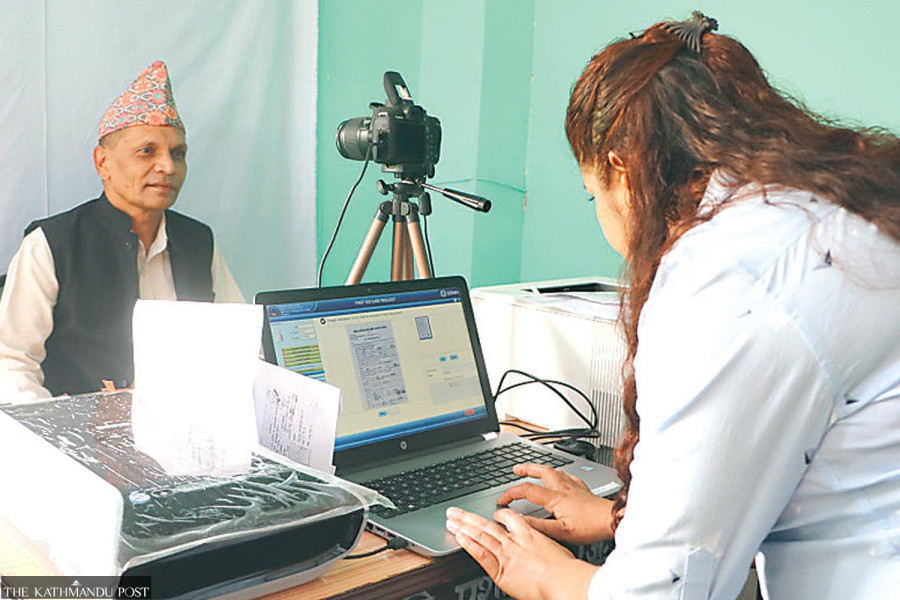
Department of Immigration officials held discussions with Indian Embassy representatives, who expressed a positive response to Nepal’s request for recognising the NID card. The NID card contains biometric information, including fingerprints, facial images and iris scans. File Photo
Nepal’s National Identity (NID) card could soon become another recognised document for travelling to India, with the government seeking New Delhi’s approval to allow its use alongside the citizenship certificate and passport.
The proposal has already been forwarded to the Indian side for consideration, and the Department of Immigration (DoI) is awaiting a formal response, a senior immigration official told the Post.
At present, Nepali citizens travelling to India, particularly by air, must carry either a passport or a citizenship certificate. Likewise, Indian citizens travelling to Nepal are required to present either a passport or an original Indian voter identity card with a photograph, according to the Indian Embassy in Kathmandu.
As the government has made the NID card mandatory for obtaining services at many government offices and in the banking sector, and plans to eventually replace the citizenship certificate with the NID card, the DoI has proposed recognising the NID as a third valid travel document.
“We have already forwarded the proposal to the Indian side through the Ministry of Foreign Affairs,” said Ram Chandra Tiwari, director general at the DoI.
As soon as an Indian nods, the NID card will work as a third identity card that assists Nepali citizens to India on both land and air routes.
Earlier this week, a team from the Indian Embassy held discussions with Tiwari and other senior DoI officials regarding the proposal. According to another immigration official, the embassy team appeared “positive” about the request and informed Nepali officials that the proposal had already been forwarded to New Delhi for further consideration.
“In the long run, we will have a single identity card replacing the citizenship certificate. It is verified, authentic and technology-friendly,” Tiwari said. “That is why we have requested India to allow the use of the National Identity Card while travelling by both air and land routes.”
A Home Ministry official said that during several bilateral meetings, Nepal and India had also discussed introducing a mechanism to maintain records of cross-border travellers and regulate their movement more systematically.
The NID card contains biometric information, including fingerprints, facial images and iris scans. More than 4.5 million Nepali citizens have already received the card, while around 20 million people have applied for one.
The government has made the NID mandatory for accessing several public services, including passport applications, land registration, opening bank accounts and other government services.
Nepal first launched the National Identity Card programme as a pilot project in Panchthar district and among employees at Singha Durbar in 2009.
“Although all Nepali citizens have not yet received the NID card, it is secure and technology-friendly. Therefore, we have proposed that India allow its use while travelling to and within India,” Tiwari said.
Since citizens of Nepal and India do not require visas to travel between the two countries, both governments currently recognise only a limited number of identity documents issued by their respective authorities. Recognising the NID card would make travel more convenient for Nepali citizens by providing an additional identification option if they do not have a passport or citizenship certificate, Tiwari added.
While the Department of Immigration reports that around 150,000 Nepalis travelled to India last year, there is no official data combining those who crossed the southern border by land and air.
Indian security and foreign policy experts have also raised concerns about strengthening identity checks at border crossings. Writing on X, Professor Brahma Chellaney argues that, given the millions of Nepali citizens living and working in India, fencing or closing the border would be impractical and harmful to bilateral relations.
“The answer is smarter, not tighter, border management: using AI-enabled facial recognition, biometric screening, automated systems and surveillance technology to prevent criminals and terrorists from exploiting the border while keeping it accessible for legitimate travellers.”
Chellaney adds that technology alone is insufficient; effective security requires closer Nepal–India cooperation through joint patrols, intelligence sharing and updated legal mechanisms to facilitate the extradition of fugitives.
Anil Giri is a Chief Sub Editor covering diplomacy, international relations and national politics for The Kathmandu Post. Giri has been working as a journalist for more than two decades, contributing to numerous national and international media outlets.




 14.82°C Kathmandu