Latest tests find faecal contamination in Kathmandu drinking water
Water samples collected from Chandragiri, Kritipur, Dakshinkali and Gokarneshwar municipalities, and Kathmandu Metropolitan City, were found to contain faecal coliform and E coli. Officials attribute the contamination to poor infrastructure, ageing and leaking pipelines, drinking water pipes laid alongside sewer lines, and inadequate protection of water sources. File Photo
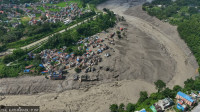
Monsoon rains and flooding have contaminated drinking water sources across much of the country, including the Kathmandu Valley.
Tests carried out ten days ago by the Public Health Office, Kathmandu, found faecal coliform and E. coli in all drinking water samples collected from households and public taps.
Faecal coliform and E. coli are bacteria found in the intestines and faeces of warm-blooded animals. Their presence in drinking water indicates contamination by sewage or human faeces, officials say.
“We collected water samples from five different locations of Kathmandu district—Chandragiri Municipality, Kirtipur Municipality, Dakshinkali Municipality, Gokarnashwar Municipality and the Kathmandu Metropolitan City,” said Saroj Roka, an official at the health office Kathmandu.
“The test results showed hazardous microbes in every sample collected from public taps and households.”
The findings are not unusual during the monsoon, when floodwaters routinely contaminate water sources. The Nepal Multiple Indicator Survey (MICS) 2024-25 in February found E. coli and other harmful microbes in over 60 percent of household drinking water samples throughout the country.
Officials attribute the contamination to poor infrastructure, ageing and leaking pipelines, drinking water pipes laid alongside sewer lines, and inadequate protection of water sources.
“We called a meeting of key stakeholders—the Kathmandu Upatyaka Khanepani Limited, Department of Water Supply and Sewage Management, drinking water consumer committees and others and informed them about the report,” said Roka. “We urged them to chlorinate water before distribution and conduct regular quality tests.”
Similar tests in previous years also detected harmful microbes in water from public taps, jar water, water supplied by the state utility, tanker water, tube well water, water from wells, and water from the Melamchi River.
Doctors warn that consuming contaminated water can cause diarrheal infections, including cholera, dysentery, typhoid, as well as hepatitis A and E.
Health facilities in Kathmandu have already reported cases of severe diarrhoea, and in some cases, patients were brought in unconscious. Rapid diagnostic tests have confirmed several cases of cholera.
Public health experts expect diarrhoeal illnesses to rise further in the coming days as floodwaters have contaminated most water sources and many people lack access to clean water.
“Most diarrhoeal patients do not seek hospital care unless their condition becomes serious,” said Dr Sher Bahadur Pun, chief of the Clinical Research Unit at Sukraraj Tropical and Infectious Disease Hospital.
“Many first take medication from private pharmacies and visit hospitals only when their condition fails to improve.”
Experts warn that the risk of a major outbreak of waterborne diseases, including cholera, remains high this monsoon season because authorities have failed to ensure safe drinking water and launch sustained awareness drives.
Last year, four people died, and hundreds fell ill with cholera outbreaks that spread across several local units in Bara, Parsa, and Saptari districts. Hospitals in Birgunj were overwhelmed with seriously ill patients. After other containment measures failed, authorities launched an emergency cholera vaccination campaign.
Cholera is a highly infectious disease that causes severe diarrhoea and vomiting, leading to rapid dehydration that can be fatal within hours if left untreated. The outbreak was caused by the Vibrio cholerae O1 Ogawa serotype.
Doctors say improving access to safe drinking water, strengthening sanitation and hygiene, raising public awareness, and ensuring early treatment are key to preventing future outbreaks.
Arjun Poudel is a health reporter for The Kathmandu Post. Before joining the Post, he worked for Sagarmatha Television, Naya Patrika, Republica and The Himalayan Times.




 25.92°C Kathmandu