No referees, just a disc: Ultimate frisbee begins journey in Nepal
A newly formed federation is organising Nepal’s first ultimate frisbee tournament on May 21 and 22 in Kathmandu, hoping to turn an informal park game into a structured sport.
Ultimate frisbee does not require expensive equipment, modern stadiums or even referees—just a disc, an open space and willing players. Yet, despite its simplicity, the sport has remained largely unknown in Nepal.
However, that may soon change as a newly formed federation—the Nepal Flying Disc Federation (NFDF)—launches its first ultimate frisbee tournament and begins introducing the game to schools and communities in hopes of building a future player base.
Ultimate frisbee is not among the “most popular” sports in the world. Further, it is only a discipline of flying disc (frisbee) sports.
“Disc golf, freestyle, guts, overall and beach ultimate are other disciplines of frisbee,” Santosh Khadka, secretary general at the NFDF, told the Post at a café along the bank of the Manohara River near Dibyashwori Town Planning, Bhaktapur. “Ultimate frisbee is the most popular discipline. Disc golf is also popular, but we have prioritised ultimate frisbee in our initial phase.”
Though not widely recognised as a sport, the flying disc would sometimes appear in Kathmandu’s open spaces, passed between friends in informal games.
“It was in Norway in 2016 when I came to know about the sport through a guy from the Netherlands,” said Khadka, who visits Norway every now and then for his job. “When I returned to Nepal after that, I started noticing the disc being thrown and caught in some parts of the Kathmandu Valley.”
Nine years on, Khadka found some friends who got fond of the sport and they coordinated to form the NFDF last year. The NFDF was recognised as a member association by the World Flying Disc Federation (WFDF) in October last year.
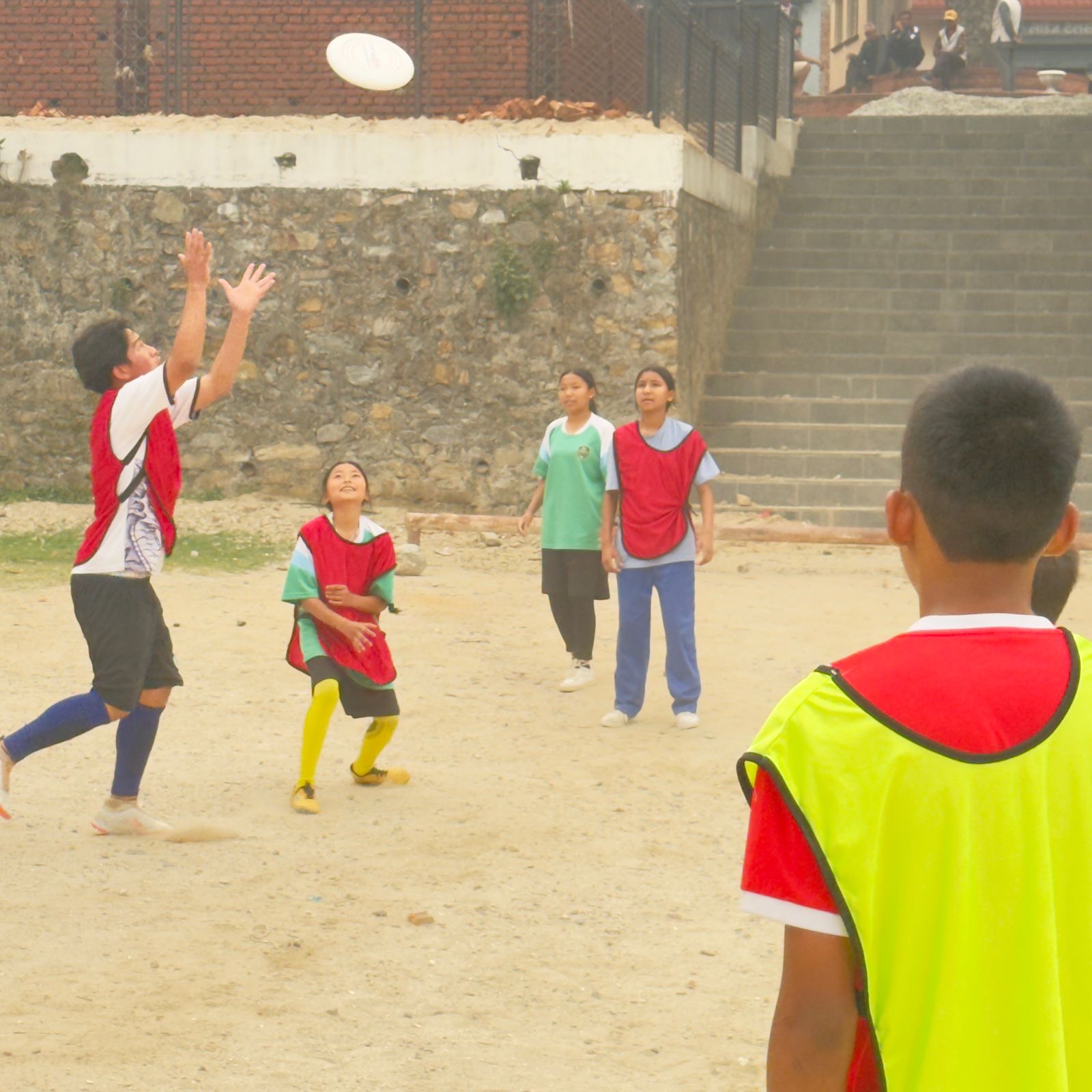
“After the formation of the national federation, we started promoting the sport, especially through schools. We started a month-long training camp at Kapan and Chunikhel in April, where 50 children, with around 1 out of three children being girls, participated,” said Khadka. “We now have an ultimate frisbee tournament, the first-of-its-kind in Nepal, in a couple of days.”
Branded as the “Himalayan Spirit Cup”, the NFDF is organising a two-day ultimate frisbee tournament at the Handball Ground in Kapan, Kathmandu, on May 21 and 22.
“The tournament will see five teams in action across two days,” Khadka informed. “Hope Foundation, a rehabilitation centre in Kapan, will be one of the teams, while the others will be those who have been introduced to the game before.”
The athletes will include seniors and children who have completed their Secondary Education Exam (SEE). Each of the matches will be 30 minutes long. The winner will be the one who scores 15 goals first or the one with the most goals in the allocated time. “If there is a tie, the golden goal rule will be applied,” Khadka said.
Under the standard format of ultimate frisbee, a match is 100 minutes. The rule for winning is the same: the first to 15 goals or the one with the most goals by the end of the match.
How is ultimate frisbee played?
The disc used for ultimate frisbee is almost like a discus, but it is not so heavy. A disc is 175 grams in weight, while that of a discus weighs two kilograms for men’s and a kilogram for women’s events.
“The disc is roughly the size of a normal plate we use for a meal,” said Khadka. “It is made of plastic, and it does not hurt when players get hit while missing the catch.”
There are two teams of seven players each when the sport is played outdoors on grass. When played indoors or on the beach, there are usually five players on each team.
The teams field their players in a ground that is 100 metres long and 37 metres wide. At each end of the playing field, there is an end zone, which is 18 metres long.
“There is a 64-metre-long playing area for the players. It is a goal when a player of a team passes the disc to his/her teammate inside the opponent’s end zone,” Khadka said. “When there is a goal, the end zone changes for each of them so that a single team does not get an environmental advantage, such as the direction of the wind. The play starts and resumes from the end zone.”
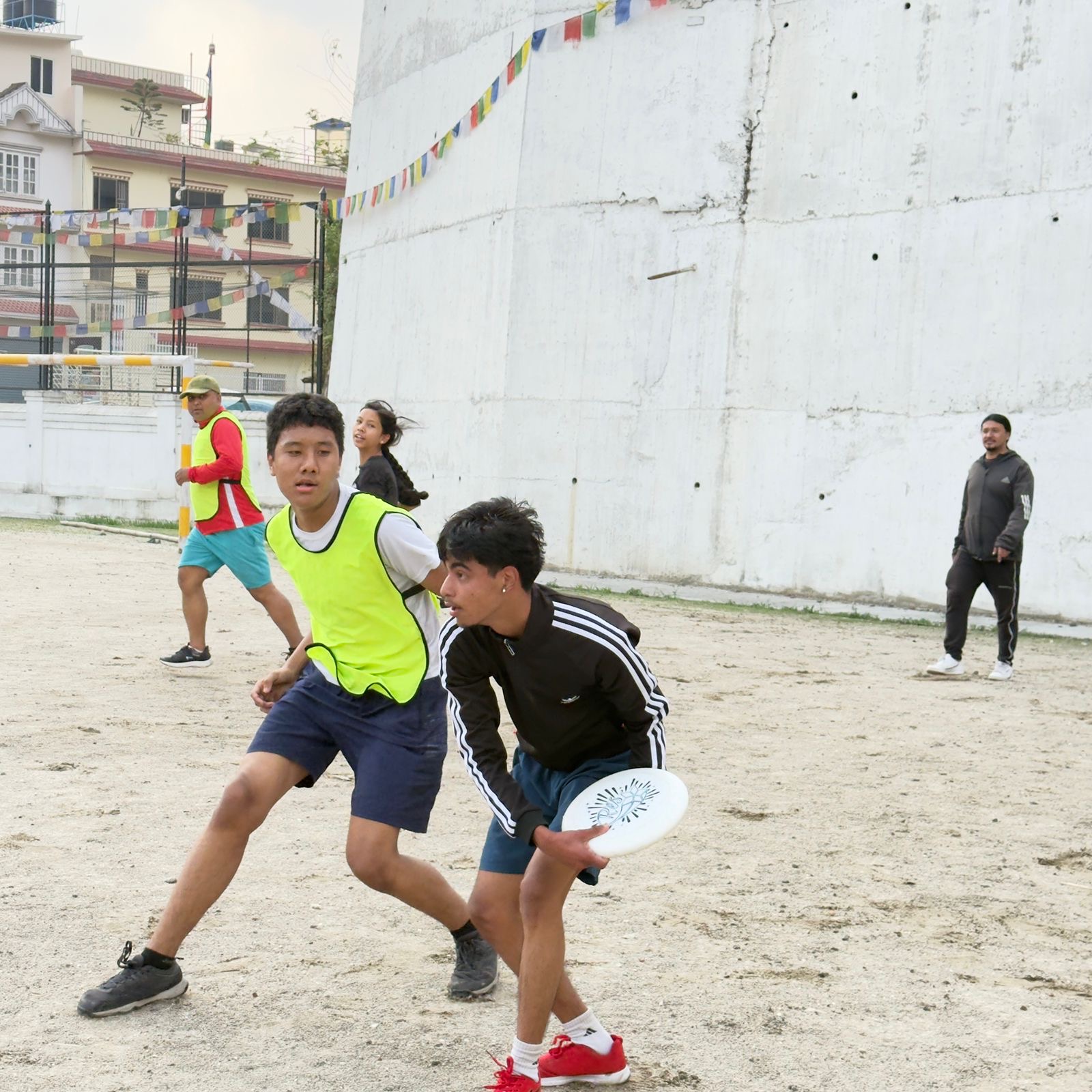
Meanwhile, it is a foul when a team drops the disc while catching or when the disc touches the ground while throwing. A player cannot run with the disc after catching. S/he should throw the ball within 10 seconds, with the opponents disallowed from snatching the disc unless it is thrown.
The most interesting part of the game is that ultimate frisbee does not require on-field referees. The sport boasts itself for relying on the “Spirit of the Game”.
“Ultimate relies upon a Spirit of the Game that places the responsibility for fair play on every player,” the WFDF writes about the discipline of ultimate frisbee. “There are no referees; the players are solely responsible for following and enforcing the rules, even at the World Championship. Competitive play is encouraged, but never at the expense of respect between players, adherence to the rules, and the basic joy of play.”
Khadka believes that ultimate frisbee improves bonding among players. “There is not much physical contact in this sport, as a player cannot touch the thrower when s/he has the disc. There is some contact when an opponent player is disturbing the catcher,” he added.
Moreover, ultimate frisbee can be played with a mixed team of boys and girls.
“This is an inclusive sport,” Khadka said with pride. “Mixed teams of boys and girls can compete. There is no gender barrier as it is the skills that matter.”
A good disc costs Rs1,000, but it is not easily available in Nepal. “There are average discs available in Kathmandu, but they break easily,” Khadka said. “A disc, a pair of shoes and casual clothes used for any other sports will suffice for a game.”
Nonetheless, like any other sport, frisbee is also struggling to find proper places to play in the packed Kathmandu Valley.
Plans and challenges
The major priority of the NFDF is to register under the National Sports Council (NSC), the governing body of Nepali sports.
“Unless we are registered with the NSC, we cannot create bank accounts, receive funding from the international federation and operate effectively,” Khadka said.
As per the National Sports Development Act, a national sports association can be registered only after it has at least four provincial associations.
“We only have district associations in Kathmandu and Lalitpur for now,” said Khadka. “We are planning to take the game outside the Valley, create new district associations and form provincial associations.”
Similarly, the NFDF is also struggling to retain athletes. “Children show interest in the game when we reach schools for demonstrations,” Khadka added. “But in the lack of regular tournaments and the popularity of the game, many don’t continue.”
It is also difficult for Kathmandu-based schools to allow students to play frisbee at their respective compounds. It is because school compounds are mostly made of concrete, which increases the risk of injuries.
“With less physical contact, frisbee has an extremely low injury rate. And the risk reduces as it is played mostly on grassy grounds and sand,” Khadka shared.
Moreover, with frisbee struggling for popularity globally, the challenges are more in Nepal, where even the established sports like cricket, football and volleyball are not having an easy time.
The WFDF is recognised by the International Olympic Committee, the International Paralympic Committee and the International University Sports Federation. However, flying disc sports are yet to make their debut in the major sporting events like the Olympics and the Asian Games.
Frisbee has been showing potential for an Olympic debut for over a decade now.
“There’s an early indicator that Ultimate has an edge over baseball, squash, and other would-be Olympic sports for inclusion in the summer of 2024,” The New Yorker wrote in an article published in August 2015.
However, with the sport being played less outside the United States and European countries, frisbee has not made its mark at the biggest stages.
“But ultimate frisbee is at the World Games. And there are several world championships organised across the world every now and then,” Khadka defended. “It is growing because it is a great sport. Once you start playing frisbee, it is hard to stop.”
The best positive in recent times for flying disc sports is that mixed ultimate frisbee and disc golf debuted at the Southeast Asian (SEA) Games in Thailand last year.
“Frisbee is a popular sport in India. It is played in other South Asian countries as well. It can be a major sport in this region if we all collaborate,” Khadka suggested. “But first, we need to produce quality players in the country.”
The NFDF also believes that it will take some time for the sport to reach the corners of the country.
“We will grow gradually in a planned manner. It should not be long to see Nepalis of all ages throwing and catching discs in the public spaces of Kathmandu and beyond,” Khadka said with optimism. “Frisbee does not need dedicated playing spaces currently. We can utilise available spaces, like football grounds. And as we grow, we will invest more in athletes and tournaments.”
For now, ultimate frisbee remains a novelty in Nepal’s sporting landscape. But with a federation in place and the first organised tournament underway, its flight is no longer informal—it is beginning to take structure, shape and direction.
Nayak Paudel covers sports for The Kathmandu Post. He previously worked at the Post (2018–19) and spent over five years at The Rising Nepal. His reporting spans crime, health, education, and social issues.




 22.12°C Kathmandu