Meet the man who has coached a generation that changed Nepali women’s football
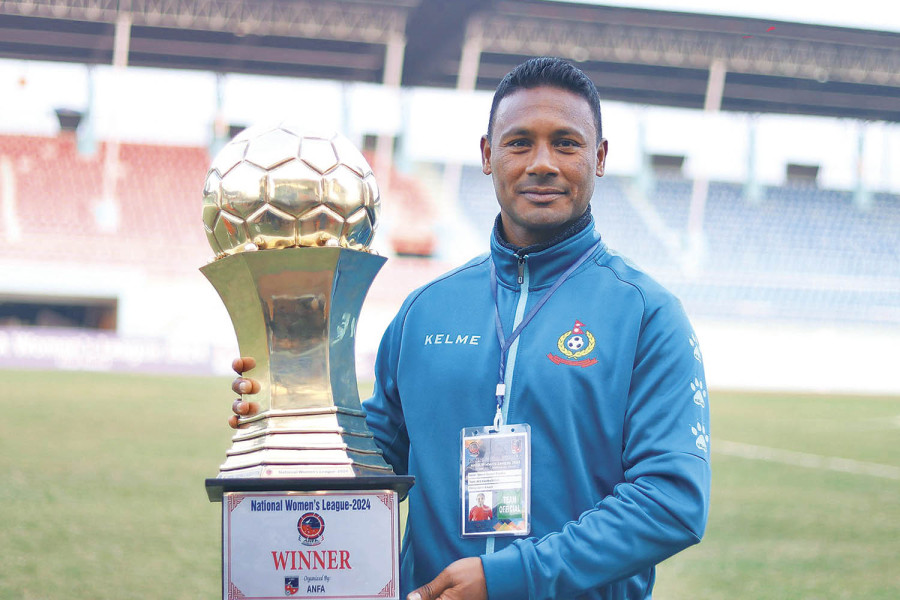
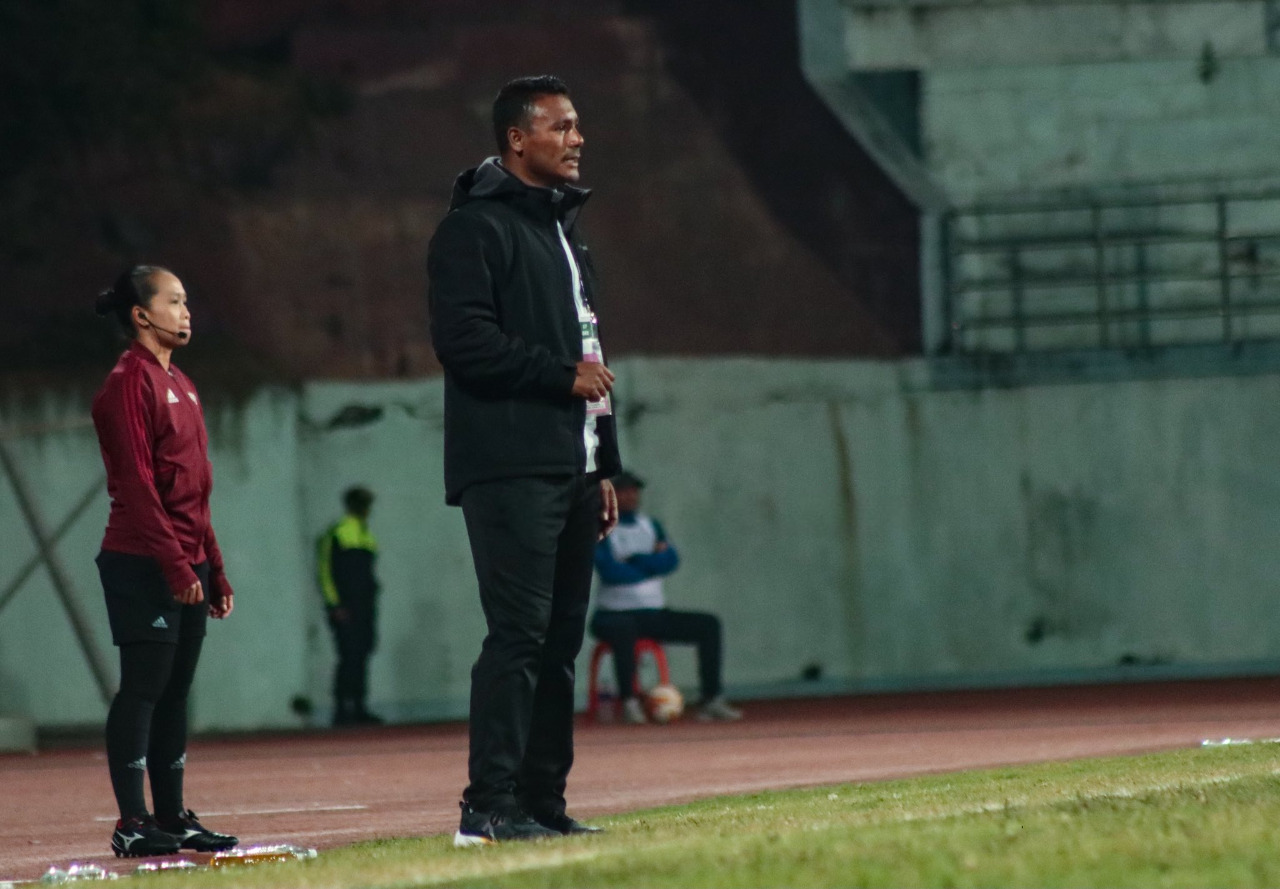
APF women’s head coach Jibesh Pandey has spent years nurturing many of the talents who transformed the women’s game in the country. APF FC’s head coach Jibesh Pandey with the trophy of the ANFA Women’s League 2024-25 season. Photos provided to the Post
Jibesh Pandey watches Nepal’s 2026 SAFF Women’s Championship opener fixture against Bhutan on a mobile phone on Monday evening. He is far from satisfied with the team’s performance.
“I had predicted it to end 1-0,” he says, as it rains outside a cafe in Thapathali, Kathmandu. “There were some good combination attacks, but there were many mistakes too. The team clearly missed the key players—Samba, Preeti [Rai] and Sabita [Rana Magar].”
Nepal had just defeated Bhutan 1-0, thanks to a lucky deflection, at Jawaharlal Nehru Stadium in Goa, India.
Pandey had several other detailed analyses of the match. And his friends from football and media nodded, suggesting they agreed with what he said.
Of course, they would. Pandey holds an unparalleled authority to analyse Nepali women’s football. He has spent nearly a decade coaching most of the players from what is often dubbed the ‘golden generation’ of Nepali women’s football.
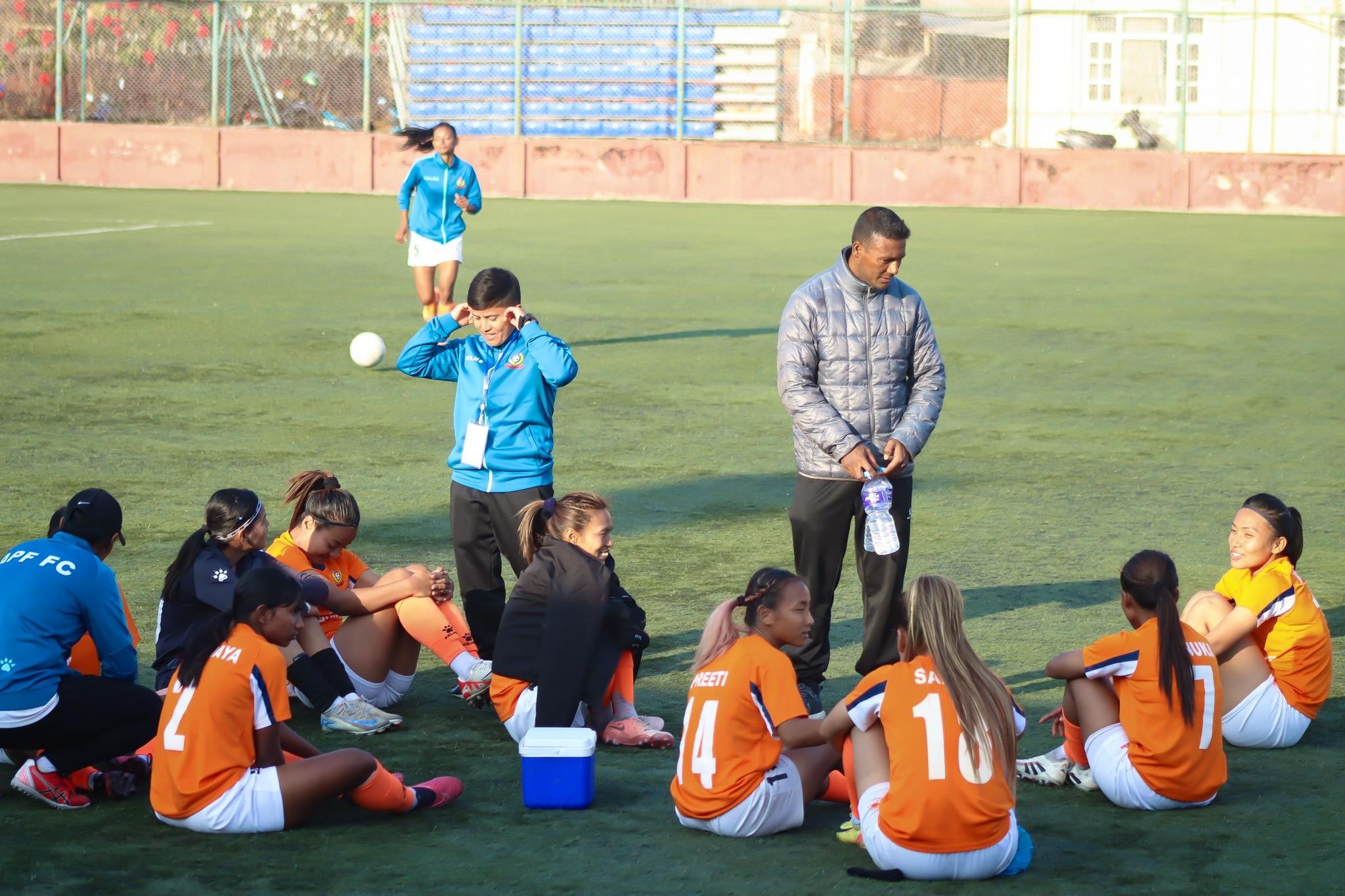
Sabitra Bhandari ‘Samba’, all-time leading women’s goal scorer in South Asia. Renuka Nagarkote, who was 15 when she debuted for Nepal as a promising midfielder in 2010. Anita Basnet, who has been quick on the wing for Nepal for years. Gita Rana, the wall of Nepali defence. And Anjila Tumbapo Subba, the experienced goalie. These are some of the players who are enjoying their peak in the national team. All of them honed their craft under Pandey’s tutelage at APF FC.
The list runs longer: other stars who trained under Pandey include Preeti Rai, dubbed as the best midfielder in South Asia, midfielders Renuka Hamal and Saru Limbu, Nisha Thokar, a main pillar of Nepal’s defence, emerging defenders like Pratishya Chaudhary and Man Maya Damai, and Anjana Rana Magar, who has proved her worth with the gloves every time she has played.
Together, the above-mentioned players, though unable to win an international trophy yet, have taken Nepali women’s football to great heights. For instance, Samba scored two goals against Paris Saint-Germain in En Avant Guingamp’s 2-6 loss at the top-tier league of France in March last year.
***
APF FC are the undisputed giants in Nepal’s domestic women’s football scene.
They have dominated the scene by winning the league for the last four consecutive editions and lifting the trophy in almost every mofussil tournament they participate in. All under Pandey.
The team was on a 46-game winning streak until it was defeated by Nepal Police Club in the final of the Jhapa Women’s Gold Cup last year. This hasn’t sat well with coach Pandey, forever hungry for the next win and the next trophy. “We will soon return to our normal selves,” Pandey declares, as he gets talking with the Post. “Undefeated and undisputed.”
***
Growing up, Pandey did not aspire to be a coach. He wanted to be a star player and went on to have a spectacular career as one. But his career was cut short. He was forced to retire after an ACL injury. A friend of his then persuaded him to take a community coaching course. He then climbed the coaching ladder. Now, he has an AFC ‘B’ License and has taken APF to the Asian and South Asian tournaments.
Born and raised in Tahachal, Kathmandu, Pandey studied in the Nepal Police School in Sanga, Bhaktapur. The police school prioritised sports, especially football. “And I played it a lot,” he remembers. “I then got a shot in the underage national team.”
In 2000, Pandey became the first Nepali to score a hattrick for the underage team in the preliminary stage of the Asian event. It was a tournament of U16 teams, a part of the Asian qualifier. “The first goal I scored was a header,” Pandey remembers, wistfully. “The ball came in the right position for me to head it.”
After that accolade, several clubs began to eye Pandey. He started his career in the Martyr’s Memorial ‘A’ Division League with Friends’ Club Kopundole (2000-2002). He then moved to Sankata FC (2002-2004).
Pandey also played for Manang Marsyangdi Club, Three Star Club and Jawalakhel Youth Club before starting his relationship with APF FC.
“APF had a football team, and they also wanted to enter the top division league,” Pandey remembers. “And they followed in the footsteps of Tribhuvan Army FC and Mahendra Police Club (now Nepal Police Club).”
Pandey was selected captain of APF FC as they debuted in the A-Division League from the 2005-2006 season.
“APF’s first match in the 2005-2006 season was against the defending champions, Three Star Club,” he recalls. “We defeated them 2-1. I made an assist.”
As a player, Pandey was dynamic, with an ability to play in various positions. His regular position was that of a striker. But he has played in the midfield and defence line too. “In a league match, I even played as a goalkeeper,” he laughs, and adds, “Our substitute goalkeeper was roaming somewhere outside the stadium as he was certain not to get an opportunity. But he was needed when the main goalie was injured.” Pandey then stepped in to take the role.
Pandey, who idolised Nepali legend Mani Shah and global legend Maradona, says his best skills as a player were speed and one-touch shots. “Once I scored a goal from near the halfway line,” he recounts.
Pandey has 51 goals in the A-Division League. He once bagged the man of the match awards for seven consecutive games in the top division.
But despite a strong resume in the domestic competition, Pandey could not do enough with the senior national team. He debuted for the senior men’s team in the match against Oman in South Korea in 2003. He played only a couple more matches after that in the national jersey.
“When I got called for the senior team, it was a dream come true,” he says. “That is what I was aiming for from the day I scored the hattrick for the U16 team. That I could not continue for long is a different story.”
Pandey shares that his father was happier when he was donning the national jersey. “I do not think my father, clad in a dhaka topi, missed any of the matches I played at the top level.”
One thing he remembers clearly about his time with the national team is that the players were given a set of home and away jerseys. “If the jersey got torn, we did not have a replacement,” he says. “We had to stitch it and use it again.”
***
Despite his short stint in the national team jersey, Pandey has left a sharp impression on fans and observers. Senior sports journalists remember Pandey as a young boy with a great physique who wanted to play in every game.
“Pandey used to consume painkillers when he was in pain,” senior journalist Ajay Phuyal, who currently edits Kheladi.com, told the Post. “He just did not want to miss any game. He loved football greatly. He still does, as we can see what he has achieved as a coach.”
Sometimes it may seem that Pandey did not have much of a role as the head coach of APF since the team was filled with star players.
But handling a dressing room full of stars is easier said than done. “I cannot claim the responsibility alone for developing these players into the stars that they are today,” Pandey says. “We can never forget the contributions of Bijay KC and other coaching and administrative staff of APF.”
Alongside the women’s team of APF, Pandey has also worked as the head coach of APF’s U16 and U18 men’s teams. He has also served as an assistant coach of the APF men’s team, while also working as the coach in grassroots training programmes of APF and ANFA.
Despite all his achievements, Pandey has some shortcomings as a coach. He has been limited to a B License since 2017. Without an A License, Pandey has been forced to travel with APF to the preliminary stages of the AFC Women’s Champions League in the last two seasons as an assistant coach.
“It is a part of the lack of football-related opportunities in the country,” Pandey argues. “The governing body of Nepali football should conduct coaching courses and extra player development activities. But neither is the league regular nor is its system proper.”
Pandey shares that he is planning to travel abroad for an A License. “It will cost a good amount, but it is essential,” he says. “The answer to why it is important to have a more educated and experienced coach could be Nepal’s performance in the AFC Women’s Asian Cup Qualifiers in Uzbekistan last year. Patrick De Wilde, a UEFA pro-license holder coach, had shown why the license mattered.”
***
Pandey has overseen Nepali women footballers grow into a golden generation. “The players improved with the guidance they got in APF and other departmental clubs,” Pandey says. “But the generation is about to end. And Nepali football is not growing any more.”
Pandey became better aware about the quality of football developing in South Asian and other Asian countries when his APF team played in the SAFF Women’s Club Championship and the AFC Women’s Champions League.
“We do not need to look far. Once Nepal women’s team struggled to beat India. They then beat them,” Pandey said. “But now, India and Bangladesh have gone ahead of Nepal in women’s football. We have not seen Nepal level up after reaching a peak.”
And Pandey fears that Nepal, who have failed to lift the SAFF trophy after losing in the final six times in the last seven editions, could be denied the title again.
“As I said, India and Bangladesh are getting stronger than Nepal. But it does not mean we will never catch up to them,” Pandey adds. “We need to invest more in the new generation. APF is doing it by running grassroots training and recruiting promising talent. We need it on a larger scale, especially from the state.”
Pandey today watches Nepali football with the eyes of a player, the concern of a coach and the hope of someone who has devoted most of his life to the sport. He knows this generation of women footballers may be the finest Nepal has produced, but he also fears the momentum could fade without stronger structures, better investment and long-term planning.
Yet, amid the worries, Pandey remains optimistic. Every time he sees packed grounds for women’s matches in mofussil tournaments or watches young girls dream of becoming the next Samba or Preeti Rai, he sees proof that Nepali women’s football has already changed the country in ways few imagined possible. And while he insists the success belongs to many people beyond himself, there is little doubt that Jibesh Pandey has quietly played a defining role in shaping Nepal’s golden generation.
“If you said before that women players would attract more crowds than men, I might have laughed at it,” Pandey says. “But now it is a reality.”
Nayak Paudel covers sports for The Kathmandu Post. He previously worked at the Post (2018–19) and spent over five years at The Rising Nepal. His reporting spans crime, health, education, and social issues.




 24.74°C Kathmandu