Nepal seeks urgent fertiliser imports from India ahead of paddy season
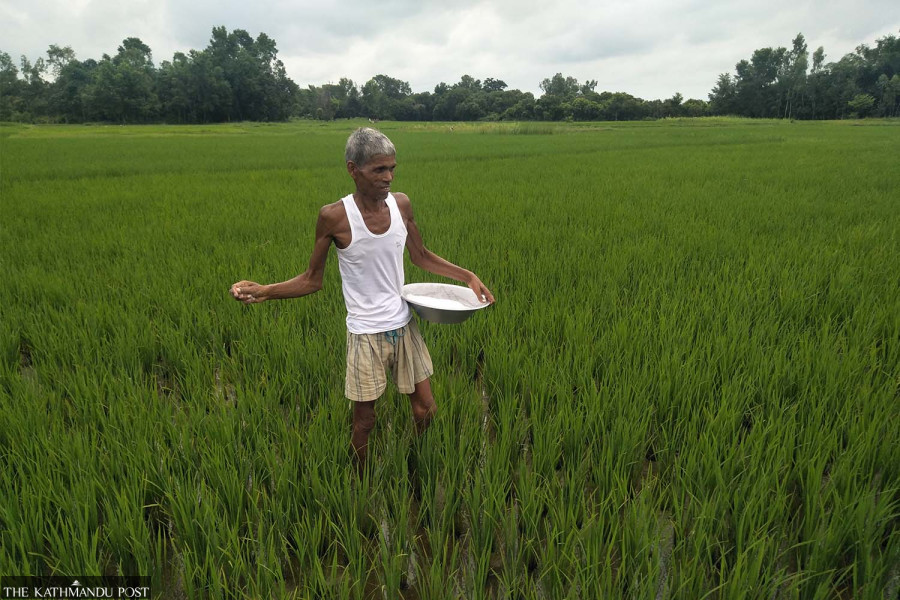
Government pushes for faster shipment of 80,000 tonnes under G2G arrangement as Gulf conflict threatens fertiliser supply chains and food security. Post file photo
Nepal has moved a step closer to procuring chemical fertiliser from India under a government-to-government (G2G) arrangement as fears grow over global supply disruptions triggered by the West Asia conflict.
Nepal has formally requested Indian state-owned supplier Rashtriya Chemicals and Fertilisers Limited to provide pricing details after the Cabinet on May 4 approved the procurement plan.
“We are expecting the price list this week,” said Ram Krishna Shrestha, joint secretary at the Ministry of Agriculture and Livestock Development. “After receiving the price, we will review the rates and formally place the order.”
According to Shrestha, the Indian company has assured delivery within 120 days after the payments. “But since it’s an emergency, we have requested a shorter delivery period,” he said.
The government earlier this month granted in-principle approval to the Agriculture Inputs Company to procure 80,000 tonnes of chemical fertiliser from India under the G2G mechanism as soaring global prices and supply uncertainties strain Nepal’s farm input system.
The one-time purchase, to be carried out under the 2022 bilateral agreement, includes 60,000 tonnes of urea and 20,000 tonnes of di-ammonium phosphate (DAP). Nepal had initially sought 150,000 tonnes, but the volume was reduced because of budget constraints.
Shrestha said the shipment would help meet demand during the top-dressing phase of paddy cultivation, when fertiliser is applied around 25 to 30 days after transplantation.
The government has allocated Rs28.82 billion in subsidies for fertiliser imports in the current fiscal year, initially targeting procurement of 550,000 tonnes. However, rising global prices driven largely by geopolitical tensions have reduced Nepal’s purchasing capacity to around 440,000 tonnes.
The Agriculture Inputs Company currently holds around 171,000 tonnes of fertiliser in stock, while contracts for 94,450 tonnes are likely to be cancelled because suppliers have failed to deliver.
Nepal requires around 250,000 tonnes of fertiliser during the paddy plantation season alone, raising fears of a potential supply gap that could hit crop yields and farm incomes.
Officials say issuing fresh global tenders could take at least 225 days. This has prompted the government to seek urgent supply from India ahead of the paddy transplantation season beginning in June.
Because Nepal relies heavily on fertiliser imports from countries in the Persian Gulf, it is vulnerable to disruptions in global shipping and energy markets.
Rice remains Nepal’s staple food, accounting for around 67 percent of cereal consumption and more than half of calorie intake. Average annual per capita rice consumption stands at 137.5 kg. Combined with legumes, rice provides nearly 23 percent of total protein intake.
A fertiliser shortage directly affects crop yields, raises food prices, lowers farm incomes and increases dependence on imports.
Currently, subsidised urea is sold at Rs18 per kg and DAP at Rs46 per kg through government-designated cooperatives. The subsidies cover around 92 percent of the urea price and 80 percent of the DAP price, with market rates hovering at approximately Rs160 and Rs162 per kg, respectively.
Nepal’s chronic fertiliser shortages have long been linked to weak distribution systems, low buffer stocks, policy gaps and exposure to global price shocks. The recurring shortages continue to affect thousands of farmers already struggling with climate risks such as droughts and floods.
The Food and Agriculture Organization of the United Nations has warned that fertiliser shortages and rising energy costs could reduce crop yields and tighten food supplies globally.
On May 7, FAO director-general Qu Dongyu said disruptions in the Strait of Hormuz could trigger lower agricultural yields and tighter food supplies in the second half of 2026 and into 2027.
Addressing the ministerial meeting of MED9++ countries on food security and fertiliser access, Qu warned that the Strait of Hormuz remains critical for the global movement of oil, liquefied natural gas, sulphur and fertilisers.
“Agriculture operates within a crop calendar that cannot be postponed,” he said. “Fertilisers must be applied at specific moments in the crop cycle. If they do not arrive on time, yields are reduced.”
He added that even a delay of a few weeks could force farmers to reduce fertiliser use or skip application altogether, affecting future harvests and food supply chains.
The outlook for Nepal’s agriculture sector this year remains uncertain. Experts cite below-normal rainfall forecasts, fertiliser shortages, rising fuel costs and tightening cross-border trade conditions as major risks.
Meteorologists have warned that Nepal could witness below-average monsoon rainfall after three consecutive years of above-normal precipitation. Since monsoon rains supply nearly 80 percent of irrigation water, any shortfall could severely affect agricultural production.
Lower rainfall combined with input shortages could weaken rural purchasing power, raise food prices, increase import dependence and reduce hydropower generation by lowering river flows.
The World Bank has warned that fertiliser affordability is likely to decline to its lowest level since 2022, threatening future harvests.
Meanwhile, the World Food Programme has cautioned that prolonged global conflicts could push millions more people into acute food insecurity this year, underscoring growing risks to global and domestic food systems.
Sangam Prasain is Business Editor at The Kathmandu Post, covering tourism, agriculture, mountaineering, aviation, infrastructure and other economic affairs. He joined The Kathmandu Post in October 2009.




 14.17°C Kathmandu