In a village where ownership of a buffalo determines social status, Lukhure’s family of indebted farmers dares to buy one.
In Ramesh Bikal’s Madan Puraskar-awarded story collection ‘Naya Sadak ko Geet’ (1959-62), one of the stories, ‘Lahuri Bhainsi’, explores a marginalised family's struggle and expedition to buy a buffalo.
What follows is not unusual. In a society where the ‘supreme power’, inherently privileged enough to own wealth and land, dictates what is right and what is wrong, which buffalo is healthy and which is not, the dynamic between the rich and the poor is predictable.
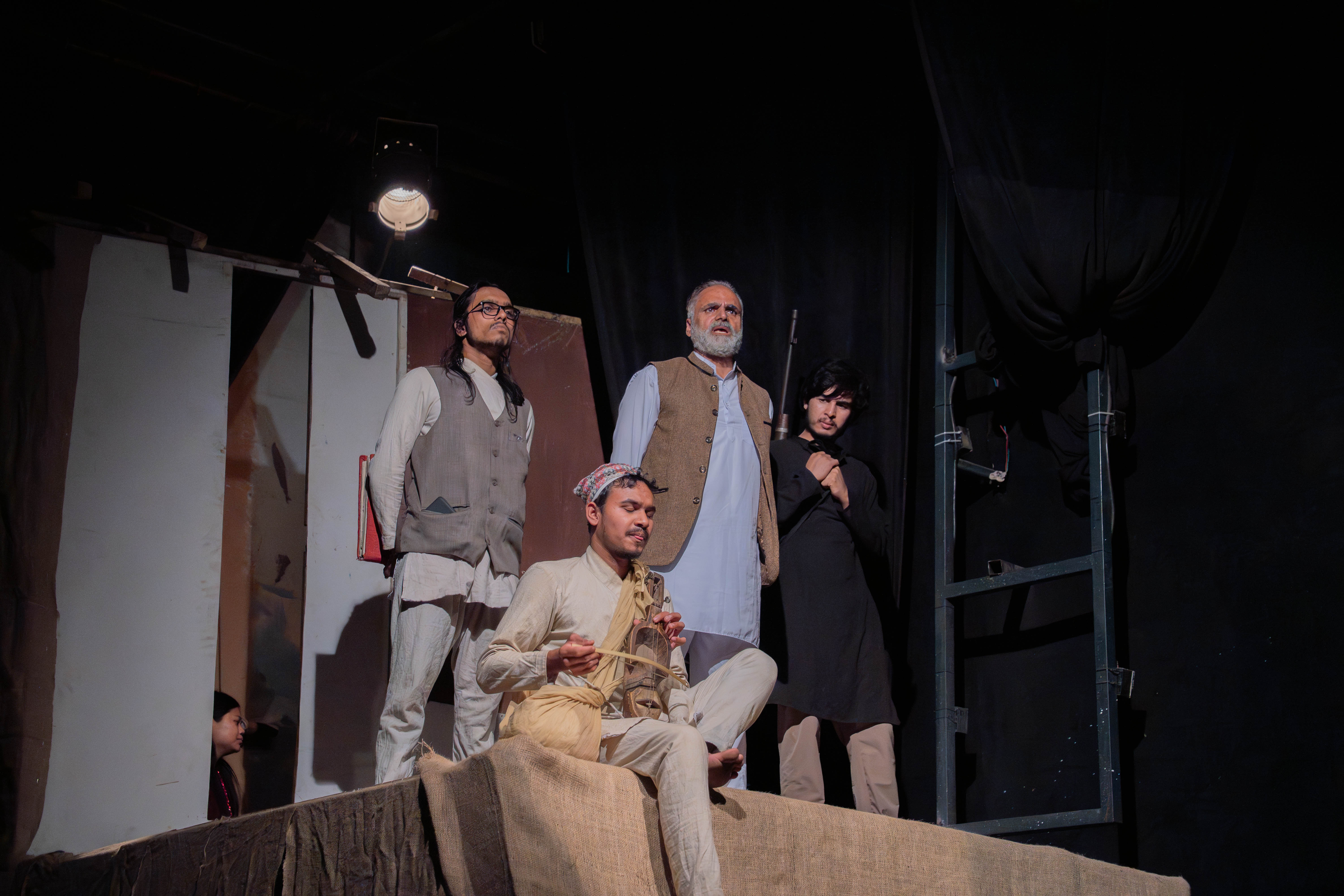
A commendable amount of a theatre’s emotional weight is carried by its live music, and ‘Lahuri Bhainsi’ is no exception. Within moments of celebration, climax, and catharsis, Salina BK's voice, amplified by the rhythms of the tabla, flute, and sarangi, echoes as a melodious undertone to the plot.
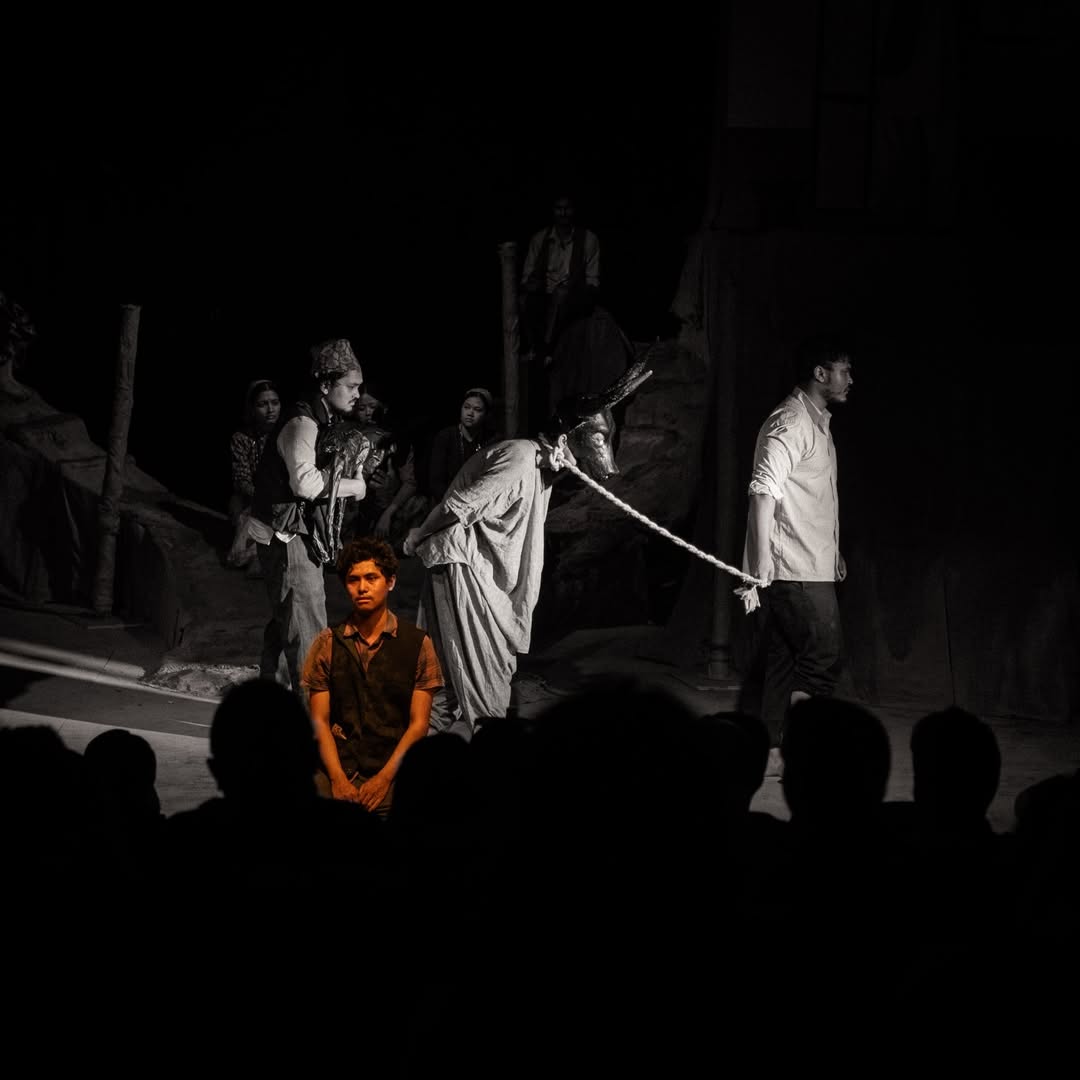
Dwarebaa cannot stand the fact that Lukhure (Nabin Taman), one of the farmers working in his fields, bought something as prestigious as a buffalo, seemingly risking his superiority. With almost the entire village indebted to him, Lukhure's audacity was fatal. Consequently, he declares that the buffalo is diseased.
Residing within the sphere of the culture that worships authority, everyone else agrees.
The actors' gestures, voices and movements in the play are memorable. Lukhure’s pitch shifts immensely throughout the play. From embodying anger towards the vendor for selling diseased buffalo to grovelling before Dwarebaa for mercy, the actor captures Luhure’s gradual erosion of dignity with remarkable conviction.
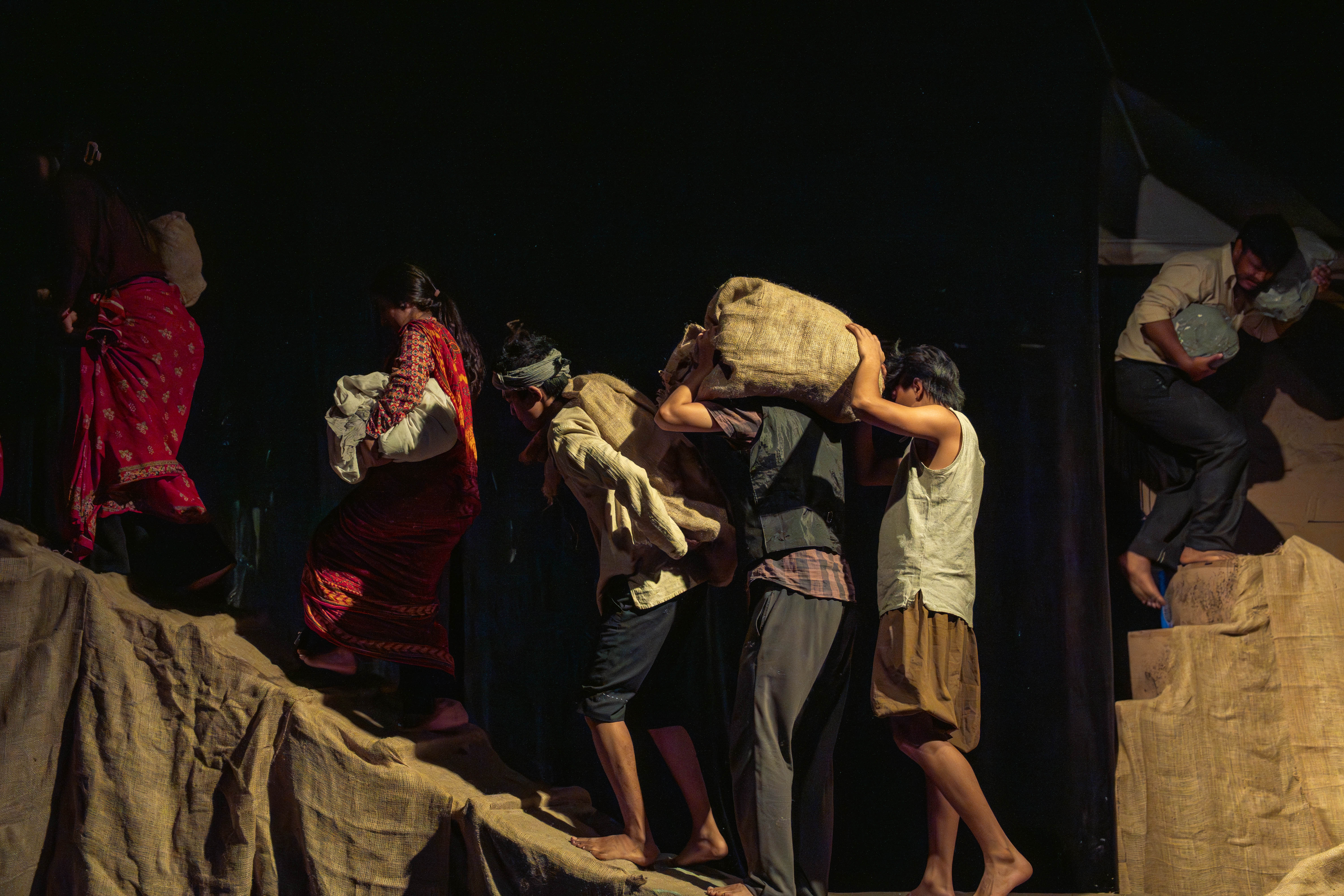
With the characters of villagers working in the field without tangible objects in hand, their body language and use of space bring their envisioned props and scenery to life.
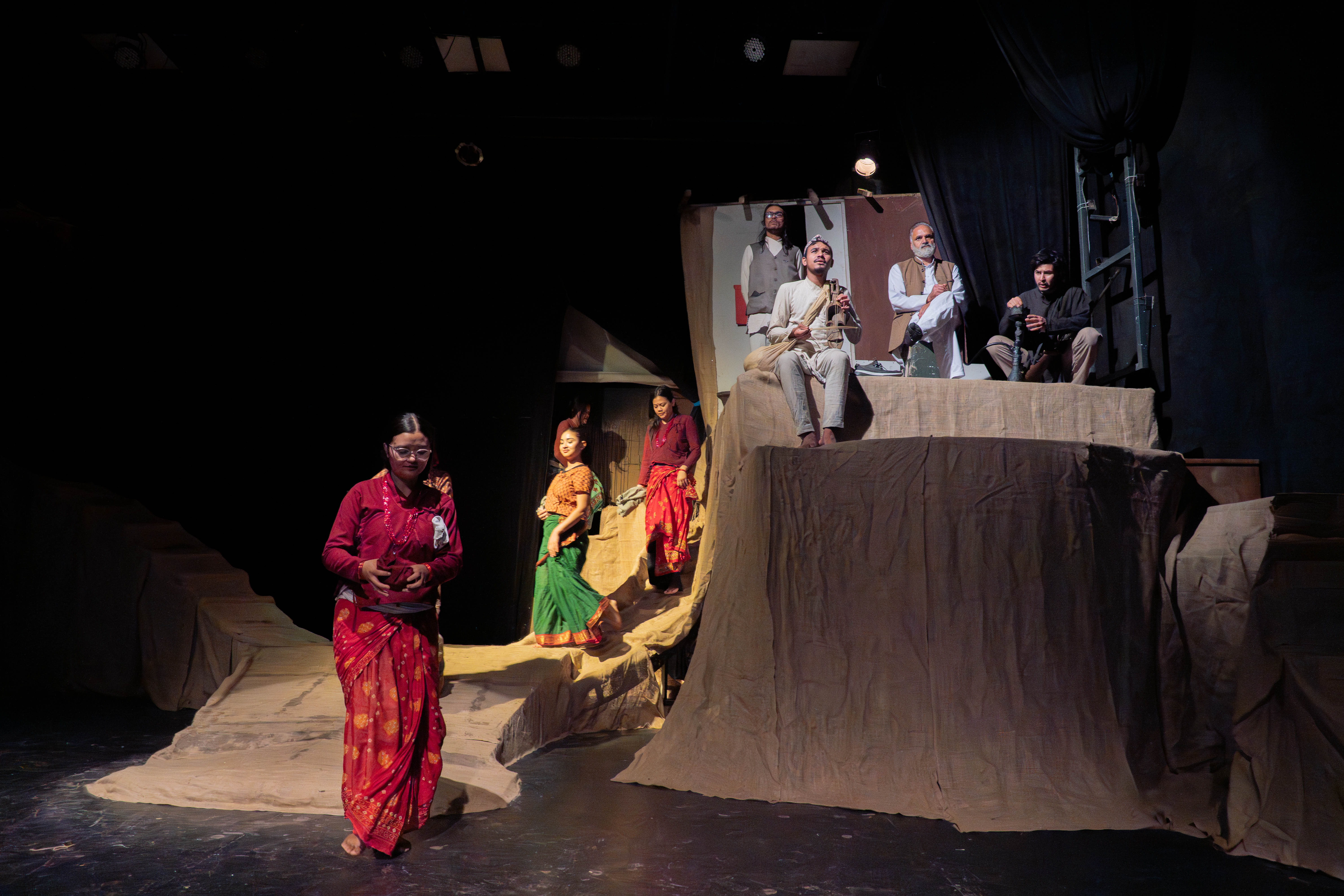
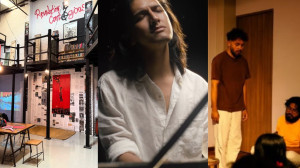
Similarly, the play’s visual appeal takes us right into the timeline in which it is set. With houses, streets and stairs plastered with red mud, the stage visualisation brings Nepal’s historical aesthetics close to the audience.
Light manipulation further complements these structures. The stage’s left edge (for the audience) features Lukure’s home, and the right features Dwarebaa’s. Lights radiate focus in accordance with their dialogues and project dead blackouts in between transitioning scenes.
The play starts before the audience enters the theatre and ends after they leave. With neither a distinct opening nor a particular closure, ‘Lahuri Bhainsi’ demonstrates how the gap between dominance and poverty sustains itself through evolving timelines, normalised, sisyphian, and inherited.
Addressing this bygone story with a powerful message in the present, however, also risks the audience’s understanding and relatability. Vernaculars are often barriers in the play. Viewers are left questioning the meaning of the characters’ lexicon, breaking the narrative's connectivity and emotional absorption. While sparking curiosity for some, this fragmentation also made the play easily forgettable for others.
Women's representation is evidently conventional in a story written decades ago. It was the courage of Luhure’s wife that made him buy the buffalo. But the village acknowledged Luhure’s achievement instead, making Ghaiti (Sushmita Karki) and almost every woman in the play mere bystanders in this occurrence.
With both the antagonist and the protagonist being male figures, the irony is that the plot would never unfold if female characters were absent. The production, therefore, simply reproduces the historical patriarchal structures without attempting to resist them.
Dwarebaa appears mostly in his residence, placed at a certain height on stage, in the comfort of his power and the villagers’ subservience. When Lukhure brings a buffalo into his home, Dwarebaa is found descending the stairs, something he would otherwise never attempt. This directorial choice reveals that Dwarebaa’s authority is neither natural nor secure. It must constantly fall into others' lives to survive.
Lukhure’s buffalo had hindered Dwarebaa’s tyranny to a significant extent. Curled up in this fear, he therefore arrives on the common ground to keep the villagers insulated in their bubbles.
The play also attempts to break the theatre’s fourth wall when Lukhure’s son Sukre (Bhaskar Budha) and his friend playfully walk towards the stage from the alleys in between the audience’s seats. Sharing Sukre’s excitement about bringing a buffalo into his house, these children interact with the viewers for a brief moment.
In a generation where wealth is determined by different sets of domains, director Anup Neupane and playwright Sanyog Guragain bring to the table a taste of their nostalgia and an introduction to a historical society where wealth equals buffalo.
With its occasional struggles with linguistic accessibility and reliance on dated gender dynamics, ‘Lahuri Bhainsi’, through its evocative stagecraft, acting and music, reminds the audience that systems of inequality survive also through collective acceptance. Decades after Bikal wrote the story, it is disturbing that the theme still finds its relevance in a different form.




 28.31°C Kathmandu