PMO scrutiny of Nepal Telecom billing tender raises concerns over interference
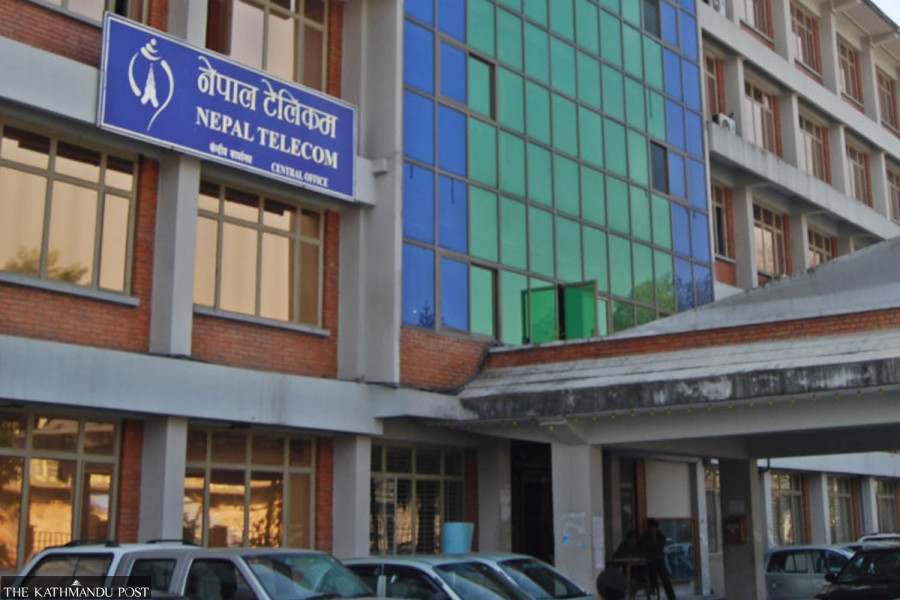
The estimated Rs5 billion procurement has been delayed by legal challenges and internal disputes over whether the billing system should be bought as a single platform or split into separate contracts. Post file photo
The prime minister’s office (PMO) has begun examining the tender process and technical specifications for Nepal Telecom’s proposed new billing system, prompting concerns within the state-owned operator over what employees describe as growing external involvement in technical and procurement decisions.
The information technology section of the PMO instructed the Ministry of Communications and Information Technology on May 27 to provide documents related to the procurement, with a copy sent to Nepal Telecom. The requested records include procurement documents, system design and architecture diagrams, geographic information system frameworks and details of the company’s 4G/LTE operations.
The review is being conducted by an information technology study task force under the PMO, according to Hemraj Aryal, PMO spokesman.
“Our IT study task force is reviewing the issues related with the billing system,” Aryal told Kantipur. “However, a comprehensive report detailing specific findings has not yet been submitted. Detailed insights will be accessible once the task force concludes its evaluation.”
Aryal said the review was a routine assessment and was not intended to interfere with Nepal Telecom’s procurement or operations.
“It is merely a standard study intended to assess the overall status of public information technology infrastructure,” he said. “The task force was previously constituted to review various IT systems across state organs. This routine assessment is unlikely to halt or impede Nepal Telecom’s ongoing operational procedures.”
The explanation has done little to ease concerns among senior Nepal Telecom officials, who argue that decisions involving the company’s core systems should be guided by established technical and procurement processes rather than political or administrative intervention.
The scrutiny comes as Nepal Telecom prepares fresh tender documents for a new billing system estimated to cost around Rs5 billion. Previous attempts to procure the system were stalled by legal challenges, complaints over tender specifications and administrative decisions.
The company’s board has recently delegated full authority to the managing director to execute the procurement, apparently to streamline decision-making and prevent further delays.
Nepal Telecom joint spokesperson Prakschet Thapa Chhetri said preparations for the revised tender were under way.
“Our technical team is working intensively. Given the intricate and highly sensitive nature of this procurement, thorough preparation is mandatory,” he said. “Once finalised, the details will be released transparently into the public domain. We view the prime minister’s office’s interest as a constructive and supportive gesture.”
Dispute over splitting the system
The latest scrutiny followed a request from the IT study task force for historical and current records relating to Nepal Telecom’s billing and other systems. The company initially submitted digital copies of tender documents by email, but officials at Singha Durbar later asked telecom representatives to provide physical copies.
“The tender documents were already available publicly on the Public Procurement Monitoring Office website,” said an employee familiar with the process, speaking on condition of anonymity. “Yet, after being pressured by central officials, our staff spent hours photocopying thousands of pages of technical archives.”
The request has also revived an earlier debate over whether Nepal Telecom should procure the billing system as a single integrated platform or split it into separate contracts. According to telecom officials, the Ministry of Communications and Information Technology, reflecting views from the prime minister’s office, initially favoured separating the system’s software and hardware, with part of the software to be potentially developed by domestic companies.
Under the proposed model, Nepal Telecom would retain the Online Charging System (OCS) and hardware infrastructure, while the Business Support System (BSS) would be procured or developed separately.
The proposal met resistance from Nepal Telecom’s management and employee unions, who argued that the billing platform is not simply a commercial software application but a core telecommunications system closely linked to customer identities, SIM registration, international roaming and real-time usage information. Separating the integrated system, they said, could create gaps in responsibility during failures and increase security and operational risks.
“This infrastructure integrates international roaming protocols, real-time location tracking, and critical socio-economic indicators,” said Lokendra Paneru, general secretary of the Nepal Telecom Workers’ Union. “It handles live profiles and data streams involving everyone, from high-ranking government officials to ordinary citizens. Approaching it casually poses immense national risks.”
Telecom engineers have similarly argued that the OCS and BSS, while performing different functions, operate within an integrated architecture and require coordinated hardware, software and technical support.
Following technical briefings from Nepal Telecom, officials at the prime minister’s office have reportedly softened their earlier position.
A senior PMO official, speaking on condition of anonymity, acknowledged that separate procurement had previously been proposed.
“A joint proposal had previously been drafted by ministry leadership and prime minister’sadvisers recommending the split procurement model,” the official said. “However, Nepal Telecom’s technical team maintained a firm stance that breaking up an integrated architecture creates severe accountability gaps during system failures.”
The dispute has thus moved beyond whether the government should scrutinise a major public procurement. It has raised a broader question over how far administrative oversight should extend into technical decisions at a state-owned telecommunications operator, particularly as delays could jeopardise the replacement of an ageing system.
Previous tenders faced legal hurdles
The current procurement is the latest attempt to replace Nepal Telecom’s ageing billing infrastructure, which was installed in 2011 by Chinese technology company AsiaInfo-Linkage Technologies. The system has remained in operation through successive contract extensions, with the current arrangement due to expire in 2027.
Efforts to replace it have been dogged by controversy and legal challenges. Earlier tender specifications were criticised for allegedly favouring Huawei Technologies, which already supplies significant network infrastructure to Nepal Telecom. Critics argued that awarding both network infrastructure and billing functions to the same vendor could deepen vendor lock-in and create risks involving competition, system dependence and data security.
The dispute eventually reached the Supreme Court, which directed Nepal Telecom to reduce its dependence on a single vendor and ensure adequate safeguards for privacy and data security.
Despite the ruling, subsequent technical evaluations again qualified Huawei while disqualifying other bidders, including Whale Cloud, renewing questions over whether the tender requirements allowed sufficient competition.
A Huawei Nepal representative defended the limited participation of international vendors, saying major global suppliers such as Ericsson, Oracle and CSG rarely participate in Nepal government tenders. That, the representative said, leaves a limited pool of vendors capable of meeting Nepal Telecom’s technical requirements.
The procurement also came under scrutiny from within the government. In November 2025, the Ministry of Communications and Information Technology formed an investigation panel led by former secretary Mani Ram Gelal after complaints alleging manipulation of the tender process.
The panel’s report warned that rigid qualification criteria could favour particular bidders and raised concerns over outdated procurement arrangements and potential financial liabilities for the state-owned company. The findings added to questions over how Nepal Telecom should structure a procurement involving a system that is both technically complex and critical to its daily operations.
The billing division had previously faced scrutiny from the Commission for the Investigation of Abuse of Authority. In May 2024, the anti-graft body filed corruption charges against former Nepal Telecom managing director Sunil Poudel and former chief business officer Sangeeta Pahadi Aryal over alleged irregularities in maintenance contracts. Pahadi Aryal was later cleared of the charges by the court and has since returned to an executive leadership role at Nepal Telecom.
Delays threaten transition
The prolonged procurement process has increased pressure on Nepal Telecom to replace its ageing system before the current contract expires.
Replacing a billing platform of this scale involves migrating large volumes of customer and network data, testing and integrating the new system, and running the old and new platforms in parallel. Nepal Telecom officials say a complex migration and data transfer requires at least 24 months of operational preparation.
Any further delay in awarding the contract could therefore leave less time for a controlled transition before the existing arrangement expires in 2027.
The concern is not only financial. A billing system processes subscriber information, usage records, account balances, charging and other functions essential to a telecommunications operator. Problems during migration could affect customers nationwide, disrupt revenue collection and compromise service management.
Nepal Telecom’s legacy infrastructure has already experienced periodic problems, with disruptions affecting mobile and data services. The Nepal Telecommunications Authority (NTA) has intervened following complaints and directed the operator to strengthen backup arrangements.
“The authority dispatched technical inspection teams to monitor network failures firsthand and directed Nepal Telecom to maintain backup systems,” said NTA spokesperson Min Prasad Aryal. “Our primary focus remains enforcing statutory quality-of-service mandates and compliance with license obligations.”
Nepal Telecom says the existing system has not caused an immediate financial loss, but continued reliance on ageing infrastructure could constrain its ability to expand services and handle growing traffic.
Joint spokesperson Thapa said previous attempts to launch a replacement tender had been stalled by administrative and legal challenges.
“We attempted to launch new tenders in the past, but administrative and legal challenges stalled progress, forcing us to make temporary fixes to the existing hardware,” he said. “If we fail to upgrade the core infrastructure systematically, network performance will deteriorate, directly impacting customer service efficiency across the country.”
The need for a replacement is also linked to Nepal Telecom’s plans to expand next-generation services, including 5G. A modern billing platform would be expected to handle more complex products, real-time charging and higher transaction volumes as data use grows.
For Nepal Telecom, the challenge is therefore to replace a system approaching the end of its extended contractual life without introducing new technological dependencies or operational vulnerabilities.
The prime minister’s office maintains that its involvement is limited to a technical review, while Nepal Telecom says it welcomes scrutiny and intends to conduct the procurement transparently.




 23.63°C Kathmandu