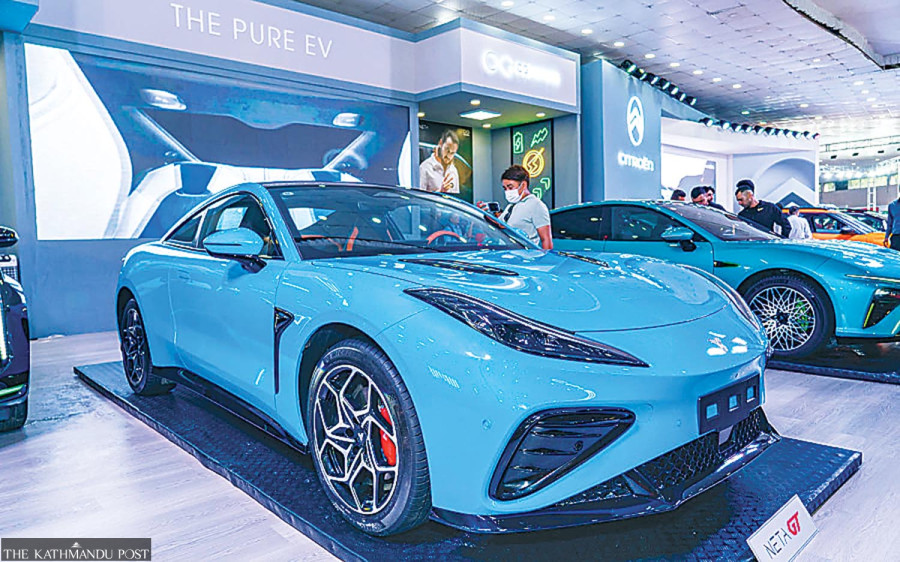
Importers say new levies could raise electric vehicle prices by Rs200,000 to over Rs10 million.New launches during the NADA auto show in Kathmandu on September 12, 2023. File Photo
The government’s new tax policy unveiled through the budget for the fiscal year 2026-27 has triggered sharp concern among electric vehicle importers and dealers, who say the revised structure will significantly increase vehicle prices and undermine Nepal’s transition towards cleaner transport.
Under the new provisions, the government has removed the excise duty previously imposed on electric vehicles and replaced it with a Clean Infrastructure Investment Fee (CIIF). While customs duty has been fixed at 20 percent for all vehicles, the CIIF ranges from 2.5 percent to as high as 130 percent depending on the vehicle’s customs value. A road construction fee of 5 percent and value-added tax of 13 percent will also continue to apply.
Automobile dealers estimate that the new tax structure could raise the price of electric vehicles by anywhere between Rs200,000 and more than Rs10 million, depending on the model.
“The increase may not be very large for entry-level vehicles, but the higher the vehicle price, the higher the tax burden,” said Dhruba Thapa, former president of the NADA Automobiles Association of Nepal. “Expensive electric vehicles will become much more expensive under the new system.”
The government has defended the change by arguing that the previous tax regime, which was based largely on motor peak power, had become controversial because importers could bring in vehicles with lower declared peak power ratings to secure lower tax rates. The new system instead calculates taxes on the basis of the vehicle’s customs value, expressed in Nepali rupees.
However, industry representatives say the revised approach has introduced greater uncertainty rather than stability.
For years, EV dealers had urged the government to adopt a predictable and stable taxation framework to support investment in the rapidly growing sector.
According to Thapa, the latest policy does the opposite. “The tax system has become even more unstable,” he said. “Vehicle prices may now fluctuate in the same way as gold or fuel prices because exchange-rate movements can push a vehicle into a different tax bracket.”
Gaurav Sharda, director of SPG Automobiles, the authorised distributor of Omoda and Jaecoo vehicles in Nepal, said taxes should have been determined in foreign currency rather than Nepali rupees.
“In recent years, the Nepali rupee has weakened while the US dollar and other foreign currencies have strengthened,” said Sharda. “When the exchange rate changes, the value of a vehicle in Nepali rupees also changes. That raises questions about how tax rates will be applied and creates uncertainty for businesses.”
Under the new system, electric vehicles with a customs valuation of up to Rs2 million will face a CIIF of 2.5 percent. Vehicles valued between Rs2 million and Rs3 million will be subject to a 20 percent levy. The rate rises to 35 percent for vehicles valued between Rs3 million and Rs4 million.
The steepest increases apply to higher-priced vehicles. Electric vehicles valued between Rs4 million and Rs5 million will attract a 90 percent levy, while those worth more than Rs5 million will face a 130 percent levy. Customs duty, VAT and road construction fees will be added on top of those charges.
Industry representatives say the sharp jumps between tax slabs will make many premium electric vehicles commercially unviable.
Sharda said vehicles currently selling for more than Rs6 million to Rs7 million would be hit hardest.
“A vehicle that previously sold in that range could see an additional tax burden of Rs2 million to Rs2.5 million,” he said. “Its final market price could exceed Rs9 million or even Rs9.5 million. It will become extremely difficult to import such vehicles.”
Even regular Omoda and Jaecoo models could become Rs200,000 to Rs400,000 more expensive, according to him.
Yamuna Shrestha, managing director of Cimex Inc, the authorised distributor of BYD vehicles in Nepal, said the changes would affect some of the country’s most popular EV models.
She estimated that the starting price of the BYD Atto 1 could rise to around Rs3.1 million, with higher-end variants could see price increases of approximately Rs3.6 million.
“The government says it wants to promote electric mobility, but at the same time the tax structure keeps changing,” said Shrestha. “The decision to calculate tax using Nepali rupees instead of dollars has added further uncertainty.”
She questioned how companies would manage vehicle bookings when exchange-rate fluctuations could alter the final tax burden before customs clearance.
“Today the vehicle may be expensive and tomorrow it may become cheaper, or vice versa,” she said. “The government needs to provide clarity.”
Bishnu Kumar Agrawal, managing director of MAW Group, said prices of Deepal vehicles would also rise.
“The Deepal S05 alone could become Rs200,000 to Rs300,000 more expensive,” said Agrawal.
He argued that several premium electric models may struggle to survive in Nepal’s market under the new tax regime. According to him, the abrupt jump from 35 percent to 90 percent and then to 130 percent is too large.
Former energy minister Kulman Ghising also criticised the policy, saying the overall tax burden on electric vehicles costing more than Rs5 million has effectively been brought close to that imposed on petrol and diesel vehicles.
“The policy sends a discouraging signal for the adoption and expansion of electric vehicles,” Ghising said. “It runs contrary to national goals of increasing consumption of domestically produced clean energy, reducing petroleum imports and promoting environmentally friendly transport.”
Nepal has emerged as one of South Asia’s fastest-growing EV markets in recent years, aided by hydropower expansion, favourable taxation and rising fuel costs.
Electric vehicles have steadily increased their share of annual passenger vehicle imports, helping reduce fossil fuel consumption and supporting the country’s clean-energy ambitions. Dealers warn that the new policy could slow that momentum.




 17.49°C Kathmandu