Seven years on, Parliament complex remains unfinished
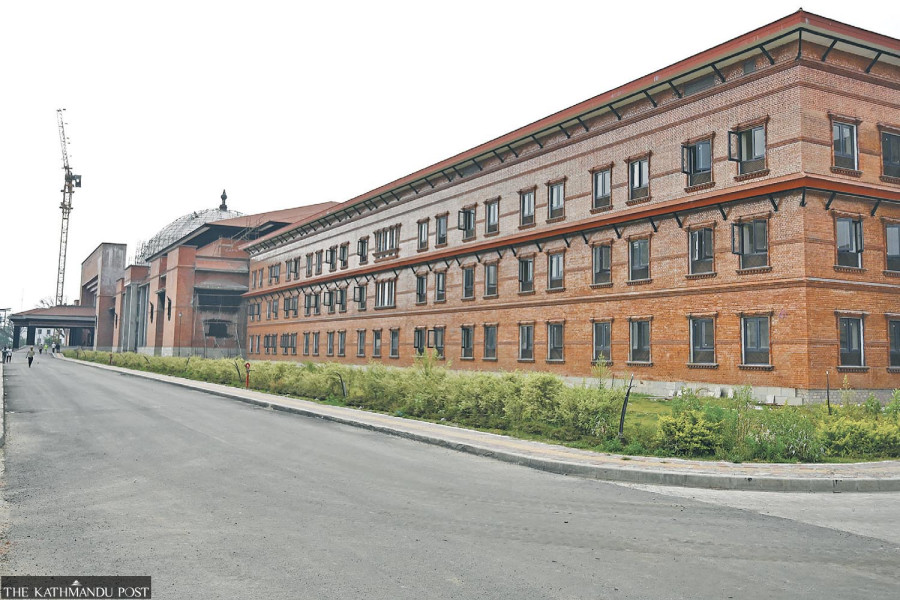
Officials are unable to provide a definitive timeline for completion of the Rs5.67 billion project. Parliament continues to operate from improvised chambers. The under-construction federal parliament complex pictured on May 20. Post file photo
Nearly seven years after construction began, Nepal’s new federal Parliament complex inside the Singha Durbar premises remains unfinished, with authorities preparing to extend the deadline for a sixth time.
No one, however, can say when the sprawling complex will finally be ready. Neither the Ministry of Infrastructure Development nor the Federal Parliament Secretariat has provided a definitive completion date.
The delay has forced Parliament to continue operating from makeshift facilities. A 300-seat multipurpose hall within the complex was hastily converted into the House of Representatives chamber after it became clear that the main parliamentary building would not be completed in time.
At the time, the Department of Urban Development and Building Construction had pledged to hand over the new building by the third week of May. That deadline passed, followed by the end of the fiscal year, but the project remains incomplete.
The construction contract was awarded on October 3, 2019, with the completion deadline set for October 3, 2022. The government had planned for the House elected in the 2022 general election to convene in the new building.
The prolonged delay has severely strained parliamentary operations, according to Ekram Giri, spokesperson and joint secretary at the Federal Parliament Secretariat.
“We have somehow managed to run the House in a single large hall,” Giri said. “We have no alternative at the moment.”
The National Assembly is operating from the lower House’s Agriculture and Natural Resources Committee’s meeting hall, which he says lacks adequate technical infrastructure.
“It is an old hall with weak technical support,” Giri said. “Using it also deprives the committee of its own workspace.”
Although the secretariat regularly seeks updates, it has received no firm timeline from the ministry overseeing the project.
“The work appears to be moving, but nobody can tell us when it will actually be completed,” he said.
The parliamentary complex consists of 12 separate buildings, meaning the project cannot be considered complete until every structure is finished.
As a result, parliamentary committees have been forced to juggle meeting schedules based on whichever rooms happen to be available.
“We constantly have to check which committee room is free before scheduling meetings,” Giri said.
The House of Representatives has 275 members, while the National Assembly has 59. Parliament also has ten House committees, four National Assembly committees and two joint committees. A shortage of functional meeting rooms has complicated committee work.
The main construction contract, worth Rs5.67 billion, was awarded to Tundi-Sec JV.
After missing its original completion deadline, the contract has been extended five times: first until April 13, 2023, then October 6, 2023; and April 1, 2024; and March 31, 2025, and most recently until December 31, 2025. Authorities are now preparing a sixth extension.
The repeated delays have drawn scrutiny from parliamentary committees, which have periodically inspected the site and urged contractors to speed up the work.
Successive National Assembly chairs and Speakers, among other high-ranking officials, have also visited the site over the years, publicly pressing contractors to complete the project.
Most recently, Speaker Dol Prasad Aryal has repeatedly inspected the site and taken a tougher stance with both contractors and government agencies. Despite the pressure, construction remains incomplete.
The project falls under the Ministry of Infrastructure Development, headed by Minister Sunil Lamsal.
Lamsal has gained attention for taking a hard line against contractors responsible for delayed road projects, threatening to terminate contracts, blacklist companies and pursue legal action. Critics say he has yet to show the same urgency over the prolonged delay in completing the Parliament building.
Roshan Shrestha, chief of the Special Building Construction Project, said only finishing work remains.
“The House of Representatives chamber is complete,” he said. “The National Assembly chamber is currently undergoing false ceiling installation and wall panelling.”
Once those works are completed, technicians will begin installing the audio system.
He said construction across the rest of the complex has also entered its final stage.
The interior contract, worth Rs2.35 billion, was awarded to KC-Shyamsundar-Baniya JV.
Signed on July 2, 2023, it was originally scheduled for completion by mid-July 2024. After repeated delays, the deadline was extended to March 29, 2025, then December 31, 2025, and later May 14, 2026. Even that deadline has expired, and officials are preparing a fourth extension for the interior contract.
The parliament complex is being built on 156 ropani (7.94 hectares) of land within the Singha Durbar premises and consists of several five-storey buildings. The project includes separate buildings for the House of Representatives and the National Assembly, a central lobby, offices for high-ranking officials, a library and a museum.
Additional facilities include buildings for parliamentary party offices, parliamentary committees, the parliament secretariat, a cafeteria and a press and printing centre. The complex is also designed to accommodate parking for 476 four-wheelers and 800 motorcycles, along with separate accommodation for security personnel.
Roofing work, contracted separately to Chainlink Engineering for Rs37.9 million, also remains unfinished despite being awarded on March 10, 2024. It, too, is expected to receive another deadline extension.
“The roofing work will still take some time,” Shrestha said.
He said the project initially relied on prefabricated materials from India but encountered repeated fitting problems. Contractors have since brought fabrication machinery to Nepal and are now manufacturing roofing components on-site.
“All the required materials have arrived,” he said. “Now we only need to fabricate and install them here.”
Shrestha said Nepal’s 15th amendment to the Public Procurement Regulations allows projects that have achieved more than 50 percent physical progress to receive a further extension.
“All contracts have technically expired,” he said. “But the amended regulations provide for deadline extensions, so we will proceed accordingly.”
Rabindra Bohora, director general for the Department of Urban Development and Building Construction, said the remaining work mainly involves finishing and technical testing.
“We had been preparing to penalise the contractors because both the construction and interior contracts repeatedly missed their deadlines,” Bohara said. “The delays stemmed largely from weak project management by the contractors. The government has not caused the recent delays.”
He said the revised procurement regulations now allow extensions for projects that have made substantial physical progress, and the Parliament complex qualifies under that provision.




 20.07°C Kathmandu