Nepal’s FDI commitments shrink as political turmoil dents investor confidence
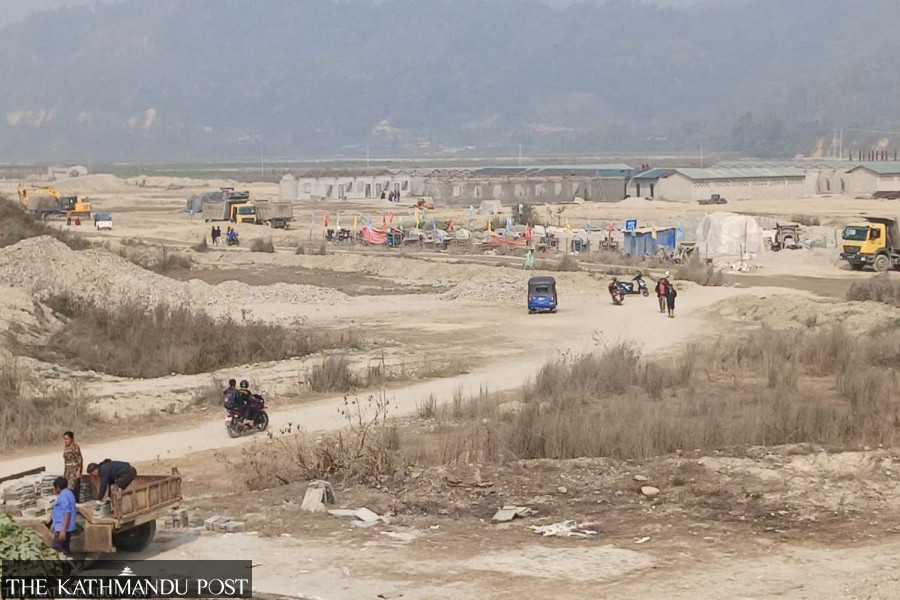
Foreign investment pledges declined to Rs58 billion in the last fiscal year amid political instability although actual FDI inflows more than doubled. The construction site of the buffalo meat processing plant, the Himalayan Food International, in Marin Rural Municipality in Sindhuli. Post file photo
Foreign direct investment commitments to Nepal fell by a double-digit rate in the last fiscal year, with experts attributing the decline largely to political instability, including the violent Gen Z anti-corruption protests that toppled the government within 24 hours.
Government data show that FDI commitments—investment amounts pledged by foreign individuals and firms—declined by 10 percent in the fiscal year ended mid-July.
According to the Department of Industry, Nepal received FDI commitments worth Rs58 billion for 1,117 projects during the review period. The pledged investments are expected to generate 28,645 jobs.
Nepal approves foreign investments through two channels: the conventional approval process and an automated route. Of the total commitments, Rs9.58 billion came through the automated system.
Large-scale industries accounted for the largest share of commitments, attracting Rs32.84 billion across 12 projects. Small-scale industries secured Rs22.14 billion for 1,093 projects, while medium-scale industries received Rs3 billion for 12 projects.
By sector, agriculture and forestry attracted the highest commitments at Rs23.18 billion for 18 projects. Tourism followed with Rs13.99 billion across 227 projects.
The energy sector received Rs7.16 billion for four projects, while the service sector attracted Rs4.91 billion through 71 projects. Manufacturing drew Rs3.93 billion for 64 projects. The information, communication and technology sector received Rs2.83 billion across 727 projects, while infrastructure attracted Rs1.8 billion for two projects.
Foreign investors repatriated Rs5.58 billion in profits during the last fiscal year, with the manufacturing sector accounting for the largest share at Rs4.38 billion.
China remained the largest source of FDI commitments, followed by India and Hong Kong, during the first 11 months of the last fiscal year, which ended in mid-June.
Prakash Kumar Shrestha, former vice-chairman of the National Planning Commission, said Nepal's political turmoil significantly affected investor sentiment.
"Nepal went through a major political crisis last year, which reduced investment commitments," he said. "Geopolitical tensions have also partly affected investor mood."
According to Shrestha, investors are likely to adopt a wait-and-watch approach under the new government.
"They will observe how stable Nepal's policies remain," he said. "Foreign investors are making long-term commitments, and policy consistency is one of their biggest considerations."
He added that attracting substantial foreign investment would remain difficult as long as domestic investors themselves remain reluctant to invest despite abundant liquidity in the banking system and relatively low interest rates.
Although FDI commitments declined, actual foreign investment inflows increased sharply.
According to Nepal Rastra Bank, Nepal received Rs22.82 billion in actual FDI during the first 11 months of the current fiscal year ended mid-June, more than double the Rs11.07 billion recorded during the same period a year earlier.
However, the gap between pledged investment and actual inflows continues to widen because of policy inconsistency, complex tax regulations and weak institutional support, experts say.
The World Bank's Business Ready Profile gave Nepal a score of 56.15 out of 100 for operational efficiency, 42.04 for public services and 61.46 for its regulatory framework.
The report evaluates the business environment from a microeconomic perspective by assessing the regulatory and institutional conditions firms encounter throughout their life cycle.
Meanwhile, the World Investment Report 2026, published by UN Trade and Development in July, noted that foreign direct investment accounts for less than a quarter of total external finance in least developed countries, while portfolio investment remains negligible.
The report said least developed countries face particularly acute challenges in attracting capital-intensive digital investments. Although developing economies have more than tripled greenfield investment in the digital economy since 2000, their share of global digital investment has remained largely unchanged at just over a third, indicating a slower transition towards digital investment than developed economies.
In November 2024, Fitch Ratings assigned Nepal a long-term foreign-currency Issuer Default Rating of 'BB-' with a stable outlook, citing low external borrowing, strong external liquidity and hydropower-driven growth potential as key strengths.
However, the agency said the speculative-grade rating also reflected persistent structural weaknesses, including fragmented coalition politics, policy uncertainty and governance shortcomings, which continue to weigh on fiscal consolidation efforts and investor confidence.
Krishana Prasain is a business reporter for The Kathmandu Post covering markets. Before joining The Kathmandu Post in 2018, she spent 3 years in New Business Age magazine covering business.




 14.81°C Kathmandu