Government buses keep displaced children in school—but at what cost?
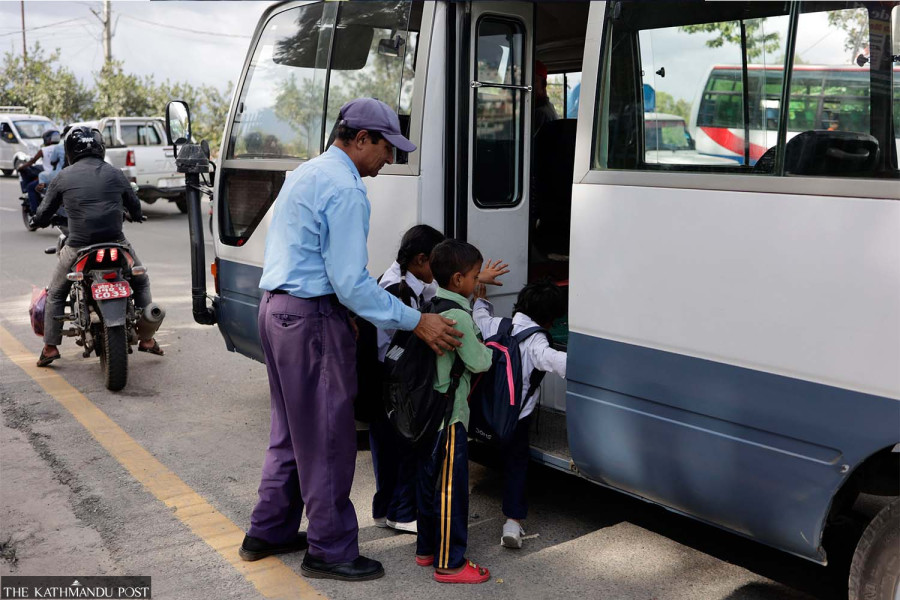
Children from Kathmandu’s holding centres endure hours in traffic to reach their schools, sparking debate over whether to prioritise school continuity or proximity. Three children of evicted squatter families board a bus on their way back to the Kharipati holding centre in Bhaktapur from Janabikas Secondary School at Balkhu on Thursday. Hemanta Shrestha/TKP
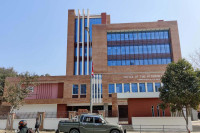
At the holding centre inside the Bode Agriculture Training Centre in Bhaktapur, 15 children wake up every morning to prepare for school. By 8 am, a government vehicle arrives to pick them up. They have a long road ahead.
Aryan, 7, for instance, attends Janabikas Secondary School in Balkhu, Kathmandu, more than 15 kilometres away. It takes anywhere between an hour-and-a-half and two hours for him to reach school. “By the time my children return in the evening, they are completely exhausted,” Punam Devi Paswan, Aryan’s mother, told Kantipur recently.
Meanwhile, Paswan’s elder son Shyam, 12, and two other children from the centre attend Paropakar Adarsha Secondary School in Bhimsensthan, over 12 kilometres away. It requires a similarly punishing commute through the Valley’s rush-hour traffic to reach their school.
Until July 11, Paswan’s family was residing at the Radha Swami Satsang holding centre in Kirtipur. At the time, Shyam and his peers walked over an hour each way to reach Paropakar Adarsha Secondary School. Although the Kathmandu Metropolitan City had previously coordinated with the Private and Boarding Schools’ Organisation Nepal (PABSON) to provide residential facilities for displaced students, families reported that they received neither boarding support nor dedicated transportation.
Things took a turn for the worse on July 11, when torrential rains caused severe flooding in the Kirtipur holding centre, forcing authorities to evacuate the squatter settlement. Officials transferred 77 individuals to Kharipati and 60 to Bode. The following day, Home Minister Sudan Gurung and a delegation of five Cabinet ministers visited Kharipati to inspect the condition of the displaced families. During the visit, the government promised dedicated transportation to ensure children would not miss school.
While the government fulfilled its promise by providing buses, the long distance between Bhaktapur and schools in Kathmandu has created a new set of challenges for the children.
Paswan said that her sons leave Bode at 8 am after having just two glasses of milk. “The school provides an afternoon snack, but no lunch,” she said. “They spend the entire day hungry and eat their first full meal only when they return in the evening. Sometimes my sons cry, complaining of severe hunger and exhaustion.”
The situation is nearly identical at the Kharipati holding centre, where 15 students reside. Menuka Gurung, who is taking shelter at Kharipati, worries constantly about her grandchildren, who attend Guhyeshwari Secondary School in Gairigaun, about 14 kilometres away.
“When we were in Kirtipur, they transferred my grandchildren to a nearby school in Balkhu,” said Gurung. “But the children ran away back to Guhyeshwari because they were attached to their old teachers and classmates. Now, traveling from Kharipati takes over an hour each way. I am relieved that the government bus carries them safely, but it pains me to see them unable to eat or rest on time.”
In total, 30 students from the Bode and Kharipati holding centres commute daily to ten different institutions spread across the Kathmandu Valley—Janabikas Secondary School in Balkhu, Paropakar Adarsha Secondary School in Bhimsensthan, Guhyeshwari Secondary School in Gairigaun and Thapathali, Srijanshil Secondary School in Babarmahal, Madan Bhandari Memorial College in Bijulibazar, Columbus School in New Baneshwar, Bishwa Niketan Secondary School and Bishwa Dev Multiple Campus in Tripureshwor, and NASA School in Tinkune.
Bus driver Ganga Lal Shrestha, who transports the children daily, confirmed the long commute. “It takes more than two hours to reach Balkhu from Bode,” said Shrestha. “If we depart at 7:30 am, we barely arrive by 9:30 am. Traffic jams are frequent, and delays are unavoidable if the children are not ready on time.”
Meanwhile, 15 displaced children relocated to the Ichangunarayan holding centre in Nagarjun were completely deprived of schooling for nearly two weeks following their relocation.
“Our children previously attended a school near Kharipati, where they could walk,” said Apsara Malik, who is taking shelter at Ichangunarayan. “Two weeks ago, authorities moved us here, and their education stopped entirely. We pleaded repeatedly, but nobody listened.”
Officials finally arranged for the Ichangunarayan children to attend Bal Bikas Secondary School in Raniban from Tuesday. “Now they must walk 30 minutes each way,” Malik added. “They do not even have proper school uniforms. Life here is very difficult.”
Sociologist Khagendra Bista, representing the High-Powered Committee for Integrated Development of the Bagmati Civilisation, defended the government’s transport arrangements. “The Ministry of Education coordinated transportation for students, while the Ministry of Labour managed transit for working adults,” said Bista. “We offered to enrol the children in schools near the new holding centres, but the parents insisted on keeping them in their original schools. We arranged the buses to respect their wishes.”
Bista acknowledged the two-week gap in education for children at Ichangunarayan, stating that local officials have now coordinated with nearby community schools to ensure all displaced children resume their studies.
Educationalists, however, argue that lengthy commutes inflict unnecessary hardship on young learners. Professor Bidya Nath Koirala said that spending three to four hours daily in traffic severely impacts children’s health and learning capacity.
“Subjecting young children to two two-hour commutes daily in heavy traffic is an immense burden,” said Koirala. “The municipal authorities and school administrators must establish dialogue immediately to integrate these displaced children into schools located in the immediate vicinity of the holding centres.”




 18.54°C Kathmandu