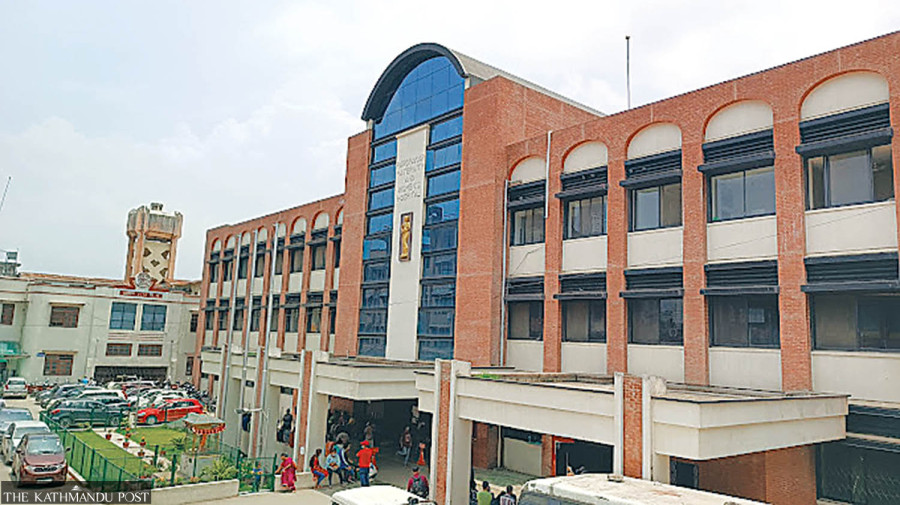
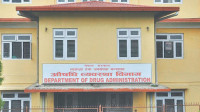
Paropakar Maternity and Women’s Hospital in Thapathali, the country’s largest maternity hospital, says specialist shortages and critical care gaps make treating complications beyond obstetric care difficult. The Paropakar Maternity and Women’s Hospital at Thapathali, Kathmandu. Post File Photo
A woman in her early 30s collapsed while being shifted from the post-operative ward to the general ward at Thapathali-based Paropakar Maternity and Women’s Hospital just before the start of the Dashain holidays last month.
Her family members had rushed her to Kathmandu from Dhading for childbirth, believing that a specialised maternity centre in the capital city would offer her the safest care.
“Everything was normal, and the woman was taken to the general ward in a wheelchair 18 hours after giving birth,” said Dr Shree Prasad Adhikari, director at the Hospital. “But when she got up from the wheelchair to lie on the bed, she collapsed and died within minutes, before doctors could assess her condition.”
Nepal has made remarkable progress in reducing maternal and neonatal mortality over the years, and received the Millennium Development Goals (MDGs) award. Yet preventable deaths continue to occur in tertiary care centres. This points to persistent gaps in the quality of care, the availability of skilled health workers, and access to essential services.
These shortcomings continue to hamper further reductions in maternal and neonatal mortality.
The incident at Thapathali Hospital, the national referral centre for maternity patients requiring specialised care, is neither the first of its kind nor likely to be the last. On Sunday evening, another woman developed a deep vein thrombosis, a condition in which a blood clot forms in a vein, usually in the leg. Doctors at the hospital say it is a postpartum complication.
“We immediately rushed the woman to Bir Hospital and admitted her to the critical care unit,” said Adhikari. “The woman survived, but we could not save a patient who suffered a similar complication a few weeks ago.”
The woman who died had suffered a pulmonary embolism, in which a blood clot blocks a blood vessel in the lungs. She died within minutes. Her family and relatives protested at the hospital throughout the day, alleging negligence by hospital staff.
These incidents point to a troubling reality: admission to a tertiary care hospital does not necessarily mean a patient is out of danger. Experts say the problem extends beyond Thapathali Hospital, with similar incidents regularly reported at provincial and other federal hospitals across the country.
A few months ago, a woman in her mid-20s died aboard a helicopter while being airlifted to Kathmandu from Karnali Provincial Hospital in Surkhet for further treatment.
Doctors had referred her to Kathmandu after her health condition deteriorated following childbirth. But she died during the flight.
“Not only mothers but also newborns die from complications, and the causes often remain unknown,” said Dr Amit Singh, chief of the hospital’s Department of Obstetrics and Gynaecology at Surkhet Hospital. “In many cases, we are unable to establish the actual cause of death. We can only speculate that it might have been one complication or another.”
Surkhet Hospital receives two to three complicated delivery cases every week. On Tuesday, a woman in labour was airlifted from Dolpa to the hospital.
Doctors at Thapathali Hospital say they cannot manage all complicated cases, while some patients have to be referred elsewhere, while others succumb to their complications. They say maternal and newborn deaths could be reduced if basic services were ensured and the authorities invested more in strengthening health facilities.
They complain that even tertiary care centres considered well-equipped lack basic requirements such as trained staff, sufficient number of staff, and advanced equipment.
“We don’t have a cardiologist, nephrologist, or critical care specialist at our hospital,” said Dr Adhikari, the director of Thapathali Hospital. “Pregnant women from across the country come here for delivery services, believing that our services are affordable and safe. But when patients develop critical complications, we have to refer them elsewhere for critical care and specialist services, including cardiology and nephrology.”
Doctors warn that transferring critically ill patients to other hospitals is itself fraught with risks. Finding intensive care beds at state-run hospitals is often difficult. Even when a bed is available, transporting patients by ambulance can be dangerous, as most ambulances in Nepal are not adequately equipped to provide advanced life support during transit.
Thapathali Hospital has a 10-bed intensive care unit for mothers, but it is only a Category B facility. A Category B Intensive Care Unit generally refers to a secondary-level or intermediate-capacity facility that provides critical care to patients needing close monitoring. Doctors say critically ill patients need to be admitted to Category A units, where critical care physicians can monitor and treat the patients.
“Two nurses have to care for 10 patients admitted to the intensive care unit at a time,” said Adhikari. “We have to call specialists from other hospitals when complications arise, and delays in receiving treatment can put patients’ lives at risk.”
The hospital refers around a dozen critically ill mothers and nearly three dozen infants to other hospitals every month for specialised critical care.
Maternal health experts say Nepal has made remarkable progress in reducing maternal mortality. The country reduced its maternal mortality ratio from 539 per 100,000 births in 1996 to 239 in 2016.
The country has reduced maternal deaths by over 70 percent since 2000, according to the World Health Organisation. The UN health body, in its latest report, stated that currently 142 Nepali women die from maternity-related complications per 100,000 live births.
Various measures have helped achieve this, including free institutional delivery at state-run health facilities and at facilities that have implemented the government’s safe motherhood programme.
Since the government introduced free institutional delivery services at all state-run health facilities in 2009, more than 2,800 birthing centres have been opened across the country. The institutional delivery rate, which was around 18 percent then, has increased to 90.5 percent in 2025.
Promoting institutional deliveries attended by skilled birth attendants is a key government priority and is credited with curbing maternal and child mortality rates.
However, despite the rise in institutional deliveries, maternal deaths or deaths during child delivery remain a concern.
Studies have identified hypertension, postpartum haemorrhage, pre-eclampsia and eclampsia (pregnancy-related high blood pressure disorders), referral delays, and mismanagement as the major causes of maternal deaths. Other causes include infections, unexplained complications, amniotic fluid embolism—a rare and unpredictable medical emergency—and complications arising from abortions, as well as underlying heart conditions.
Experts say only multidisciplinary hospitals, with specialists from different medical fields available under one roof, can identify the causes of complications and provide timely, life-saving treatment.
“A critical care facility can make a huge difference,” said Dr Singh of Surkhet hospital.
A recent study by the Ministry of Health and Food Safety in all seven provinces found that nearly three out of four maternal deaths in Nepal occur in health facilities or while patients are being transported to them.
The report attributes the deaths to weak referral mechanisms, limited functionality of health facilities, and delays in receiving timely and quality care.
“Expensive equipment alone cannot reduce maternal deaths. Quick gains are possible with modest efforts, but further progress requires substantial investment and strong political will,” said Dr Pawan Sharma, a maternal health expert. “Patients and their relatives can feel safe only when the government ensures specialised care. Investment in this area must increase.”
Public health experts have expressed concern over a study showing a rise in maternal and neonatal deaths occurring at health facilities.
Arjun Poudel is a health reporter for The Kathmandu Post. Before joining the Post, he worked for Sagarmatha Television, Naya Patrika, Republica and The Himalayan Times.




 16.73°C Kathmandu