



 22.94°C Kathmandu
Thu, Oct 22, 2026
Money
Foreign tourists are staying longer, but spending less in Nepal
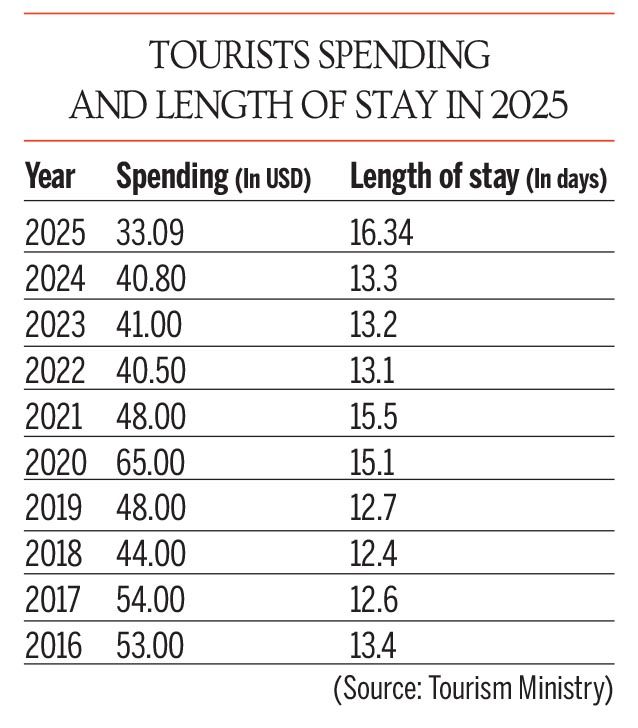
Average tourist stay hit a record 16.34 days in 2025, but daily spending fell to $33.09, the second-lowest on record. Hoteliers blame weak transport safety, price wars and political disruptions for keeping high-value travellers away despite a boom in luxury hospitality.
bookmark![]()
Sangam Prasain
Published at : July 21, 2026
Updated at : July 21, 2026 06:56
Kathmandu
Foreign tourists are staying in Nepal longer than ever, but they are spending less each day, raising fresh concerns about the country’s ability to attract high-value visitors despite a surge in investment in luxury hotels and resorts.
According to government statistics, the average length of stay of foreign tourists reached a record 16.34 days in 2025. However, their average daily spending fell to $33.09, the second-lowest level on record and far below the regional average of $100-150.
The figures highlight a growing mismatch in Nepal’s tourism industry. While visitors are extending their trips, largely due to trekking, mountaineering and leisure travel, businesses say the country is failing to convert longer stays into higher tourism earnings.
Tourism ministry data shows tourist spending has been on a long downward trend since peaking at $79.1 per day in 2003.
The lowest spending on record was $31.9 in 1996, when Nepal received 393,613 tourists. This was the time when the Communist Party of Nepal (Maoist) launched an armed “People’s War” against the government to overthrow the constitutional monarchy and establish a communist republic. Led by Pushpa Kamal Dahal, the Maoists initiated the conflict by launching simultaneous attacks on police posts across multiple districts.
The tourism ministry said the latest length-of-stay figures now are more reliable because, from 2025 onwards, they are generated through a centralised electronic tourism management information system rather than traditional estimation methods.
According to the ministry, the record stay indicates that tourists are spending more time exploring Nepal’s natural and cultural attractions, supported by improved tourism services and better promotion.
Longer stays are generally considered a positive indicator because visitors spend more on accommodation, food, transport and activities, boosting the economy.
But hoteliers say the expected financial gains have not materialised.
“To be honest, our airspace and roads are not safe and, as a result, rich tourists normally avoid visiting Nepal,” said hotelier Yogendra Shakya. “If we want to attract tourists who spend more, the first reform should be in the transport sector.”
He said Nepal now has luxury resorts and hotels comparable to international standards, but safety concerns continue to discourage affluent travellers.
Nepal has remained on the European Commission’s air safety blacklist since December 2013, preventing Nepali airlines from operating in European skies and reinforcing concerns over aviation safety.
In 2025, Nepal welcomed 1.05 million foreign tourists, of whom 91 percent arrived by air, underlining the country’s heavy dependence on air connectivity. Another 146,630 visitors entered through land border points.
Despite crossing the one-million mark for the third consecutive year, arrivals have yet to recover to the pre-pandemic level recorded in 2019.
Tourism entrepreneurs say recurring plane crashes, poor highway infrastructure and weak international promotion continue to undermine Nepal’s competitiveness.
At the same time, Nepal has witnessed a wave of investment in high-end hospitality.
Luxury properties including Shinta Mani Mustang, Dusit Thani Himalayan Resort & Spa, The Terraces Resort & Spa in Lakuri Bhanjyang and Kavya Resort in Nagarkot have opened in recent years, with more projects under development.
Marriott International, in partnership with CG Hospitality, is also developing two ultra-luxury hotels in Kathmandu, including a Rs15 billion Ritz-Carlton in Thamel.
However, many of these running properties have struggled to achieve expected occupancy levels.
Hoteliers say aviation accidents, road safety concerns, political instability and last year’s Gen Z protests during the peak autumn tourism season significantly hurt bookings and tourist spending.
An official at Dusit Thani Himalayan Resort & Spa, requesting anonymity, said the resort faced severe challenges during and after the Gen Z protests.
“We have recovered now,” the official said. “Wedding and anniversary celebrations, mostly from India, have increased. Indian guests usually book three-night packages.”
Industry insiders say Nepal has enormous potential in the luxury tourism segment, but repeated natural disasters, aviation accidents and political unrest continue to erode traveller confidence.
Mid-range hotels, meanwhile, remain less dependent on foreign arrivals as they continue to rely heavily on domestic travellers.
Shakya said the growing number of Indian visitors, many travelling for trekking and mountaineering, has contributed to the longer average stay.
“But we still doubt whether all the money they [Indian] spend in Nepal is formally channelled through the banking system, particularly spending on shopping, restaurants and local transport,” he said.
Mani Raj Lamichhane, director of the Nepal Tourism Board, attributed the decline in daily spending partly to the appreciation of the US dollar against the Nepali rupee, which has made Nepal cheaper for international tourists.
“The rapid increase in the number of hotels and resorts has also intensified unhealthy price competition,” Lamichhane said.
Luxury hotels, in particular, continue to offer rooms at rates significantly below pre-pandemic levels in an effort to attract guests.
Nepal currently has more than 1,600 hotels capable of offering around 64,000 room nights, including 222 star-rated properties.
According to the government’s latest report, travel remained Nepal’s largest service export in fiscal year 2024-25, generating Rs88.66 billion and accounting for 37.15 percent of total service exports.
However, as global uncertainty persists, including the conflict in West Asia, Nepal’s tourism industry has become increasingly reliant on domestic travellers while spending by international visitors has remained largely stagnant at pre-Covid levels.
Shakya said hotels and resorts around the Kathmandu Valley and in other destinations now depend heavily on Nepali guests to sustain operations.
He also pointed to broader global economic factors behind weaker visitor spending.
Inflation has eroded household purchasing power worldwide, encouraging tourists to take more budget-conscious trips. Rising airfare and fuel costs have also forced travellers to cut spending on accommodation and dining, while the growing popularity of short-term trips has diverted business away from full-service hotels.
“As a result of the rising airfare, the number of Indian tourists has reached record levels in Nepal and they are staying longer,” Shakya said.
The ruling Rastriya Swatantra Party has pledged to double annual tourist arrivals to around 2.5 million and significantly increase tourism earnings within five years.
Tourism entrepreneurs say private investment in hotels and resorts continues to pour into the sector, but unless the government improves transport safety, infrastructure and destination promotion, filling thousands of newly built rooms with high-spending international visitors will remain a daunting challenge.
Sangam Prasain
Sangam Prasain is Business Editor at The Kathmandu Post, covering tourism, agriculture, mountaineering, aviation, infrastructure and other economic affairs. He joined The Kathmandu Post in October 2009.

Most Read from Money
Nepal travel agents threaten to stop selling Thailand trips over visa rules

Why does an hour long flight to Dhangadhi cost more than a flight to New Delhi?
Malaysia rejects Nepal’s demand to open recruitment to all manpower agencies

No school, but a graduation cap for women dairy farmers
Nepal arrests four medical service providers as Malaysia recruitment row deepens
Editor's Picks




E-PAPER | October 22, 2026

×