Bird flu hits 162 poultry farms; Rs507 million paid in compensation
The government has compensated 104 affected farmers after culling more than 835,000 birds, while officials say fresh claims could require another Rs100 million.
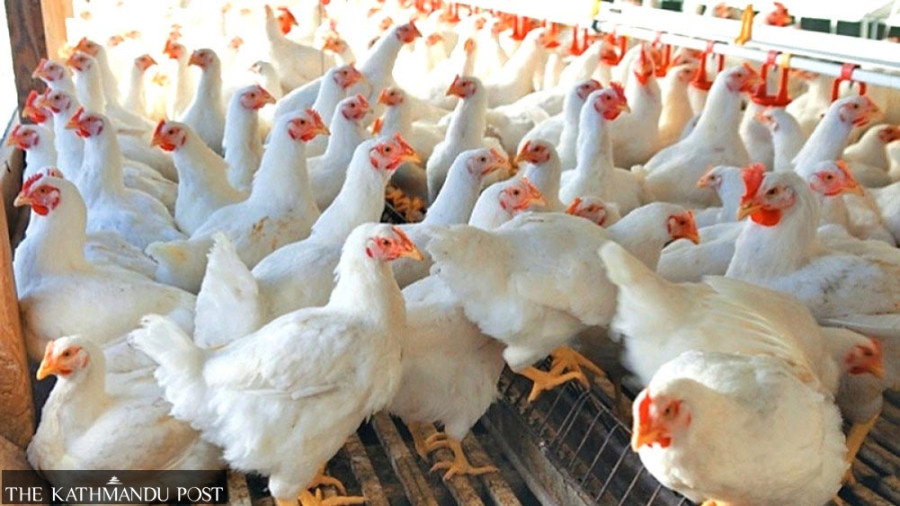
Bird flu outbreaks have affected 162 poultry farms across Nepal over the past four months, with the government distributing more than Rs507 million in compensation to affected farmers, according to the Department of Livestock Services.
The department said compensation totalling Rs507.1 million has been deposited into the bank accounts of 104 affected farmers and poultry farms.
Senior Veterinary Officer Mukul Upadhyay said the Ministry of Agriculture, Forests and Environment allocated Rs500 million for compensation at the end of the last fiscal year, and the entire amount has already been disbursed. The department has been allocated Rs20 million for compensation during the first four months of the current fiscal year.
Upadhyay said additional claims are expected, and the department estimates it will require around Rs100 million more to meet compensation payments.
“Since mid-July, all test results have been negative,” he said. “Farmers are receiving compensation, and we expect infections to continue declining.”
He clarified that compensation is provided only for birds culled by the government as part of disease control measures, not for birds that die from the infection.
“Not every affected farm is eligible for compensation,” Upadhyay said. “In many cases, birds die before culling takes place. Compensation is paid only for birds destroyed by the government.”
According to the department, authorities culled 835,563 birds to contain the outbreaks. They also destroyed 1,225,536 eggs and 264,213 kilograms of poultry feed.
Bird flu was first confirmed in the last fiscal year 2025-26 on February 16 in Sundarharaicha-4 and Urlabari-8 of Koshi Province. By the end of the fiscal year, the disease had spread to 162 farms across 12 districts.
Bhaktapur recorded the highest number of infected farms, with 45 outbreaks. Kathmandu reported 32 affected farms, followed by Kavrepalanchok with 27, Sunsari with 23, Lalitpur with 15, Morang with 11 and Jhapa with four. Cases were also confirmed in Chitwan, Nawalparasi West, Bara and Mahottari.
The highest number of birds was culled in Sunsari, where authorities destroyed 285,531 birds. A further 135,158 birds were culled in Bhaktapur, 111,407 in Kathmandu and 104,659 in Morang.
The Kathmandu Valley and neighbouring Kavrepalanchok together accounted for 119 confirmed outbreak sites.
Under the Bird Flu Control Regulation (Fourth Amendment), 2017, owners are entitled to compensation of up to 75 percent of the assessed value of birds, poultry products and related materials destroyed under official disease control measures.
The Standards for Relief for Items Destroyed During Bird Flu Control, 2022 provide that each district forms a compensation committee chaired by the chief district officer. The committee assesses losses, determines compensation rates and authorises payments. Compensation is available only when birds and related materials are destroyed under the committee's supervision.
Tilchandra Bhattarai, a member of the Nepal Poultry Federation, said he received around Rs100 million in compensation after authorities culled 150,000 chickens at his farm in Sunsari.
“My total losses were between Rs180 million and Rs200 million,” Bhattarai said. “The compensation arrived only recently. It will certainly provide some relief to the business.”
Although the outbreak has largely been brought under control, the Department of Livestock Services warned that the risk of further infections remains.
The department identified several major risk factors, including poultry farms located near tall trees that attract wild birds, farms situated close to wetlands, poor compliance with biosecurity standards, unrestricted movement of vehicles and visitors, and the reuse of egg crates without proper disinfection.




 24.59°C Kathmandu