



 17.63°C Kathmandu
Sat, Oct 24, 2026
Money
Army retiree turns family farm into thriving dairy enterprise
Helped by local government support and growing demand for value-added dairy products, Shiva Bahadur Basnet of Dhankuta has built a business that creates jobs, boosts farmers’ incomes and strengthens the local rural economy.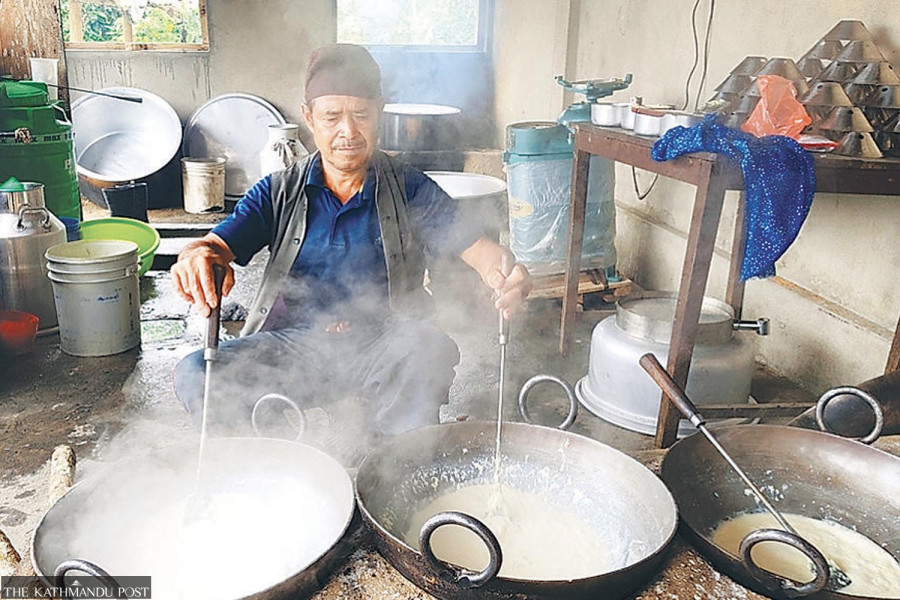
bookmark
Binod Ghimire
Published at : July 14, 2026
Updated at : July 14, 2026 07:04
Dhankuta
Every morning, Shiva Bahadur Basnet of Dandagaun, a hill settlement in Dhankuta's Mahalaxmi Municipality, sets out across his village to collect milk. The rest of his day is spent boiling the milk in large vats, stirring it for hours to make kurauni (caramelised milk fudge), packaging the products, and delivering them to customers.
After serving 17 years in the Nepali Army, Basnet chose not to rely on his pension or seek foreign employment. Instead, he transformed his family's traditional livestock farming into a modern dairy enterprise.
Today, his dairy processing business provides employment not only for his family but also for local residents. The kurauni produced at his plant is sold in Dhankuta as well as Kathmandu and Sankhuwasabha.
Basnet raises improved breeds of cows and buffaloes on his farm, and also collects milk from local farmers. Every member of his family is involved in the business.
One of his two sons works abroad, while the other manages milk collection, production of kurauni and chhurpi (hard cheese), and marketing. His wife and two daughters-in-law assist with production, and the enterprise also employs several local youths.
Initially, Basnet produced only kurauni. However, as milk production increased, unsold milk began to spoil, and this prompted him to diversify into chhurpi and ghee production. He now processes around 250 litres of milk daily into kurauni, depending on orders.
"There is no shortage of orders," Basnet said. "The real challenge is the poor road network, which makes it difficult to deliver products on time."
The kurauni produced in Dandagaun sells for Rs700 per kilogram, and demand continues to grow, he said.
Mahalaxmi Municipality is well known for dairy farming. To capitalise on the area's potential, Basnet has cultivated fodder grass on 20 ropani (1.02 hectares) of land. By producing his own fodder, he has overcome one of the biggest challenges facing livestock farmers.
"We grow grass on our own land, so we don't face any shortage of fodder," he said.
Basnet's success has also encouraged other farmers in the village. Previously, they struggled to find markets for their milk. Now, they can sell it locally, where it is processed into value-added dairy products.
Recognising the area's potential, the municipality has prioritised dairy production and launched various support programmes with assistance from the federal and provincial governments. Wards 1, 3 and 6 have been designated as dairy pocket areas, where farmers receive improved cows and buffaloes under cost-sharing schemes.
Dhruva Raj Rayamajhi, mayor of Mahalaxmi Municipality, said that in the fiscal year 2023-24, 25 farming households in ward 1 received improved cows under a 50 percent cost-sharing programme funded through a conditional federal grant. In the following fiscal year, 50 farming households in ward 6 received 50 buffaloes through a similar programme supported by a conditional provincial grant.
During the current fiscal year, with continued federal government support, 25 farmers in Dandagaun, ward 3, have each received a grant of Rs100,000 to purchase improved cows and upgrade their cattle sheds. Farmers contribute the remaining 50 percent of the investment under the cost-sharing arrangement.
Basnet said the municipal assistance has been instrumental in expanding his business.
"Support for purchasing cows, improving sheds and other facilities has made it much easier to grow the enterprise," he said.
Local farmer Ranjita Basnet said she received not only a subsidy to purchase a cow under the dairy pocket programme but also assistance to buy a chaff cutter machine and improve her cattle shed.
Rayamajhi said the municipality has also distributed solar-powered systems for boiling cattle feed and heating water to reduce farmers' production costs.
"Our policy is to prioritise areas based on their comparative advantages," he said. "The municipality will always support farmers who are committed to increasing production."
Ghumauane, Murtidhunga, Marek and Katahare are major centres for livestock farming, dairy production and vegetable cultivation in the municipality. The Melangchung area in ward 5 has been developed as a turmeric pocket, while vegetable pocket programmes are being implemented in Ghumauane and Murtidhunga. The municipality also plans to further strengthen ward 6 as a buffalo pocket area and ward 3 as a cow pocket area.
Milk production in Mahalaxmi is no longer limited to farming alone. The municipality has gradually expanded the entire value chain—from processing to marketing. As locally produced milk is increasingly processed within the village, the dairy industry is emerging as a reliable pillar of the rural economy through value addition, employment and higher incomes for farmers.


Most Read from Money

Why does an hour long flight to Dhangadhi cost more than a flight to New Delhi?
Nepal travel agents threaten to stop selling Thailand trips over visa rules
Malaysia rejects Nepal’s demand to open recruitment to all manpower agencies
No school, but a graduation cap for women dairy farmers
Nepal arrests four medical service providers as Malaysia recruitment row deepens
Editor's Picks




E-PAPER | October 24, 2026

×