Ignored safety rules drive up deadly accidents in Phewa Lake
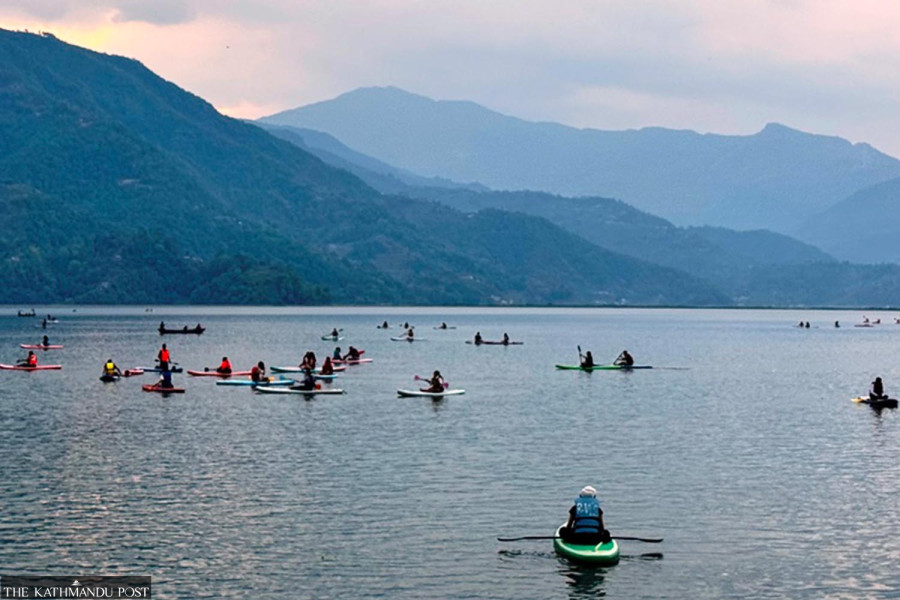
The craze for stand-up paddleboards has brought thrill to Pokhara’s iconic lake, but weak oversight and poor compliance are putting lives at risk. Tourists enjoy stand-up paddleboarding on Phewa Lake. Deepak Pariyar/TKP
On June 23, 19-year-old Amar Thapa from Ram Bazar, Pokhara, went to Phewa Lake to try stand-up paddleboarding (SUP), a water sport that has rapidly caught the attention of the city’s youth.
Thapa paddled into the lake after 6 pm. Within less than an hour, the outing turned fatal. At around 6:40 pm, he fell into the water and disappeared.
A disaster management team from the Armed Police Force, Pokhara, including trained deep-water divers, recovered his body at around 9:10 pm from a depth of about 25 feet. Police detained the lifeguard working for the paddleboard operator immediately after the incident and arrested the company owner the following day. Both were charged with causing death through business negligence and have since been released on bail.
Thapa’s death was not an isolated tragedy. Eight people lost their lives in Phewa Lake in the last fiscal year alone, according to records maintained by security agencies.
The deaths expose a growing safety crisis in one of Nepal’s most popular tourist destinations, where new recreational activities have expanded faster than regulations and enforcement mechanisms.
On February 14, 24-year-old Adit Gurung died after his car veered off the road near Gaira Chautara and plunged into the lake. On April 10, 32-year-old Nisu Bhagat (Agarwal), a resident of Siliguri, India, drowned while swimming. On May 1, 10-year-old Aarish Lama from Khapaudi died while swimming in the lake. Weeks later, on May 21, 27-year-old Riwaj Gurung from Kahun Khola, in Pokhara, also drowned while swimming.
The fatalities continued into June. A day after Thapa died on a stand-up paddleboard, 34-year-old Shankar Nepali from Nayabazar drowned at around 5:30 pm while fishing near Khapaundi.
Concerned by the rising number of incidents, the District Administration Office (DAO) issued a safety notice on June 25 along with stricter rules for boats, kayaks and surfing equipment operating on the lake.
The notice required all water sports operators to register their businesses, provide life jackets to customers, maintain safety insurance coverage, follow designated operating hours and monitor weather conditions before allowing activities. The administration also warned of legal action against businesses that ignored the rules.
But the directives have done little to prevent further deaths.
On July 10, 36-year-old Rohit Kumar from Bihar, India, fell into the lake near Tal Barahi Temple while visiting Pokhara with friends. Rescue personnel stationed at a nearby Armed Police Force monitoring tower responded immediately but failed to save him.
Five days later, the body of 50-year-old Bir Bahadur Rai, originally from Sindhuli and living in Ratnachowk, Pokhara, was found floating near the lakeshore.
Whenever emergencies occur on Phewa Lake, rescue teams from the APF Kalika Battalion are deployed. Personnel from the 24th Battalion operate round-the-clock from the Phewa Watch and Rescue Tower at Barahighat.
According to battalion records, 28 major water-related incidents occurred in the 2025-26 fiscal year. These included wooden boats, kayaks and stand-up paddleboards capsizing because of sudden winds or human negligence, as well as drowning incidents and people entering the water in risky circumstances. Rescue teams saved 85 people, but eight people died.
Inspector Binod Paudel, chief of the Gandaki Province Disaster Management Team under the APF, said 20 personnel work in two shifts at the rescue tower daily. At least three deep-water divers remain on standby at all times.
However, rescue capacity has not matched the increasing number of recreational activities on the lake.
Data from the Kaski District Police Office show nine people drowned in Phewa Lake in fiscal year 2023-24 and four in 2024-25. Five of those who died in the latter year were children.
Kumar Pariyar of Pumdibhumdi, who has operated wooden boats on Phewa Lake for more than a decade, says he has witnessed the risks created by the rapid growth of stand-up paddleboarding.
According to him, many young users venture into the lake alone, remove life jackets while swimming or enter the water after consuming alcohol.
“Many people take these boards out without understanding the risks. A small gust of wind can overturn them,” Pariyar said. “If someone does not know how to swim, they can disappear under the water within seconds.”
He added that during storms, traditional wooden boat operators often assist APF rescue teams in saving people stranded in the lake.
Balaram Giri, chairman of the Phewa Boat Entrepreneurs’ Committee, said 767 wooden boats and 72 large motor-assisted boats operate under the official committee. However, hundreds of stand-up paddleboards are now available for rent through 42 operators, including private rental companies, hotels and lakeside restaurants.
Neither the local administration nor Pokhara Metropolitan City has an exact record on how many paddleboards are available to use on the lake.
A paddleboard can be rented for as little as Rs200 per hour. Giri said only five of the 42 operators have obtained permits from the local government.
“Stand-up paddleboards are unstable by nature. Even a small wave can overturn them,” Giri said. “The bigger problem is that they operate without proper monitoring. The metropolitan city has failed to introduce clear operating guidelines, and the sector has grown largely unregulated.”
Stand-up paddleboarding was introduced to Phewa Lake around seven or eight years ago by Paddle Nepal. But its popularity surged sharply over the past two years, with operators expanding across the lakeside area.
Assistant Chief District Officer Chitrangad Baral said the administration intervened after receiving repeated complaints about unregistered water sports businesses, lack of price lists, failure to provide receipts, absence of safety insurance and unsafe operating practices.
The June 25 directive required all water sports operators to register and renew permits before continuing operations. It also made life jackets compulsory for every user.
Operators must provide customers with safety briefings covering basic navigation, possible hazards and emergency procedures before allowing them onto the water. They are prohibited from serving people under the influence of alcohol or drugs and must refuse service to anyone appearing intoxicated.
The rules also prohibit children aged 16 and below from using paddleboards or boats without adult supervision. Operators must maintain continuous visual contact with customers and ensure immediate rescue assistance in case of emergencies.
To address monsoon-related risks, the administration has prohibited boating, kayaking, and surfing after 2 pm during adverse weather conditions. All water tourism activities must stop after 6 pm every day.
Compliance remains weak.
Deputy Superintendent of Police Namraj Bhattarai of the Baidam Ward Police Office acknowledged that many operators continue to ignore safety requirements.
“We have repeatedly detained operators violating safety protocols and released them after they signed written commitments,” Bhattarai said. “Many recent accidents have occurred because people enter the water after consuming alcohol.”
Pokhara Metropolitan City Mayor Dhanraj Acharya said the city has drafted a Water Transport Act to regulate recreational activities on the lake.
“The act will come into force within a few days after its publication in the official gazette,” Acharya said. “We believe strict registration requirements, clear standards, and active regulation will help reduce accidents.”
For now, Phewa Lake continues to draw visitors seeking adventure, but the absence of effective monitoring has turned a popular recreational activity into a growing public safety concern.




 14.81°C Kathmandu
.jpg)