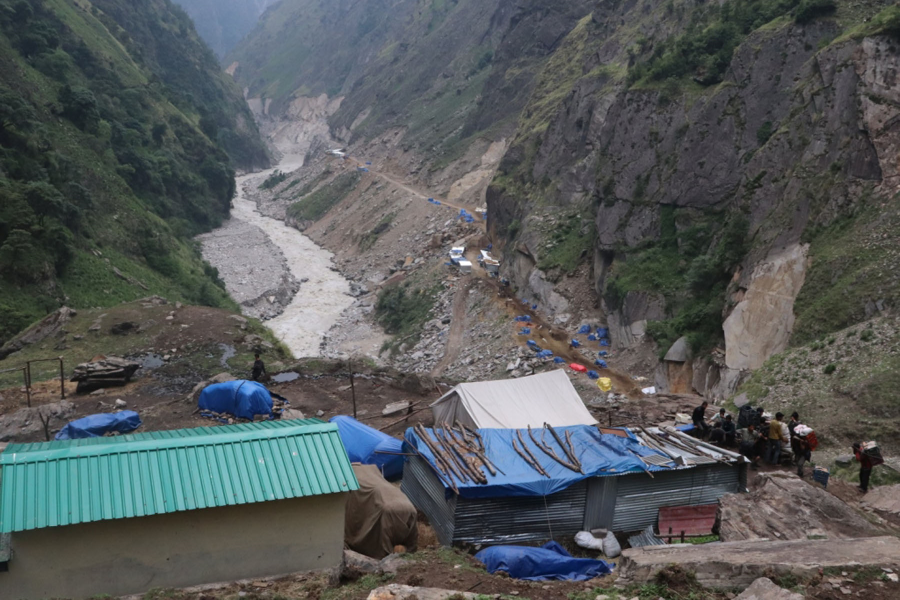
After years of hiatus, India and China have decided to resume the Kailash Mansarovar Yatra via Lipulekh, a strategic Himalayan pass at the Nepal—India—Tibet trijunction, currently administered by India but claimed by Nepal.
Issuing a statement on Thursday, India’s Ministry of External Affairs said, “Kailash Manasarovar Yatra organised by the Ministry of External Affairs in coordination with the Chinese government is set to take place from June to August 2026.”
Ten batches, each consisting of 50 pilgrims, are scheduled to travel through India’s Uttarakhand state, crossing over at Lipulekh Pass. Similarly, another 10 batches, each with 50 pilgrims, would travel through Sikkim State, crossing at Nathu La Pass.
The Lipulekh Pass, known as Pulang-Gunji in the local Tibetan dialect, is one of three villages located in the Kalapani area. Though currently under Indian control, Nepal has consistently asserted its claim over the area.
Nepal has previously protested India and China's making bilateral arrangements over Lipulekh in 2015 and 2020. The new announcement has reignited concerns about Nepal’s sovereignty and put pressure on the government of the Rastriya Swatantra Party (RSP) to raise this issue with both India and China.
Asserting its claim to the land, Nepal has written several diplomatic notes to India and China and has raised the issue with leaders of both countries multiple times. The Ministry of Foreign Affairs has also repeatedly issued statements asserting that the Lipulekh pass is an inseparable part of Nepal. It was also incorporated into Nepal’s official map in 2020 through a constitutional amendment.
On August 19 of last year, during Chinese Foreign Minister Wang Yi’s visit to India, the two neighbours agreed to reopen the Lipulekh Pass for border trade. The agreement triggered widespread opposition in Nepal, and the RSP condemned the move in the strongest terms, stating that the Lipulekh pass belongs to Nepal and that neither India nor China can conduct trade through it without Nepal’s consent.
Issuing a statement on August 26, 2025, the party firmly maintained that Limpiyadhura, Lipulekh, and Kalapani are integral parts of Nepal’s sovereign territory, based on the country’s statute, the Sugauli Treaty of 1816, and subsequent historical agreements and evidence. The party had said Nepal’s claim over these areas is clearly established on historical, geographical, political, and legal grounds.
Welcoming the decision to host the pilgrimage via different routes, including Lipulekh and Yu Jing, the spokesperson of the Chinese Embassy in New Delhi, welcomed the resumption of the pilgrimage for Indian pilgrims.
“We are pleased to facilitate 1,000 Indian pilgrims this year,” the spokesperson wrote on social media platform X. “May this Yatra (travel) become a bridge of faith, friendship, and people-to-people bonds between our two great civilisations.
During his visit to China at the end of August last year, former Prime Minister KP Oli had also raised the matter with Chinese President Xi Jinping at the Shanghai Cooperation Organisation (SCO) summit in Tianjin. On August 20, 2025, the Ministry of Foreign Affairs issued a statement stating that Lipulekh is an inseparable part of Nepal.
“The Nepal government is clear that Limpiyadhura, Lipulekh and Kalapani, situated East of the Mahakali river, are inseparable parts of Nepal. These are also officially incorporated in the Nepalese map, included in the Constitution as well,” the foreign ministry had said.
India, in response, rejected Nepal’s claim, asserting that trade through Lipulekh has been happening for decades. “We have noted the comments of the Ministry of Foreign Affairs of Nepal related to the resumption of border trade between India and China through the Lipulekh Pass,” Randhir Jaiswal, spokesperson for India’s Ministry of External Affairs, had said.
“Our position in this regard has been consistent and clear. Border trade between India and China through Lipulekh pass commenced in 1954 and has been going on for decades.”
The spokesperson had further claimed that the trade had been disrupted in recent years due to Covid and other developments, and both sides had now agreed to resume it. On Nepal’s territorial claims, Jaiswal said such claims were “neither justified nor based on historical facts and evidence,” while describing them as “untenable.” India has also said it remains open to “constructive interaction” with Nepal on outstanding boundary issues.
India’s foreign ministry further stated that the website kmy.gov.in has been opened to accept applications. The pilgrims will be selected from among applicants through a fair, computer-generated, random and gender-balanced selection process, it stated.
To facilitate traders and pilgrims, India is planning to set up multiple infrastructure facilities, such as banking services, currency exchange, customs, transit camps, communication, security, and medical facilities for traders and others.
Anil Giri is a Chief Sub Editor covering diplomacy, international relations and national politics for The Kathmandu Post. Giri has been working as a journalist for more than two decades, contributing to numerous national and international media outlets.




 13.86°C Kathmandu