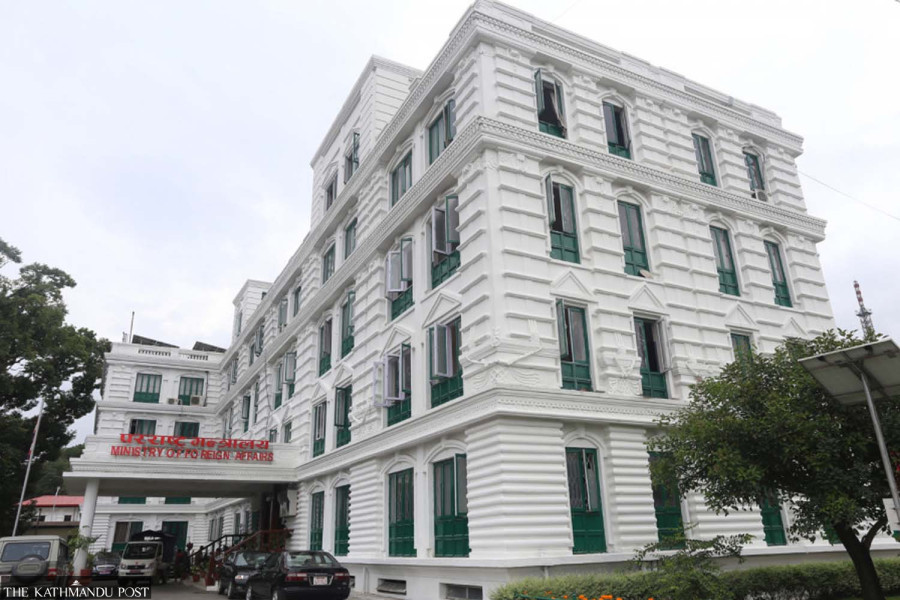
For the first time, the Ministry of Foreign Affairs is drafting country strategy papers to guide its engagements with key bilateral partners.
Until now, the ministry has largely relied on generic country briefs that merely outlined the status of bilateral relations rather than providing comprehensive, forward-looking strategic guidance.
After assuming office, Foreign Minister Shisir Khanal instructed senior ministry officials to develop strategy documents to ensure a more nuanced and professional approach to foreign policy implementation.
Each paper will map out a partner country's core priorities regarding Nepal—spanning foreign policy, strategic interests, trade, military cooperation, security, people-to-people ties, and cultural relations. Crucially, the documents will also outline Nepal’s own priorities towards that country, defining the specific diplomatic actions required to protect and advance Nepal's national interests, according to two officials directly involved in the drafting process.
Out of 15 divisions at the ministry, those handling political desks such as Europe; Americas; South Asia; Northeast Asia; Southeast Asia and the Pacific; Central Asia; West Asia; and Africa have been instructed to prepare the strategy papers.
Each division is to prepare country strategy papers, starting with a few countries, said a senior foreign ministry official.
During a meeting on Monday, the ministry’s senior management team—comprising joint secretaries—was instructed to formally submit these country strategy papers.
The submission deadline is set for Friday, according to an under secretary.
Earlier, the ministry used to prepare country-specific strategy papers on economic diplomacy, but lacked a comprehensive country strategy paper, said former foreign secretary, Shankar Das Bairagi, who also served as ambassador.
During his tenure as foreign secretary from October 2015 to October 2020, the ministry prepared strategy papers for over three dozen countries, with specific focus on economic diplomacy, along with recommendations on how to engage with them and how Nepal could benefit. Bairagi later served as an advisor to the National Security Council.
“We had also discussed preparing country-specific strategy papers to bring clarity in our engagements with countries we frequently deal with, but could not complete it. This is a good idea. Such papers will give clarity to political and bureaucratic leadership while dealing with specific countries. Once prepared, they should be regularly updated,” said Bairagi.
A few foreign ministers and secretaries had earlier raised this matter within the ministry, but due to lack of manpower, it remained a long-pending issue.
A country's strategic paper should analyse trends, provide a proper understanding of the major features of each country, and include feedback from missions, along with an inter-agency coordination, said Bairgai.
In the fiscal year 2019-20, the then government led by KP Oli had introduced a 31-page document outlining Nepal’s foreign policy priorities, including guiding principles, strategic direction, economic and regional diplomacy, multilateral engagement, protection of citizens abroad, public diplomacy, institutional reforms, and implementation mechanisms.
The new strategy paper requires extensive homework, a former joint secretary said, adding it involves understanding what a particular country expects from Nepal, reviewing past developments, and identifying how Nepal can align its national interest with that country, he said.
“This serves as roadmaps for Nepal’s diplomatic, economic, and developmental engagement with specific countries. These help align foreign policy objectives with national priorities, ensuring consistency and focus in diplomatic efforts, the joint secretary told the Post.
The papers, he added, examine the political, economic, and cultural context; the history of bilateral ties, including past collaborations and agreements; strategic areas of cooperation such as trade, investment, education, infrastructure, security; concrete steps for diplomats, trade missions, and development projects; and potential challenges including geopolitical considerations.
Anil Giri is a Chief Sub Editor covering diplomacy, international relations and national politics for The Kathmandu Post. Giri has been working as a journalist for more than two decades, contributing to numerous national and international media outlets.




 14.81°C Kathmandu