Skateboarders in Kathmandu are getting a long-awaited home
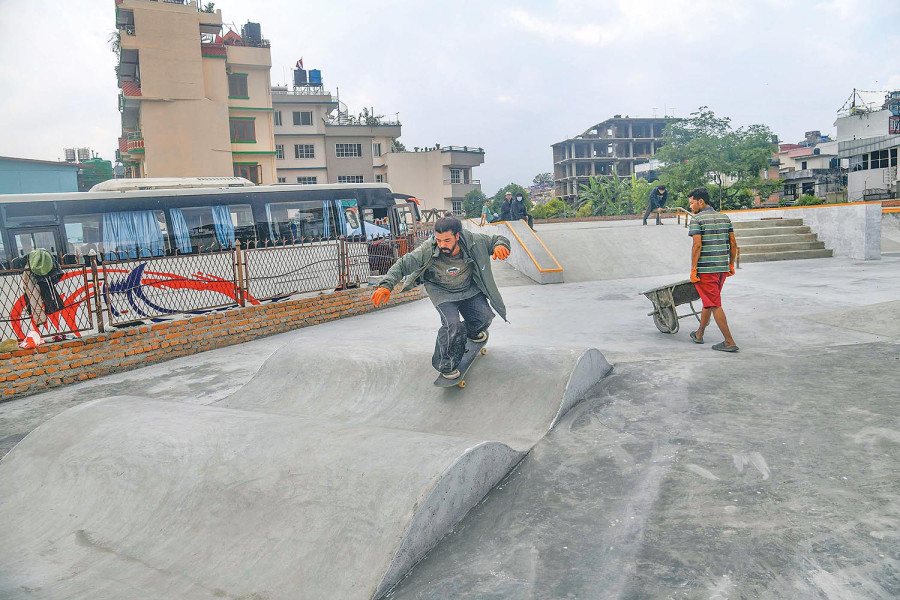
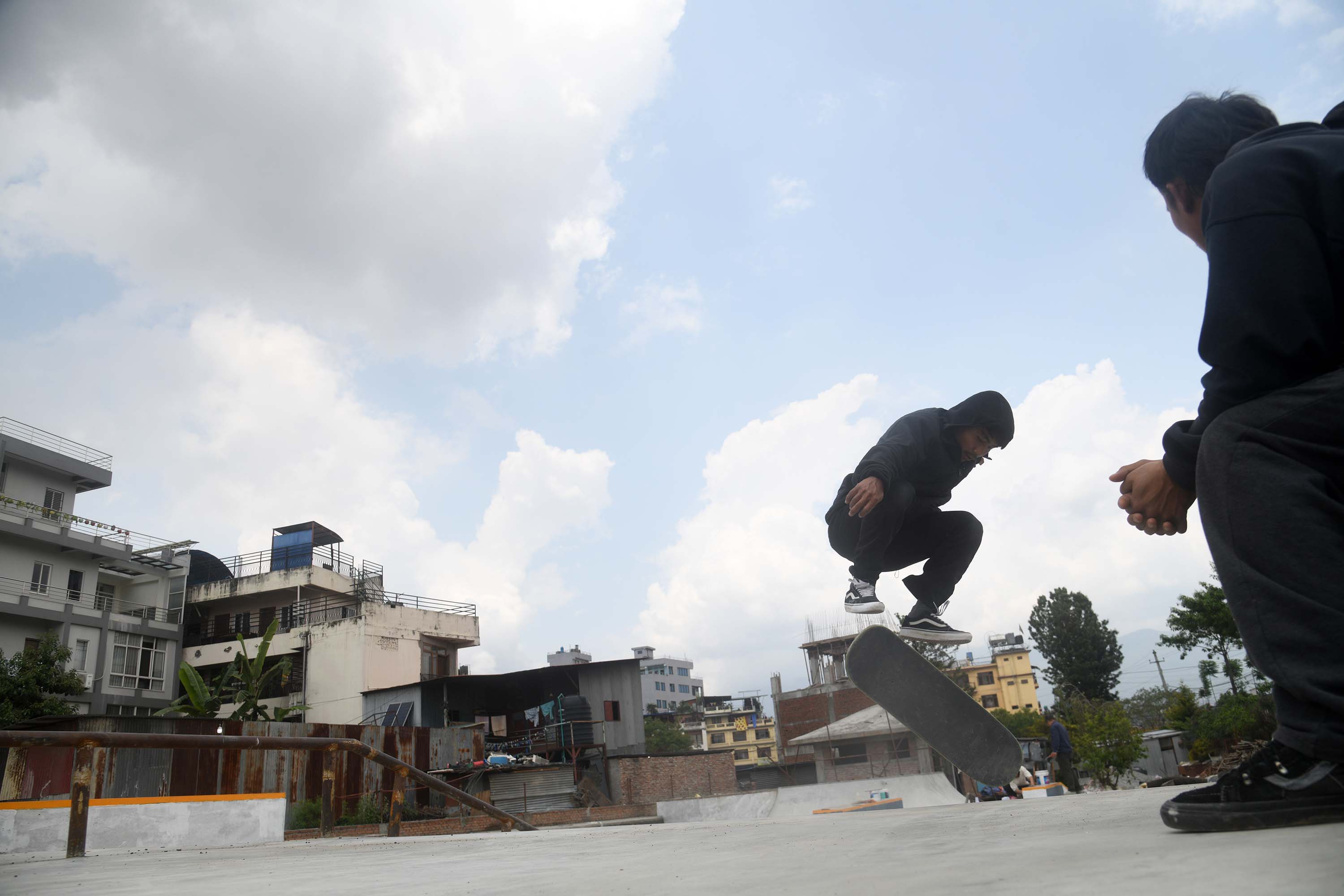
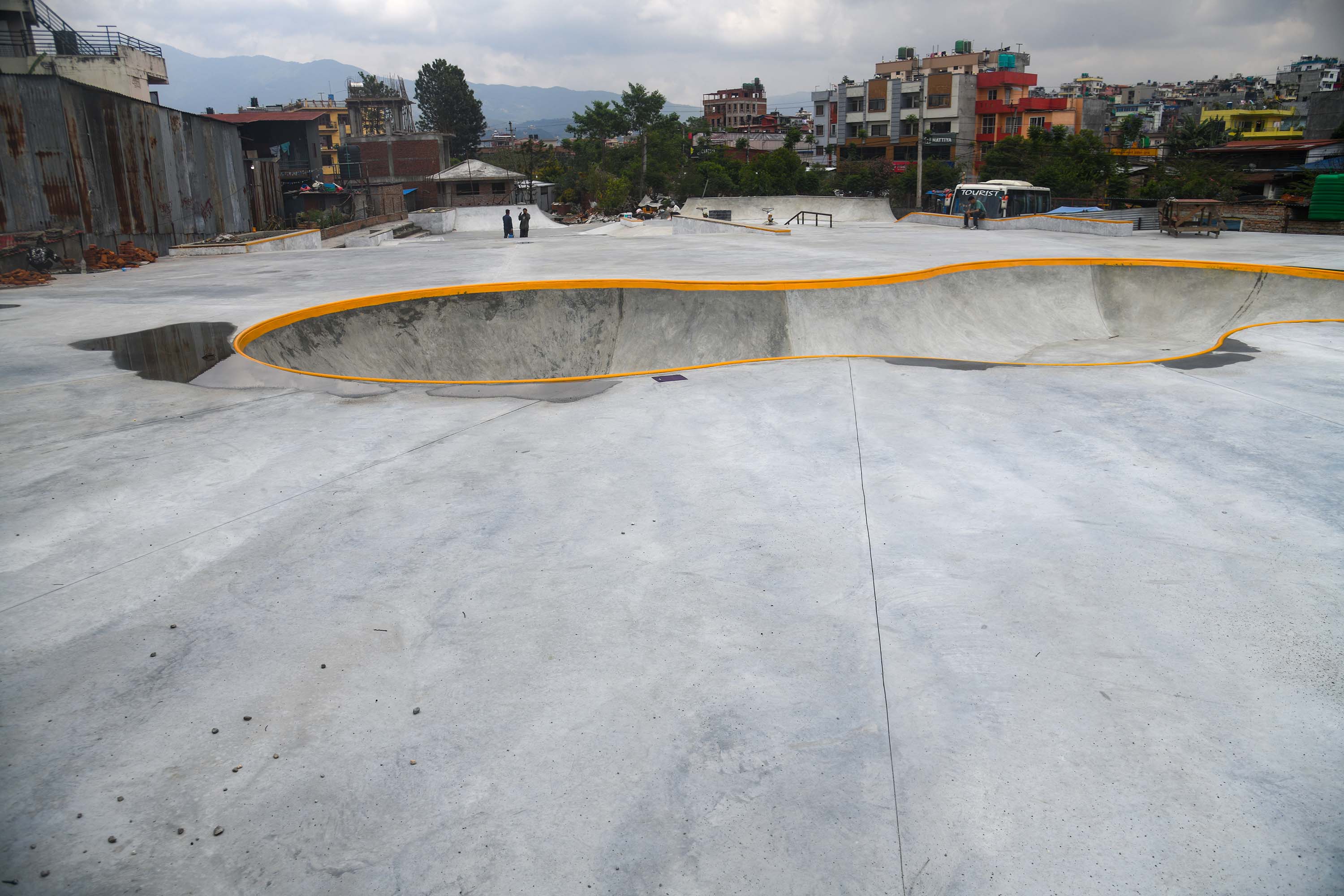
Named after hip-hop pioneer Yama Buddha, Kathmandu’s first public skateboard park marks a turning point for a community that once skated in hiding but now rides towards recognition.Yama Buddha Skateboard Park is being constructed with the involvement of many professional Nepali skateboarders. Deepak KC/TKP
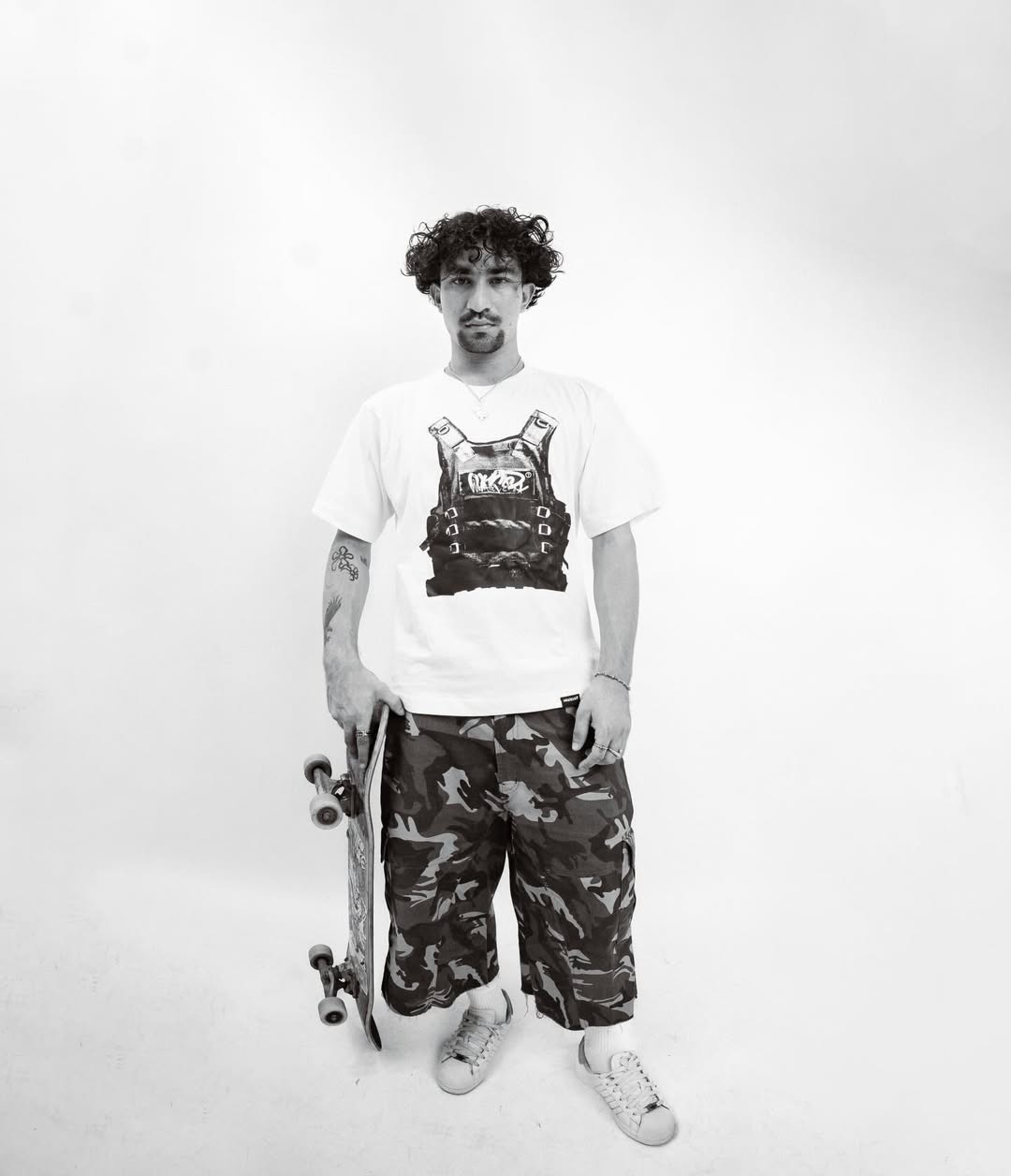
Curly hair. A casual T-shirt. Baggy pants. Tattoos running down his right arm.
On Wednesday morning, a man in his mid-20s sat on the edge of the Yama Buddha Skateboard Park, Kathmandu’s first public skateboard park, which is near completion, along the banks of Dhobikhola.
His legs rested over a skateboard, the white shoes on his feet worn thin—a familiar mark of skateboarding, where constant friction slowly tears footwear apart. Holding up his phone, he filmed the unfinished park taking shape before him.
He introduced himself as 26-year-old Gajendra Bardewa, the defending champion of the National Skateboarding Championship.
“It was my third time winning the nationals in the eighth edition last year,” shared Bardewa, who won the tournament in 2018 and 2019 as well. “I came to have a look at the obstacles in the park as it is hosting the ninth edition on June 6 and 7.”
Kathmandu Metropolitan City invested Rs67 million in the project during the mayoral tenure of Prime Minister Balendra Shah. It is being constructed by the Sanu Suwal-Pawan JV. The two sides signed the deal on June 11, 2024, to complete its construction by June 14 this year.
Initially, the park was planned to be constructed in Ward 16 of the metropolis. But a land dispute led the project to be moved to Ward No 5, where illegal structures on 40 ropanis of encroached government land had been removed, and sufficient space was available.
The park is being constructed on 13 ropanis of land situated between Kalopul and Panhelopul.
But despite being along a busy corridor, the park can go unnoticed for passersby. However, it will be noticeable with the sounds of cheers and skateboards after the park is officially inaugurated on June 6.
“The park will be inaugurated on the opening day of the 9th National Skateboarding Championship,” Achut Khanal, president of Nepal Skating and Skateboarding Association (NSSA), told the Post. “We believe this will be the best edition so far because it will be hosted at an international-standard facility. We are extremely happy that this dream has finally materialised.”
Construction of the skate obstacles—including stair sets with rails, humps, corner ramps, flat bars and a large bowl, among others—has been completed. Only the association’s administrative building and the entrance area remain under finishing work.
Gajendra Bardewa Courtesy of Gajendra Bardewa's Instagram
“The association will operate its administrative office here, and we also plan to run a hostel for promising young talents,” added Khanal, who said that the association had sent an invitation letter to the prime minister to inaugurate the park if possible.
“Yes, Prime Minister Shah played a vital role in making this project a reality when he was the mayor of Kathmandu. He has a deeper connection with the park as it is named after someone whom he admires a lot,” said Khanal. “But the prime minister has a busy schedule, and his arrival for the inauguration is not confirmed. Minister for Education and Sports Sasmit Pokharel’s arrival has, meanwhile, been confirmed.”
A rapper himself, Shah was close to Yama Buddha, whose real name is Anil Adhikari. Yama Buddha is one of the pioneers of the Nepali hip-hop and rap scenes. At 30 years old, Yama Buddha was found dead at his London-based flat on January 14, 2017.
The naming of the park reflects the deep cultural connection between hip-hop and skateboarding.
“Hip-hop and skateboarding have a close connection. It fits when you listen to hip-hop music while skateboarding,” Bardewa said. “I also love dressing up in hip-hop style. It was also my love for hip-hop that I started skateboarding.”
It has been around a decade since Bardewa, 26, started skateboarding. “I was introduced to this sport by a friend, who had learned it from his brothers, who were into hip-hop culture,” he recalls.
Like many skateboarders of his generation, he faced scepticism at home.
“People would ask, ‘Why do you want to become a tyape(street punk)?’” he recalled. “If you wear baggy clothes, have tattoos and carry a skateboard, society treats you almost like an outlaw.”
“I don’t smoke or drink,” he added. “But people judge you based on appearance. Things are slowly changing, though. And even if society doesn’t fully accept us yet, we have our own skateboard family.”
That sense of belonging, he says, extends far beyond Kathmandu.
“Whenever I see someone carrying a skateboard anywhere—in Nepal or abroad—we instantly connect,” Bardewa said. “We talk about tricks, shoes, music, hairstyles. We become friends almost immediately.”
As he spoke, an old friend arrived to meet him. Anil Gurung, a DJ known by his stage name ‘Kool’, had travelled from Tokha before leaving for Australia, where he has lived for eight years.
The two reminisced about their early skating days near Chyasal Stadium in Lalitpur, once a popular gathering spot thanks to its smooth roads and light traffic.
“It was fun days, dai,” Gurung said.
“Yes, vai,” Bardewa replied, smiling. “Those were some unforgettable times.”
They also remembered frequent clashes with police officers unfamiliar with skateboarding.
“I was once hit with a stick while running away with my board,” Bardewa said. “Another time, I was detained. It was young blood. Police didn’t understand skateboarding then.”
Gurung laughed as he shared a similar experience. “I was taken to a police station once, and my brother had to come get me out. I never even got my board back.”
Today, attitudes have shifted. “Now officers stop me to talk about skateboarding,” Bardewa said. “They even ask to try the board or take photos.”
In the absence of proper facilities in Kathmandu, Bardewa and his friends often travelled to skate parks in Butwal and Pokhara to practise.
Seated before the nearly finished Yama Buddha Skateboard Park, the two fell briefly silent.
“It feels unreal,” Bardewa said softly. “This is a dream come true—not just for us but for those who started skating long before us. We finally have a place where we can skate freely.”
“Freedom,” he repeated, “is why I fell in love with skateboarding.”
He again drew parallels with hip-hop culture.
“In hip-hop, you use words to challenge stereotypes and express yourself,” he said. “In skateboarding, you do the same with movement. Society doubts you, but you prove yourself by overcoming obstacles—literally.”
That persistence has slowly changed perceptions around him.
“I’m a full-time skateboarder now,” Bardewa said proudly. “I receive sponsorship for boards, shoes and accessories from HKIT Skateboard Shop in Hong Kong.”
Skateboarding has taken him far beyond Nepal—to Spain, Germany, Portugal, the UAE and South Korea for international competitions, including Olympic qualifiers.
He also works with Skate-aid Nepal, part of an international organisation promoting skateboarding worldwide. The group helped build a public skate park in Butwal, operational since 2022. He is also into modelling.
“You may not become rich through skateboarding in Nepal,” Bardewa said. “But at least you don’t have to sleep hungry.”
Many skateboarders are also directly involved in building the Yama Buddha Skateboard Park itself.
“This is my sixth skate park construction,” said 28-year-old skateboarder Bijay Tamang while working at the site earlier this year. “I’ve worked on parks in Butwal, Pokhara, Australia and India. You can’t survive on skating alone.”
Tamang, 28, fell in love with skateboarding after watching it in the Teenage Mutant Ninja Turtles movies. “I was given a skateboard as a gift by my sister,” he recalled. “But it was always a hassle to find a proper place to skate. As I work, I feel I am not only fulfilling my dream, but that of many, for a proper skate park in the country.”
International professionals from Mind Work Ramps, a Latvia-based skate park construction organisation, echoed similar sentiments after volunteering in the project earlier this year.
“Nepali skateboarders truly understand the emotion behind this culture,” members of the visiting team told the Post after spending two weeks working alongside local skaters. “In Brazil, where skateboarding is hugely popular, we also faced restrictions years ago. Today, we have hundreds of parks. Nepal has that same potential.”
According to Bardewa, Nepali skateboarders have already made their presence felt across South Asia.
“I travel to India frequently, and I don’t remember a competition where Nepali skaters didn’t reach the podium,” he said. “Foreign skaters come to Nepal too, but we rarely let them win on our home ground.”
Bardewa now aims to defend his national title when the park officially opens with the upcoming championship.
As the sun burned brighter, Bardewa rolled slowly across the fresh concrete surface. For years, skateboarders searched for empty streets, smooth corridors and acceptance. With the Yama Buddha Skateboard Park finally ready, Nepal’s skateboarding community is no longer hunting for space—it has found a home.
Nayak Paudel covers sports for The Kathmandu Post. He previously worked at the Post (2018–19) and spent over five years at The Rising Nepal. His reporting spans crime, health, education, and social issues.




 22.15°C Kathmandu