Dalit youth held over child marriage dies in police custody. Mother demands, impartial investigation, action
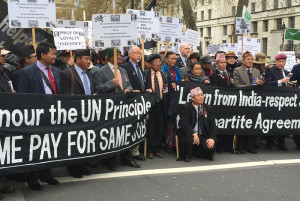
Shree Krishna was found hanging inside a toilet at the Area Police Office in Khurkot on April 20 after being detained over allegations linked to child marriage and rape. Binda Maya BK sits at Maitighar Mandala in Kathmandu, demanding a fair investigation into the death of her 23-year-old son while in police custody in Sindhuli. Post photo
For a month, Binda Maya BK has spent her days on the pavement at Maitighar Mandala in the Capital, demanding answers about the death of her 23-year-old son inside police custody in Sindhuli.
In the morgue at the Tribhuvan University Teaching Hospital in Maharajgunj lies the body of Shree Krishna BK, which his family has refused to collect until authorities complete an impartial investigation.
“I will not receive my son’s body until there is justice,” said a protesting Binda Maya. “My husband died years ago. Now the son who earned for the family is also gone. Who will support me now?”
Shree Krishna was found hanging inside a toilet at the Area Police Office in Khurkot on April 20 after being detained over allegations linked to child marriage and rape. But his family and Dalit rights activists insist the case cannot be closed simply as suicide.
The victim’s family has demanded an independent investigation, punishment for those responsible and compensation. They argue that police negligence, procedural failures and prejudice against an inter-caste relationship contributed to the death.
The BK family is originally from Jumlidanda in ward 3 of Sunkoshi Rural Municipality in Sindhuli, a hill district in Bagmati province. Shree Krishna, the second eldest among five siblings, had been living in Lalitpur, where he had been in a relationship with a local girl for three years.
According to his mother, the couple had willingly eloped and travelled to Sindhuli together after deciding to marry.
The dispute began after the girl’s brother filed a missing person complaint at the Satdobato Police Circle in Lalitpur on April 13. Police later called both families for mediation. However, after the girl’s family stated that she was 16 years old, the complaint was changed into charges related to child marriage and rape.
On April 17, police transferred Shree Krishna to Khurkot in Sindhuli for investigation. His relatives claim they were never informed about the transfer beforehand. Nirmala Bishwakarma, the victim’s sister, said police had asked the family to come to the Satdobato office at 10am the next day, but by 8am Shree Krishna had already been taken to Sindhuli.
“We waited there for hours without any information,” she said. “Only in the afternoon did police tell us that my brother had already been transferred to Khurkot.”
Binda Maya accused both Lalitpur and Sindhuli police officials of mishandling the case from the beginning. “They turned a consensual relationship into a rape case. Those responsible must not be protected. Whoever made mistakes should face strict punishment,” she said.
Deputy Superintendent Purnima Chand, chief of the Satdobato Police Circle, rejected accusations that the transfer was concealed. She said the suspect was sent to Sindhuli in coordination with local police because the incident was connected to that district.
Police in Sindhuli obtained a seven-day remand extension from the district court to continue the investigation. Three days later, officers said Shree Krishna was discovered hanging inside the toilet during his detention.
Sindhuli police spokesperson Surya Prakash Subedi said officers rushed him to hospital immediately after finding him unconscious. Doctors later declared him dead.
Yet doubts deepened after police failed to provide CCTV footage from the detention centre. The family says officers first promised to show the footage in Sindhuli, but later claimed that the recordings were unavailable because of technical problems.
According to Nepal Police records, 27 detainees have died by suicide inside police custody over the past decade.
Dalit rights activist JB Bishwakarma said the state still lacks sensitivity towards justice for Dalits. “The government only pays attention after major protests. That shows how weak the state’s commitment remains when Dalits face discrimination or violence,” he said.
Following criticism and protests by activists and lawmakers, Nepal Police formed a five-member investigation committee led by Deputy Inspector General Dinesh Acharya.
The committee’s report concluded that there was no evidence of physical or mental torture in custody and that post-mortem findings indicated suicide. However, it also found failures in detention management.
According to the report, police violated detention management guidelines by failing to assign dedicated personnel to monitor the detainee. It stated that no alternative arrangement was made while the detention management officer was on leave and that regular monitoring of detainees was neglected for long periods.
The report also described the absence of CCTV footage as a serious weakness. It noted that missing footage had further increased suspicion among the victim’s relatives.
The committee recommended departmental action against Inspector Basanta Bahadur Bhujel, chief of the Area Police Office in Khurkot, and disciplinary measures against several officers on duty that day, including sentry personnel accused of negligence.
The report also questioned the role of the Satdobato Police Circle. It stated that police should have handled the sensitive case involving an inter-caste relationship and a minor more carefully instead of transferring it elsewhere without sufficient consideration.
The committee further recommended strengthening the Nepal Police Dalit Cell, improving detention infrastructure and ensuring round-the-clock CCTV monitoring in custodial facilities.
The case has reignited debate about the treatment of inter-caste relationships in Nepal, particularly when Dalit men are involved. Rights activists say families frequently resort to criminal complaints after opposing such relationships.
The incident has also renewed wider concerns over custodial deaths, weak supervision and lack of transparency within Nepal’s law enforcement agencies. Human rights advocates argue that every custodial death should automatically trigger an independent investigation because detainees remain under state responsibility at all times.
For Binda Maya, however, the official findings remain incomplete without accountability.
“My son entered police custody alive,” she said at Maitighar Mandala. “He should have returned home alive as well.”
XXXXXXXXX
Photo caption: Binda Maya BK protesting at Maitaghar Mandala recently demanding thorough investigation into her son, Shree Krishna, who was found dead in police custody on April 20.




 15.33°C Kathmandu