Susta residents object after Indian border force enters Nepali territory
Locals said embankment construction work in Susta was disrupted after SSB officials visited the site following the prime minister’s remarks and asked workers to halt the project.
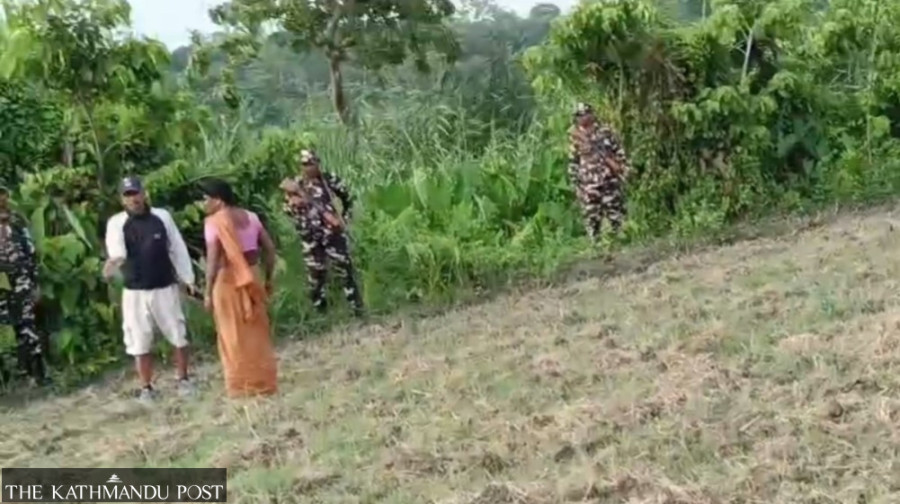
Residents of Susta in Nawalparasi West confronted personnel from India’s Sashastra Seema Bal (SSB) after they entered Nepali territory on Friday morning, prompting a brief standoff before the Indian force withdrew.
The incident occurred at around 7:00 am in Tharu Tol of Susta Rural Municipality-5. Locals working in nearby fields questioned the presence of the Indian security personnel and demanded that they return to their side of the border.
Following a brief verbal exchange, the SSB personnel retreated to Indian territory.
The area has remained tense since May 31, when SSB personnel entered the area and objected to embankment construction work along the Narayani River.
Deepak Raj Ghimire, chief district officer of Nawalparasi West, said the Indian patrol had crossed into Nepali territory while attempting to bypass a waterlogged section near the border.
“However, Nepali security personnel reached the site immediately, and the situation in Susta is now normal,” Ghimire said.
Rabindra Jaiswal, spokesperson for the Save Susta Campaign, said the dispute arose after locals spotted Indian security personnel inside Nepali territory and asked them not to enter the area.
He said the issue was later resolved through coordination between security personnel from both countries.
Susta has long been a sensitive border area. In 1965, the late King Mahendra resettled around 400 families, including former security personnel, in the area to strengthen Nepal’s presence along the border. However, the settlement was displaced in 1977 after the Narayani river changed course, turning much of the area into a riverbed.
Local residents allege that the shift in the river and the absence of boundary markers have facilitated continued encroachment from the Indian side.
According to local estimates, of Susta’s 40,980 hectares, around 14,000 hectares are under Indian occupation, while another 19,480 hectares remain disputed, preventing local residents from cultivating the land. They currently cultivate about 7,500 hectares.
Although 16 border pillars exist between Sanahi and Kudiya in Nawalparasi West, a 24-kilometre stretch in Susta remains without official boundary markers. In the absence of pillars, residents rely on natural landmarks such as rivers and trees to identify the border, often leading to disputes over land use. A single silk-cotton tree currently serves as an informal boundary marker in part of the disputed area.
The latest incident comes less than two weeks after Prime Minister Balendra Shah told Parliament that border encroachment issues existed on both sides.
“After becoming prime minister, I came to know that not only has India encroached on Nepal’s land, but Nepal has also encroached on India’s land in multiple places,” Shah said while responding to a question in the House of Representatives on May 31. “Both sides need to sit down and look into the matter.”
Local residents said embankment construction work in Susta was disrupted after SSB officials visited the site following the prime minister’s remarks and asked workers to halt the project.




 23.25°C Kathmandu