Police officer fired bullet that killed 15-year-old in Siraha clashes, probe finds
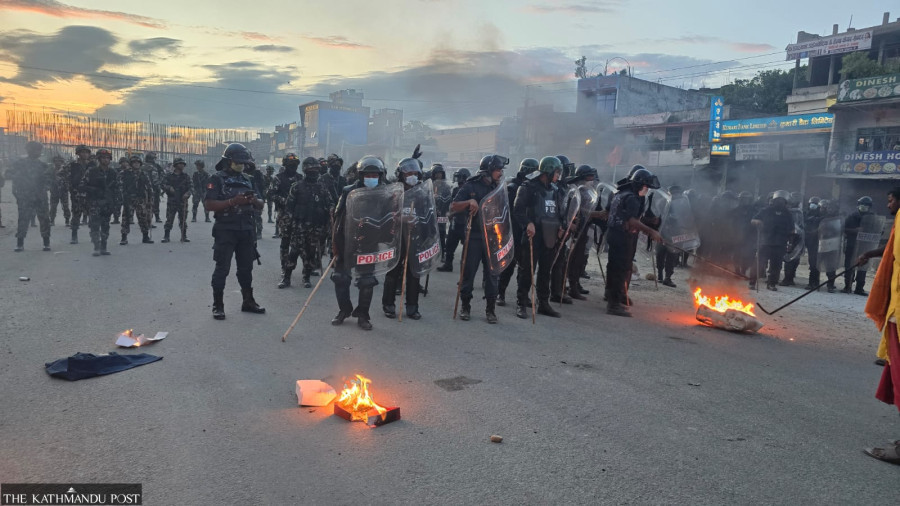
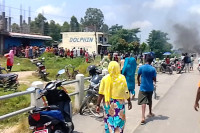
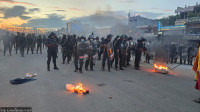
A government investigation into the July 30 violence recommends disciplinary action against officers carrying handguns and calls for major changes to crowd-control procedures across Madhesh.Security personnel stand guard in Golbazar, Siraha, as protesters burn tyres during demonstrations on July 30. Unrest spread across several Madhesh towns following communal tensions that began in Sunsari on July 27. Post file photo
A government investigation has found that a Nepal Police officer fired the bullet that killed 15-year-old Ganesh Yadav during clashes in Siraha district on July 30, contradicting initial claims by security agencies that they had not used live ammunition against protesters.
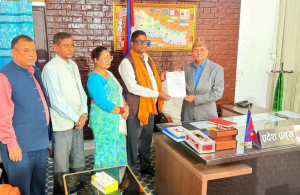
The investigation committee led by Pushpa Raj Shahi, a joint secretary at the Ministry of Home Affairs, submitted its final report to the government after examining CCTV footage, videos recorded by local residents, eyewitness accounts and forensic evidence.
According to an official familiar with the investigation, the panel concluded that Yadav was killed by a handgun bullet fired by a police officer.
The finding is significant because security agencies deployed during the clashes, including the Nepal Police, Armed Police Force and Nepali Army, had initially denied firing at protesters or residents. Local security officials had said that Nepal Police and APF personnel fired about 20 rounds into the air to disperse the crowd.
The investigation was expanded to include two forensic experts from the Nepal Police Forensic Science Laboratory, Superintendent of Police Manohar Singh Dhami and Inspector Dipesh Awasthi, to determine the type and source of the bullet.
The panel also included Superintendent of Police Mohan Kumar Thapa of Nepal Police, Superintendent of Police Naresh Bhandari of the APF, Deputy Superintendent of Police Pawan Kumar Dhungana of the Central Forensic Science Laboratory and Home Ministry under-secretary Kul Sekhar Aryal.
Medical examinations found that Yadav died from injuries caused by a pistol bullet, while ballistic analysis ruled out the involvement of any other firearm at the scene, according to officials familiar with the report.
The committee has recommended departmental action against officers who were carrying handguns during the incident. It has left the nature and severity of the disciplinary measures to the government.
Officials involved in the investigation said security personnel may have withheld information from their initial reports because they feared disciplinary action.
The report also goes beyond identifying responsibility for Yadav’s death, recommending changes to how security agencies respond to violent protests and communal clashes.
The Siraha panel, along with a separate committee investigating the violence in Sunsari, has recommended making non-lethal weapons mandatory for crowd-control operations.
The panels have also called for changes to the chain of command governing the use of lethal force. Under the Local Administration Act, 1971 (2028 BS), security forces can use lethal weapons only as a last resort to maintain public order and after issuing warnings. The chief district officer (CDO) currently has the authority to order security forces to open fire.
The Siraha panel has recommended giving field commanders greater authority to make such decisions during rapidly developing situations.
“While the law vests the authority to order the use of firearms in CDOs, they are rarely present on the ground during fast-evolving, volatile situations. This creates severe operational friction and coordination hurdles for security units,” a panel member said. “We have therefore recommended shifting direct responsibility to field commanders to ensure operational accountability.”
The report also calls for clearer operational roles for the Nepal Police and APF during joint deployments, where overlapping responsibilities can create confusion.
Yadav’s killing came amid a wave of communal unrest in Madhesh in late July.
The tensions began on the night of July 26 in ward 4 of Dewanganj Rural Municipality of Sunsari, where a Nepal Police team sent to contain an inter-community clash came under attack and was forced to withdraw.
An APF reinforcement team later fired 20 rounds, killing 30-year-old Om Prakash Mehta and injuring nine residents. Two of the injured later died while receiving treatment.
The deaths triggered protests and anger across Madhesh and intensified pressure on the government to establish responsibility for the use of force. Home Minister Sudan Gurung subsequently travelled to the region and held talks with victims’ families and community representatives as authorities sought to restore calm.
The findings from Siraha now put the conduct of security personnel under renewed scrutiny, particularly the use of firearms during crowd-control operations and the mechanisms for holding officers accountable when force results in civilian deaths.




 17.57°C Kathmandu