Nepali worker’s death in Saudi Arabia leaves family deep in debt
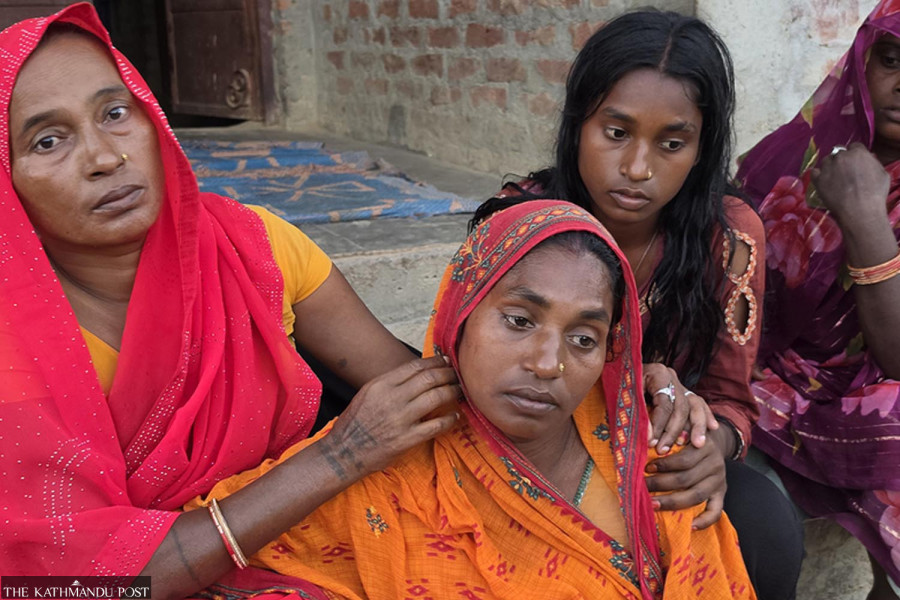
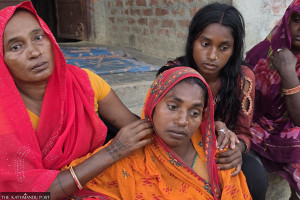
Bharat Mahato’s earnings had sustained his household and financed a new home. Now his wife is left to raise four children and repay Rs1.1 million loan. Grieving family members at Bharat Mahato’s home in Mahottari. His wife, Indrika, second from the left, is grief-stricken. Shiva Puri/TKP
On Monday evening, the courtyard of a home at Dhekaha in ward 1 of Pipara Rural Municipality, Mahottari, was crowded with neighbours. A pall of grief hung over the gathering. Sitting quietly and struggling to steady herself was 41-year-old Indrika Devi Mahato.
Her husband Bharat Mahato, 45, who had been working as a labourer in Saudi Arabia, was killed in a drone attack on October 21. The strike was part of an escalating series of attacks launched by Iran-backed Houthi rebels targeting locations in Saudi Arabia—a tragic blow for an impoverished Nepali family entirely unconnected to the conflict.
Relatives attempted to revive Indira, who was on the verge of losing consciousness, by sprinkling water on her face. Her husband's earnings had served as the financial lifeline for the household. Having spent 14 years toiling abroad, Bharat had recently purchased a small plot of land nearby and was constructing a four-room concrete house.
Indrika had never imagined that her husband would die before their home was completed. “The light of hope in our lives has gone out,” she said, her eyes welling with tears. “How am I supposed to raise our sons and daughters now? How cruel fate can be. All our happiness has been shattered.”
According to Indrika, she had taken out a loan of Rs1.1 million from a bank to fund the construction. Bharat had been regularly sending around Rs20,000 a month from abroad to cover instalments. Now, grappling with both her husband's death and a heavy debt burden, she voiced her anguish over raising their four children alone.
“My husband was working tirelessly abroad to build a future for our family, and we were dreaming of moving into our new house and living happily together. How are we going to repay the bank loan now?” she asked.
Bharat worked as a cleaner at a Saudi Aramco project site in the kingdom's Eastern Province. On October 21, a Houthi-launched drone struck the project site. The attack killed Bharat and Pakistani and Indian workers. Indrika recalled that a supervisor at the site called her hours after the incident to report that Bharat had been caught in the attack and hospitalised with injuries. She was later informed about his death.
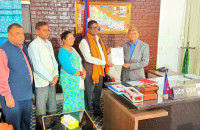
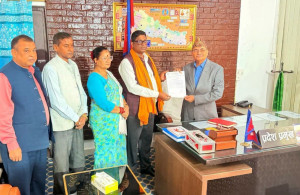
On Monday, accompanied by relatives, Indrika visited the District Administration Office in Jaleshwar and submitted a formal petition requesting government assistance to bring her husband's body back to Nepal.
Chief District Officer Indradev Yadav said that the application had been forwarded to the Ministry of Home Affairs. “We have sent the letter along with the petition submitted by the victim's family to the Home Ministry,” said Yadav. “From the ministry, it goes to the Ministry of Foreign Affairs to initiate the repatriation process.”
The Consular Department forwarded the case to the Nepali Embassy in Riyadh on Tuesday. The embassy confirmed that it had already received Bharat's death certificate.
Since news of his death reached the family, no fire has been lit in Bharat's kitchen. The night before the incident, Bharat had made a video call home, urging Indrika to take care of the family and their children. That conversation turned out to be their last.
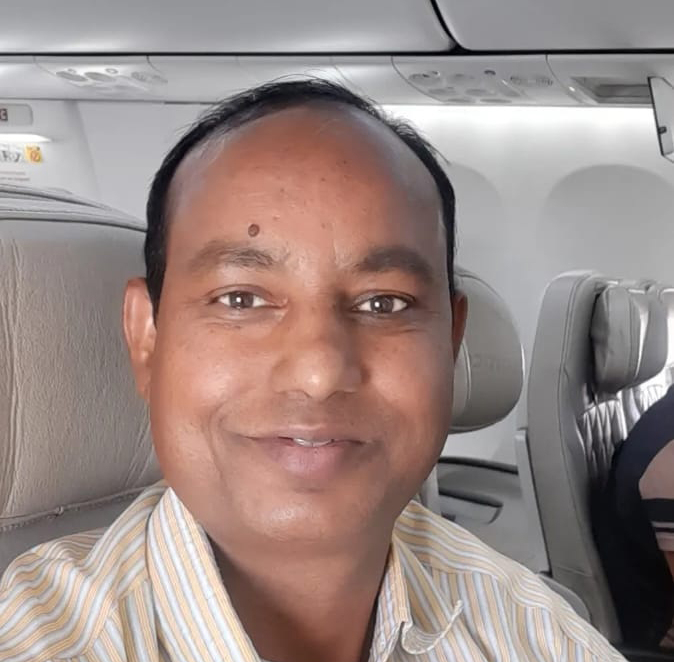
Bharat Mahato Provided to the Post
In 2012, Bharat paid Rs120,000 to a local agent to secure employment in Saudi Arabia, financing the migration by borrowing from a local lender at a steep 24 percent annual interest rate. Since arriving in Saudi Arabia, he had continuously renewed his visa, returning to Nepal only twice—in 2013 and 2021.
Because his labour permit had expired a year prior to his death, his family is ineligible for financial relief typically provided through the Foreign Employment Board’s welfare fund and term life insurance. The two schemes typically provide around Rs1 million and Rs1.5 million, respectively.
Bharat’s elder brother Ramjas Mahato expressed deep frustration that the family has received no comfort or guidance from government authorities. “So far, no official body has stepped forward to offer guidance or support,” he lamented. Indrika shared her hope that the government will at least intervene to bring her husband's body home and arrange adequate relief and compensation for the grieving family.
Minister for Foreign Affairs Shishir Khanal told Kantipur that he was deeply shocked by the news of Mahato's death in the Saudi drone strike. “Efforts are underway to bring Mahato's body back to Nepal as quickly as possible,” he said. “I am leaving no stone unturned in fulfilling the government's responsibilities. We are also in direct communication with the Saudi government regarding the incident.”
Security tensions in Saudi Arabia have escalated since September. The Iranian-backed Houthi rebel movement has intensified attacks against the kingdom, heightening security challenges. Yemeni Houthis have carried out a series of strikes targeting Saudi oil installations, airports, and vital infrastructure. Saudi Arabia is a close US ally, and the Houthis also target it because of its role in the Yemen war.
“We never imagined there would be such unrest in Saudi Arabia,” said Ritesh Mandal, a Dhanusha native who has worked in the Dammam region for two decades. “You never know when or where an attack will strike. Whenever an alert message pops up on my phone, my heart races with fear.”
According to official tolls compiled by AFP news agency, Houthi attacks in Saudi Arabia had claimed 22 lives as of October 22. On October 10, a passenger terminal attack at King Khalid International Airport in Riyadh instantly killed 12 people, while an injured Indian national died the following day, injuring 309 individuals in total.
A subsequent strike on Riyadh airport on October 12 killed a Pakistani national and injured 11 people, while an October 6 attack on Abha airport killed two and injured 28. Earlier in July, the same airport suffered missile and drone strikes. On September 17, falling debris from an intercepted Houthi drone over Taif killed one person and injured two.
Embassy urges Nepalis to remain alert
Amid rising risks of missile and drone attacks in Saudi Arabia, the Nepali Embassy in Riyadh has urged Nepali nationals residing in the country to exercise extreme vigilance and strictly follow instructions from local security authorities.
In a notice issued on Monday, the embassy advised citizens to avoid going outdoors during security alerts, regularly monitor announcements from official Saudi bodies, and fully adhere to safety guidelines. With conflict escalating between Yemeni Houthi rebels and Saudi Arabia, missile and drone incidents have targeted airports, oil infrastructure, and other critical sites. On Tuesday, the Saudi-led coalition reported intercepting three ballistic missiles and four drones targeting the kingdom's eastern and southern regions.
The embassy also urged Nepalis to refrain from posting or sharing unverified news, information, photos, or videos on social media platforms, emphasising that unconfirmed materials should not be forwarded to others.
Nepali travelers planning air journeys have been advised to exercise caution. Before traveling from Saudi Arabia to Nepal or other destinations, citizens should verify flight schedule updates with their respective airlines or official sources before heading to the airport.
Nepalis requiring assistance have been advised to contact the Nepali Embassy in Riyadh or the Consulate General in Jeddah. An estimated 400,000 Nepali nationals currently work across Saudi Arabia, making heightened safety awareness critical amid ongoing security threats.




 13.27°C Kathmandu