Movie review: In ‘Chiso Maanchhe’, a journey with a corpse becomes a meditation on grief and human connection
Dipendra K Khanal’s 2022 film follows a dead migrant worker on his final journey home, finding grief, intimacy and a changing society in the silences along the way. Photos: Screengrabs via YouTube
There are not many Nepali filmmakers willing to trust their audience to understand their film without announcing its intentions through dialogues. Dipendra K Khanal, however, seems to have given us a space to sit with his images, silences and ambiguities to make sense of ‘Chiso Maanchhe’ on our own.
Released in the theatres in 2022 and on YouTube in 2025, the film begins with a rolling wheel as the radio announces the number of deaths in Nepal during the coronavirus pandemic. Ashok (played by Arpan Thapa) has a mask hanging under his chin and a sanitiser on the edge of his truck’s window.
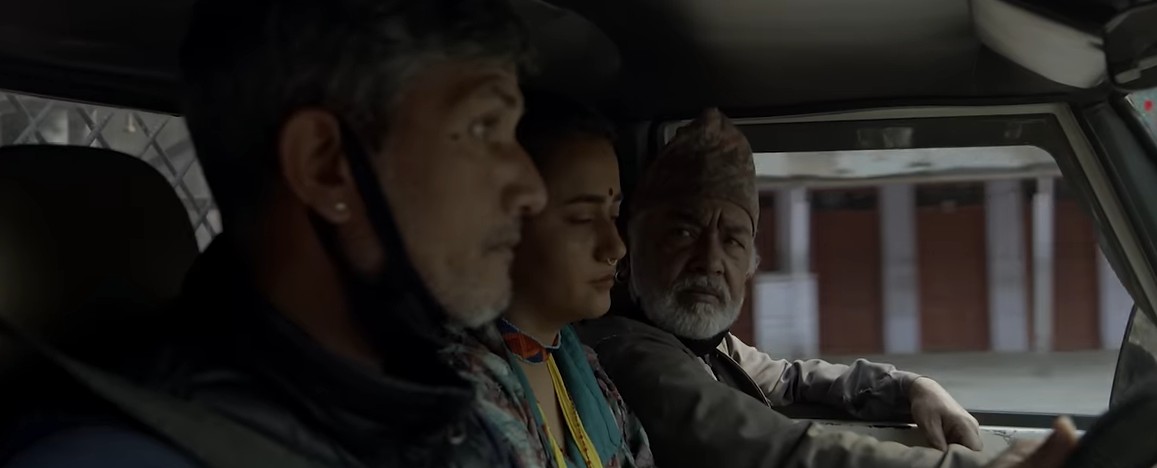
Ashok, a driver, is hired to take a corpse from Kathmandu to Bajura in his truck. This is a corpse that has freshly arrived from Qatar, one of the major destinations for Nepali migrant workers. Accompanying Ashok are a grieving father, Sher Bahadur (Deshbhakta Khanal), and a widowed wife (Swastima Khadka). The wheels roll and the journey begins.
As they travel from Kathmandu to Bajura, they encounter the broader terror of the widespread virus with the roads engulfed by corpses, migrants, police, and youth patrols. Some go along with them and others obstruct their passage.
With them moving, stopping, negotiating, rebelling and starting again, the story becomes an emblem of the precariousness of life. Along with this, the characters, initially entirely as strangers, begin to understand each other’s worlds, and more importantly, their own.
Khanal, also the director of ‘Aama’, ‘Pashupati Prasad’, ‘Ke Ghar Ke Dera’, is best known for depicting social issues and everyday struggles in his films and he continues doing so in ‘Chiso Maanchhe’. The film shows a broader picture of a frozen, individualistic and isolated society.
In a scene, Khadka’s character is found frolicking in the woods, as though she stumbled upon an oasis. Her father-in-law calls her out, quickly and furiously, and says, “If this was the old days, you would’ve had to become a sati.”The sati is a historical custom where a widow self-immolates on her deceased husband’s funeral pyre.
“If not physically, I have been made a sati in heart,” she says.
It is a line the film never explains, and doesn't need to, because by then, Khanal has already taught us to read what isn't said. Non-verbal cues in the film stand monumental for its provocative ways to communicate its themes and the characters’ emotions.
The truck carrying the corpse of Damber Bahadur, who died of “heart failure” in Qatar, has a quote painted on its back in red. “Life goes on with happiness and laughter. If we work hard, we can find gold in our own country.”
The irony is stark and unmistakable.
Further, these non-verbal cues particularly elaborate the dynamics between Ashok, the driver, and the daughter-in-law.
Whether it’s buying her a bag of titaura to satisfy her cravings or extinguishing his cigarette when she looks uncomfortable, these small, wordless gestures create a sense of intimacy throughout their journey.
With this screenwriting, as commendable as to earn him the ‘Best Writer Award’ for the film, Khanal, however, fails to depict the nuances of his female character. He neither gives a promising background to the daughter-in-law nor a name.
Khadka’s character attempts to run away before retrieving her husband’s dead body. Later, she is found staring at a poster that showed the winner of ‘Nepal Idol’, a singing reality show. We understand consequently that her dream was to become a singer, and that the marriage had not given her enough reasons to grieve her dead husband.
She is given a dream. And a somewhat rebellious nature to chase it. But not enough to earn her a platform of her own.
However, Khadka’s body language, dialect, eye contacts, and even the way she blinks are carefully curated habits to build her character which results in a memorable depiction despite being written unidimensionally.
Ashok, on the other hand, gets to reminisce about his dead wife and six-month-old child whom he left behind with his sister. We understand his financial struggles after he receives a call from his bank warning about the confiscation of his vehicle.
Ashok’s cognitive understanding of self and emotional intelligence add depth to his character.
Costumes of the three lead characters, which are the same throughout the film along with their make-up, also amplify the realism of the film, fitting perfectly into the travel-cinema narrative.
Khanal knew his ways to create a connection between the audience and the screen. With minimal dialogues, the audience, from early on, can get the idea of having to pay close attention to the cinematography, colours, props, and every edge of a frame.
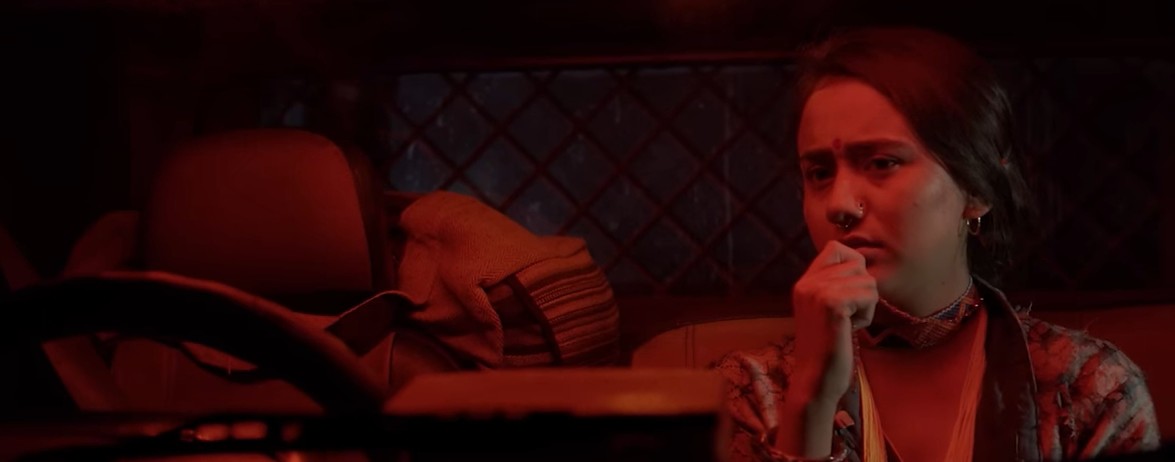
One that stands out the most is the red light inside the truck juxtaposed by the darkness of the outside. Ambience as such gives the film a sense of depth under the warmth, or the discomfort of red.
However, at times, it is almost difficult to put into words the intent of the director. One is compelled to replay some scenes over and over again, simply to understand its underlying motive.
There’s a scene, for instance, where a line of people wearing masks and carrying their belongings walk in a corner of a moving frame. But it is not clear what Khanal is trying to imply with it. After all, why were the people there? Why in a single line? Why were they carrying their belongings and where were they going? Questions like these remain unanswered.
This ambiguity further enters the moral terrain inhabited by the film’s characters. Scenes of dispute and altercation also follow the journey. Yet, every character is given their own motivation and moral ground, resisting the easy division between right and wrong.
Therefore, the film pivots toward a moral question. And Sher Bahadur seems to be the most affected by it. His character, initially a grieving father and a culturally restrictive father-in-law, slowly melts into a man capable of introspection.
‘Chiso Maanchhe’ may seem like it has a slow pace. And it certainly does. But rather than a drawback, it is the film’s conscious choice to demand patience from its viewers.
In the end, the film leaves a corpse, an unrequited love, and a society in transition. It asks us to sit in the cold with its characters. Perhaps the coldness is not only theirs.




 17.57°C Kathmandu