Movie review: ‘The Social Reckoning’ is an analogue call-to-action for a digital dystopia
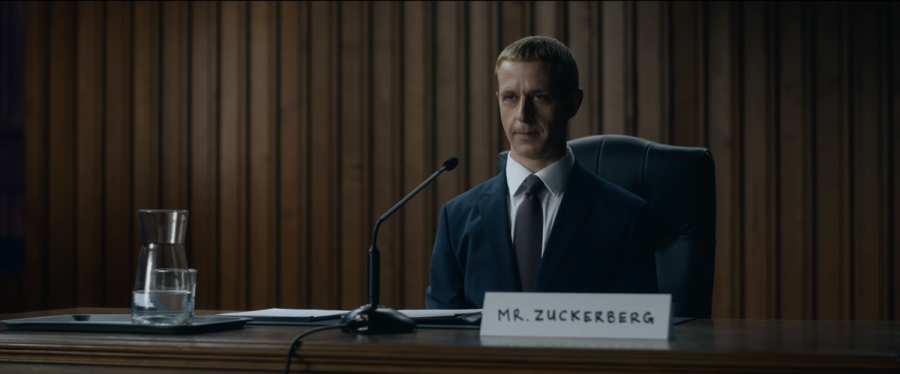
One might get a sense that the movie doesn’t have a full handle on the mayhem Facebook has caused. Or Aaron Sorkin didn’t think it would make for compelling cinema.Jeremy Strong as Mark Zuckerberg in ‘The Social Reckoning’. Photos: THE WIRE
Writer/director Aaron Sorkin has mostly written about the best “American values” have to offer. As he adapted Ben Mezrich’s The Accidental Billionaires into a film, around a website whose tangible footprint in our lives was still being determined, he might have considered himself lucky to find a collaborator in director David Fincher, whose films have reiterated the worst humanity has to offer. Sorkin’s faith in America’s institutions, coupled with Fincher’s distrust of humans – and a remarkably sophisticated visual style-resulted in arguably the best film from a Hollywood studio in the 2010s.
It refined Sorkin’s (sometimes indulgent) dialogue and gave it a bulletproof, titanium glaze. 16 years later, after seeing it more than a dozen times, I can’t remember a single quip from The Social Network (2010) that feels redundant, or out of place. At the runtime of an exact two hours, it’s interesting not just for the riveting manner in which film recounts the tale of Facebook’s founding, but also for the questions it elicits and the things it leaves unsaid.
As soon as The Social Reckoning was announced, it had its task cut-out, following up on a cultural totem. Fincher’s film accurately characterised Mark Zuckerberg (founder of Facebook) as an anti-hero, long before he began doing mindful harm, making it more prescient. Without Fincher’s precision, Jesse Eisenberg’s unnerving rendition of Zuckerberg (played by Jeremy Strong here), Sorkin’s follow-up film was always going to be a step down.
However, one must also not underestimate the efficacy of Sorkin dialogue, and their ability to shine even in the workmanlike hands of director Sorkin in his last three features (Molly’s Game, The Trial of the Chicago 7, and Being The Ricardos).
The result, here, is a fundamentally strong film, which is (sometimes) gratingly upbeat and an analogue call-to-action for a digital dystopia. You can tell Sorkin wants The Social Reckoning to be his own film, especially how Trent Reznor and Atticus Ross’s electro-ambient score is replaced with Alexander Desplat’s hopeful trumpet. It begins with a prologue: “white girl wasted,” featuring a character that will come back to haunt the climax.
A lone woman, stranded on a highway next to her broken-down car, is greeted by two non-white cops. Seemingly drunk, the cops ask her routine questions, following which the conversation turns hostile and she begins livestreaming it on Facebook.
It ends with her being arrested for verbally abusing and threatening the cops. The hysterical livestream ends up on Frances Haugen’s (Mikey Madison) desk, who works in Facebook’s Civic Integrity Team. Its function is to make the platform more conscientious, in a time when growth is prioritised to justify trillion-dollar valuations.
Mikey Madison in a scene from the movie.
If The Social Network was a start-up/legal thriller, The Social Reckoning might be a whistleblower thriller. Without doubt, it’s my favourite genre of films. Especially, since it sees an individual summon enough strength and conviction to do right by millions (in this case, billions) they know nothing about. Also, because such films feature journalists (journalism films are my second favourite genre).
When Frances’ warnings are repeatedly not paid any heed to by the Facebook management, she hands out the discomforting information to tech reporter, Jeff Horwitz (Jeremy Allen White). Jeff is decidedly averse to technology, he doesn’t even use a car’s GPS. The detail is amusing, though it also feels like a contrivance designed to give an exposition-heavy film a distinctive character.
Hence, Jeff becomes a stand-in for the audience, each time Frances throws some jargon at him, about some nefarious Facebook ploy. “What does it mean?”Jeff asks Frances, many times during the film. It’s a prime example of a Sorkinism, where he’s able to break down complex topics and get to the gist of it. It can feel silly sometimes, but the important part is it works more often than it fails.
Sorkin boils down the 17-part series, which ran as ‘The Facebook Files’, into how the company began incentivising fake news, ragebait and fully abdicated any responsibility for how their platforms are used (including child pornography and drug trafficking) in a bid to inflate their bottomline. It’s a practice that has carried on to X (formerly Twitter) after Elon Musk began paying out blue-tick accounts, based on their monthly engagement.
In a parallel track in 2021, Mark Zuckerberg (Jeremy Strong) is being coached for a Congress hearing around Facebook’s [lack of] fact-checking policy around political ads, as he’s pummelled with rude questions by former investor Charlie Garrigan (Bill Burr). Strong’s Zuckerberg is a cold, armoured CEO, who knows he can hide behind deniability and exploit the grey areas of a civilised debate.
“We’re a corkboard,” he tells his counsel, Raya (Wunmi Mosaku) in one scene. He lets his armour slip in just once, when Garrigan tells him how the world characterises him as a supervillain. I preferred Eisenberg in the role, for the mix of vulnerability and savagery he brought to the character and how effortlessly he could switch between the two. But Strong’s performance, too, is undeniable. Especially in a scene towards the end, when the team awaits a crucial order from him as chaos unfolds on his screen.
It’s not a deal-breaker, but I didn’t buy 27-year-old Madison as Frances (who was 36 at the time), plying us with an echo of how coders are social misfits, quirky and slightly neurotic. Allen White is a shade better as Jeff. You can hear the concern and the good intention in his voice, borrowing from his most popular role as Carmen (in The Bear), even as he goes on cancellable spiels.
One might get a sense that The Social Reckoning doesn’t have a full handle on the mayhem Facebook has caused. Or Sorkin didn’t think it would make for compelling cinema. Hence, in some way it’s admirable how he’s kept his blinders on to make an old-fashioned journalism thriller – about corporate malfeasance.
Some might find the slightly upbeat score at the end of the film, followed by some very disturbing epilogue text-on-screen, jarring. But my takeaway was that Sorkin’s belief in one person standing up and doing the right thing (“… like a Frank Capra character,” as he maintains in most of his shows/films) still stands.
It’s purely coincidence that The Social Reckoning releases in India, a day before arguably the most high-profile nationwide civilian protest to take place in the last decade. The mobilisation is happening primarily through social media platforms, the war is being fought through memes, parody songs and witticisms (from one side).
Even with all its harms, such platforms have been crucial for youth protests around the world, representing the boon they could have been. To fight injustice, to unmask corruption, to expose the brutality of regimes. Sorkin’s film reminds you how tragic it is when such platform owners cop out at crucial points and side with the powerful. This article was originally published in The Wire and is republished here with permission, under a special arrangement with The Wire.




 15.56°C Kathmandu