Baglung’s proposed industrial village remains stalled seven years on
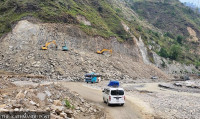
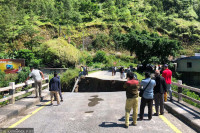
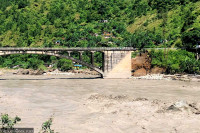
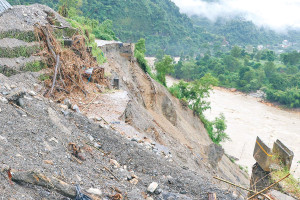
Lack of roads, electricity, security arrangements and worsening river erosion have left the ambitious project in limbo, while industries continue to operate haphazardly inside Baglung bazar. The proposed 'industrial village' site at Kalakhola area of Baglung Municipality-13. Prakash Baral/TKP
Seven years after Baglung Municipality announced plans to establish an industrial village in Kalakhola area of ward 13, the project remains stalled due to a lack of road access, electricity and security infrastructure.
The municipality had prepared around 86 ropanis of land for the project, which was launched under the Gandaki Province government’s plan to establish at least one industrial village in every local unit. However, the project has seen little progress since then, and more than one-third of the acquired land has already been eroded by the Kaligandaki river.
No construction work has begun on the remaining land. Instead, Bidari Construction, the company involved in building the Kaligandaki Corridor road, has been operating a crusher plant at the site.
The company continues to run the crusher despite failing to complete the road project even a year after the contract deadline expired.
Locals say the municipality has effectively abandoned one of its own flagship projects. Although elected representatives before 2022 had promoted the industrial village as an ambitious development initiative, no substantial work was carried out during their tenure. Even as the municipality marked four years of the current local government on Wednesday, the industrial village project received no mention during the celebrations.
“The municipality only gave attractive slogans about the industrial village, but nobody actually worked on it,” said a local resident.
The municipality had previously invested around Rs2 million in levelling land and carrying out preliminary works at the site. But the Kaligandaki river has continued to erode the area, and the municipality has yet to introduce any concrete river protection measures.
The erosion threat has intensified in recent years after large-scale extraction of riverbed materials in Parbat’s Sahasradhara area altered the river’s course towards the Baglung side. Last year, Baglung Municipality had warned that the industrial village was at high risk after around 30 ropanis of land and an access road were washed away by the river.
Despite a Supreme Court order issued in 2020 banning the extraction of riverbed materials from the Kaligandaki, locals say illegal extraction continues unchecked, increasing the risk of floods and erosion.
Meanwhile, industries and workshops continue to operate in a disorderly manner inside Baglung bazar due to the absence of a designated industrial area. Motor garages, grill industries and furniture factories have expanded into market areas, contributing to pollution and congestion.
Locals complain that construction materials are often piled haphazardly on roadsides, creating risks for pedestrians and worsening the urban environment.
“Hotels and furniture industries are operating side by side in the market area. Dust and noise from these industries make it difficult for tourists to stay,” said Kumar Bikram Chhetri, chair of ward 4. “If such industries can be relocated to the industrial village, the town will become cleaner and quieter.”
The municipality had initially planned to relocate at least 50 industries from the market area to the industrial village.
Officials say procedural flaws also contributed to the project’s failure. The industrial village plan was launched around five years ago without a proper operational procedure in place. Two years ago, technical teams from the Ministry of Industry and the municipality revised the project’s detailed project report (DPR), but the revised document has also remained unused.
Municipal officials said the earlier municipal executive had awarded two contracts without approving the necessary operational procedures. After those contracts also failed to progress, the municipality began a cancellation process on the ministry’s recommendation.
Baglung Mayor Basanta Kumar Shrestha acknowledged that procedural weaknesses and technical issues had delayed the project.
“There were problems in the earlier estimates, where the municipality planned to construct buildings and rent them out. That is no longer necessary,” Shrestha said. “Now the municipality plans only to provide infrastructure such as roads, drinking water and electricity, while industries themselves will construct buildings and facilities according to their needs.”
He said the municipality would prioritise security arrangements inside the industrial village. However, locals remain sceptical because the project has not been incorporated into the municipality’s current policies and programmes.
“If the municipality is serious about implementation, the project must be included in official policies and plans,” said local resident Ram Krishna Sharma. “So far, we have only heard assurances.”
A municipal official said at least Rs10 million would be needed to construct a concrete embankment stretching more than 100 metres with a height of around 10 metres to protect the remaining land from further erosion. However, the municipality has been unable to move forward due to budget constraints.
The municipality has also failed to finance embankment construction through its own resources.
Similar problems have emerged in neighbouring Tarakhola Rural Municipality, where local authorities purchased around 100 ropanis of land for another industrial village seven years ago. Not a single industry has been established there either.
Tarakhola Rural Municipality chair Dhan Bahadur Bik said the lack of reliable electricity and proper road access had prevented the project from moving ahead.
“If the roads are upgraded, we can operate many industries there,” Bik said. “The plan is to relocate medium-scale industries rather than the small cottage industries currently operating in villages.”
The rural municipality had even fenced off land near Bhuskatan in ward 1 for the proposed industrial village, but the project has yet to move beyond preliminary preparations.




 26.19°C Kathmandu
.jpg)