BBC documentary puts Bardiya’s tigers in global spotlight
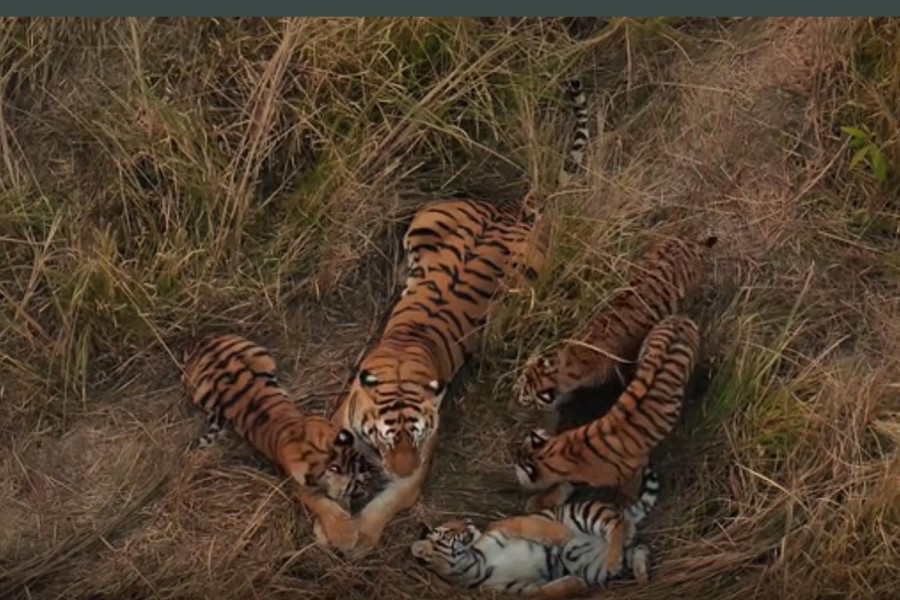
The series documents tiger behaviour that challenges long-held assumptions about the species and highlights Nepal’s remarkable conservation achievements. Jogini rears the cubs of herself as well as of another tigress in Bardiya National Park. Photo: Courtesy of BBC One
A new BBC wildlife series filmed in the forests of western Tarai has thrust Bardiya’s tigers onto the global stage, revealing extraordinary behaviour that has surprised scientists, conservationists and wildlife enthusiasts alike.
Broadcast worldwide on BBC One and BBC iPlayer on June 7, ‘Tiger Island’ showcases rare and intimate footage from buffer-zone community forests surrounding Bardiya National Park. The series documents tiger behaviour that challenges long-held assumptions about the species and highlights Nepal’s remarkable conservation achievements.
Among the most striking discoveries featured in the nearly hour-long first episode is evidence that female tigers can share parental responsibilities. Cameras captured one tigress helping care for another tigress’s cubs, a behaviour rarely documented in the wild.
The documentary also challenges another widespread belief—that male tigers invariably kill cubs. While the series records instances of infanticide by rival males, it also shows resident males displaying tolerance and even parental behaviour towards young cubs.
“These observations revealed entirely new aspects of tiger behaviour,” said Sushila Mahatara, a seasoned nature guide from Bardiya who worked closely with the BBC team. “When we began following these tigers, we never imagined we would witness something so remarkable.”
The story began in late 2022 and early 2023 when BBC Asia crews arrived in Bardiya to film tigers known locally as Goma and Jugini. Footage of the two females interacting and mating sparked the idea for a larger project that eventually became ‘Tiger Island’.
“There was a meeting between the two tigresses at a distance of about 100 metres. That encounter became the starting point for the entire series,” said Sushila. “After discussions with director Patrick Evans, we decided to continue tracking them.” Evans later became co-director of the series.
For months, local guides closely monitored the movements of Goma and Jugini. They observed signs of pregnancy and later followed the females as they raised their cubs. When the BBC returned to continue filming, Goma was seen caring for two cubs that were around nine months old.
Then came an unexpected discovery. “One day we suddenly saw five cubs with Goma instead of two,” said Manju Mahatara, another member of the guiding team. “The BBC crew was astonished.”
Drone footage and subsequent analysis revealed that three of the cubs belonged not to Goma but to Jugini, whose territory overlapped nearby. The two females appeared to be sharing childcare responsibilities and raising their offspring together.
The finding immediately attracted scientific interest because tigers are generally regarded as solitary animals. Researchers say the behaviour could indicate previously undocumented social flexibility among tigers living in areas where populations have recovered strongly.
The documentary follows a third tigress named Mala, believed to be Goma’s offspring. About four years old and a first-time mother, Mala becomes the central character of the series’ second episode, scheduled for broadcast on June 14.
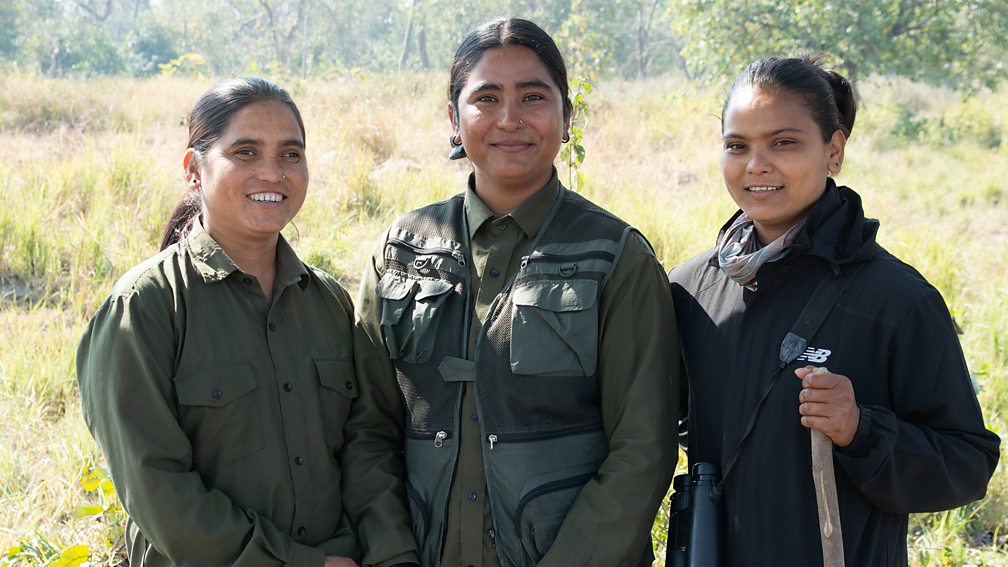
Mahatara sisters Sushila (left), Manju and Ranju played a crucial role in shooting the film. Photo: Courtesy of BBC One
That episode contains some of the most dramatic footage ever recorded in Nepal’s forests. It shows a visiting male tiger killing and eating Mala’s cubs, providing rare visual evidence of infanticide in the wild.
“Mala’s cubs were around three months old,” said Sushila. “The footage is difficult to watch, but it helps explain the realities of tiger survival.”
The second episode also focuses heavily on nocturnal behaviour. According to the guides, much less scientific research has been conducted on tiger activity after dark, prompting the BBC team to devote considerable attention to night-time filming.
In 2021, BBC One aired ‘Return of the Tiger’, highlighting Bardiya’s conservation success. Another tiger documentary followed in late 2023. The latest series involved two filming expeditions in 2025, with crews spending nearly two months in Bardiya.
A team of 16 people, including several Nepali experts, worked across buffer-zone forests in Shivapur, Banarawa, Banugaun, Bahadurpur, Kailasi and Asare Gairi. Using drones, remote cameras and advanced filming technology, they recorded footage over many months before spending nearly a year editing the material.
Conservationists say the documentary arrives at an important moment for Nepal.
Ajit Tumbahamphe, chief of the National Trust for Nature Conservation’s Bardiya programme, said the series demonstrates the success of long-term protection efforts.
“This will make Bardiya’s tiger a global brand,” he said. “The park will become an even stronger destination for tourists, researchers and wildlife enthusiasts from around the world.”
According to tiger expert Baburam Lamichhane, the documentary raises important scientific questions. “This is new information that requires further study,” he said. “We need to understand whether this behaviour reflects changes in tiger ecology, population growth, habitat pressures or other factors. What is clear is that Bardiya remains a unique place for tiger research.”
Ram Shahi, a local ornithologist, credited the achievement largely to the dedication of three local sisters—Sushila, Manju and Ranju Mahatara—whose patience and field knowledge helped capture the historic footage. “Their role demonstrates how local communities can lead conservation-based tourism,” he said.
For conservationists, the images of mothers and daughters collectively raising cubs are among the documentary’s most powerful moments.
“Seeing five cubs being raised together by related tigresses in a natural setting is extraordinary,” said Ghanashyam Gurung, WWF Nepal’s country representative. “This documentary will market Bardiya more effectively than any promotional campaign could.”
Nepal’s tiger recovery has become one of the world’s leading conservation success stories. The country’s tiger population increased from 121 in 2010 to 355 in the 2022 census, surpassing international targets to double tiger numbers.
The results of Nepal’s latest national tiger census, conducted in 2026, are expected to be released on International Tiger Day on July 29.
Experts say the presence of healthy tiger populations reflects healthy ecosystems. As apex predators, tigers regulate prey populations and help maintain ecological balance. Their survival is also closely linked to cultural traditions and religious beliefs across South Asia.
However, conservationists caution that growing tiger numbers also bring challenges, particularly in landscapes where people and wildlife live side by side. “The next step is demonstrating that humans and tigers can coexist safely,” said conservation expert Bhagwan Dahal, the country representative of the Zoological Society of London in Nepal. “If Nepal can achieve that, it will become an example for the entire world.”




 25.92°C Kathmandu